
Political ClimatePolitical Climate in Great Falls, VA
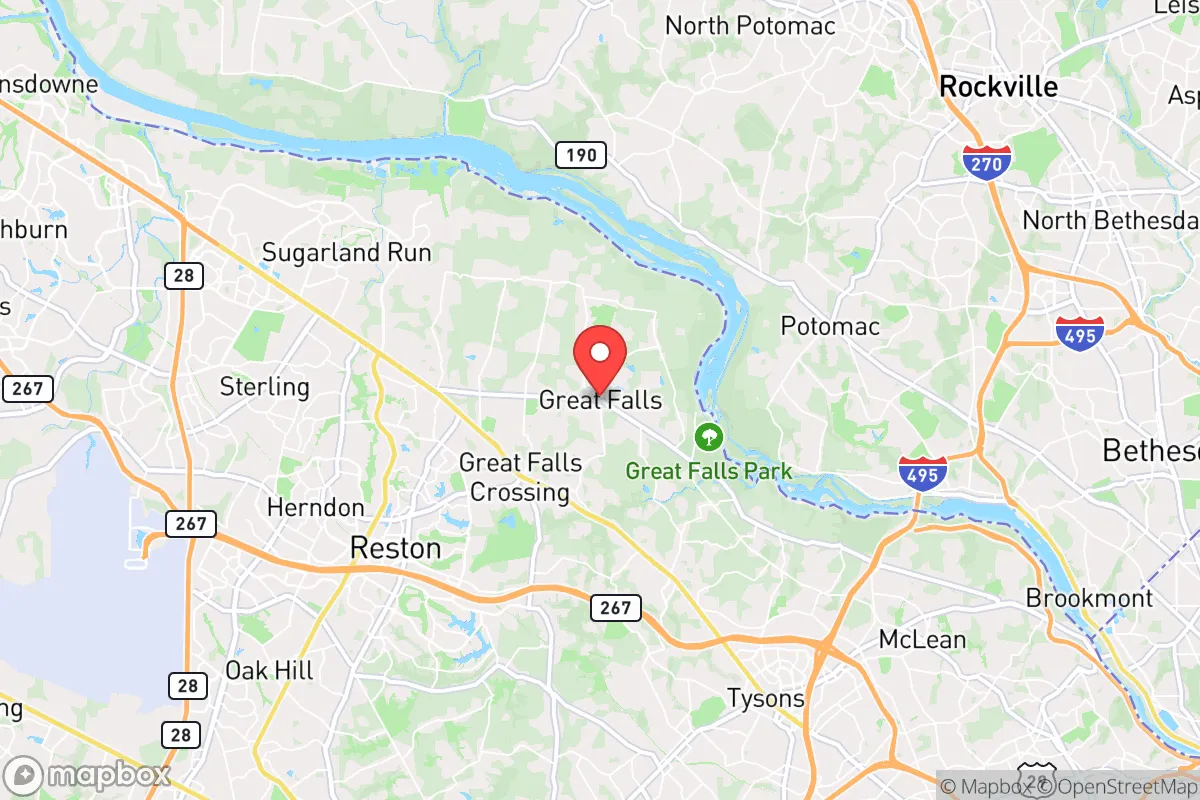
District shown is the primary district for this city’s centroid. Cities may span multiple districts.
Local Political AnalysisPolitical Analysis of Great Falls, VA
Great Falls, Virginia, leans heavily Democratic, with a Cook PVI of D+18, meaning the area votes about 18 points more Democratic than the national average. This wasn't always the case—twenty years ago, this was a reliably conservative pocket, a place where folks minded their own business and valued low taxes and personal liberty. Now, the political trajectory has shifted sharply left, driven by an influx of D.C. transplants who bring a more progressive, government-first mindset. If you're looking for a place where individual freedoms and limited government are still the norm, you might feel like a stranger in your own hometown here.
How it compares
To understand Great Falls' politics, you have to look at the neighbors. Drive ten miles west to Leesburg or Purcellville in Loudoun County, and you'll find a more balanced mix—still trending blue, but with a stronger conservative undercurrent, especially in the rural western parts. Head south to Fairfax City or Vienna, and you're in similar D+ territory, though those areas have a more suburban, establishment-Republican feel compared to Great Falls' increasingly progressive tilt. The real contrast is with Clifton, a tiny, unincorporated town just southeast, which retains a more traditional, small-government character. Great Falls, by contrast, has become a bellwether for the region's shift: where once you'd see "Don't Tread on Me" flags, now you see yard signs for candidates who champion expanded government programs and stricter regulations on everything from property use to school curriculum.
What this means for residents
For a long-time resident, the biggest concern is how this political climate affects daily life. Property taxes have crept up as the county prioritizes new social programs and infrastructure projects that feel more about control than necessity. School board meetings, once quiet affairs, are now battlegrounds over curriculum and parental rights—a clear sign of government overreach into how you raise your kids. The local zoning board has become more aggressive, pushing density and transit-oriented development that erodes the rural character that made Great Falls special. If you value personal freedoms—like the right to choose your child's education, keep your property unencumbered by new regulations, or simply live without a growing list of mandates—you'll find yourself increasingly at odds with the local political machine. The trajectory suggests more of the same: tighter controls, higher costs, and a culture that prizes collective conformity over individual liberty.
Culturally, Great Falls has lost some of its independent spirit. The annual Fourth of July parade used to be a celebration of community and freedom; now it feels more like a political rally for the progressive agenda. The local farmers' market, once a gathering spot for everyone, has become a place where political canvassers outnumber the vendors. The policy distinctions are subtle but real: the county has adopted stricter environmental regulations that limit what you can do on your own land, and there's a growing push for "equity" initiatives that prioritize group outcomes over individual merit. If you're a conservative looking for a place where your values are respected, Great Falls is no longer that haven. The long-term outlook is clear: the political tide here is only going to get bluer, and the government's hand in your life will only get heavier. It's a beautiful area, but the price of admission—in taxes, regulations, and cultural friction—keeps going up.

State Political ClimatePolitical Climate in Virginia
State Political AnalysisPolitical Environment in the State
Virginia has shifted from a reliably conservative-leaning state to a solidly blue one over the past two decades, driven by explosive growth in the Washington, D.C. suburbs and a steady erosion of rural influence. The state’s overall partisan lean is now Democratic, with the party controlling the governorship, both chambers of the General Assembly, and both U.S. Senate seats. However, this is a tale of two Virginias: the urban crescent from Northern Virginia down to Richmond and Hampton Roads votes overwhelmingly blue, while the rest of the state—from the Shenandoah Valley to Southside and Southwest Virginia—remains deeply red. The trajectory has been a steady leftward march since the early 2000s, with the 2021 gubernatorial election being a rare exception where Glenn Youngkin won by threading a needle on education and parental rights, but the underlying demographic trends remain firmly Democratic.
Urban vs. rural divide
The political map of Virginia is a textbook case of the urban-rural split. The entire political gravity of the state is pulled by Northern Virginia—specifically the counties of Fairfax, Loudoun, Prince William, and Arlington—which now account for over a third of the state’s population and vote Democratic by margins of 20 to 40 points. These suburbs are filled with federal employees, defense contractors, and tech workers who lean heavily progressive. Richmond and Hampton Roads (Norfolk, Virginia Beach) are also reliably blue, though Virginia Beach has a more mixed character. Meanwhile, the rural and exurban counties—like Augusta, Rockingham, Bedford, and Montgomery—vote Republican by similar margins. The Shenandoah Valley and Southside (counties like Pittsylvania, Halifax, and Mecklenburg) are deeply conservative, but their populations are shrinking or stagnant. The 2021 gubernatorial race saw Youngkin flip Loudoun County—the epicenter of the parental rights movement—by focusing on school transparency, but that was a one-off; in 2024, Loudoun went back to voting Democratic by double digits. The divide is so stark that a resident of Abingdon in Southwest Virginia might feel they live in a different country from someone in Arlington.
Policy environment
Virginia’s policy environment has become increasingly progressive under Democratic control. The state income tax is a flat 5.75%, but there’s a constant push to raise it for higher earners. Property taxes are set locally and vary wildly—Loudoun County has some of the highest in the state, while rural counties are much lower. The regulatory posture is business-friendly in some respects (Virginia is a right-to-work state), but the General Assembly has passed a slew of new mandates: a minimum wage hike to $12 an hour (with a path to $15), expanded collective bargaining for public employees, and strict renewable energy mandates. Education policy has been a flashpoint: the state eliminated its charter school cap in 2021, but the Virginia Department of Education under Youngkin has been fighting to restore parental rights after the previous administration pushed critical race theory and LGBTQ+ curriculum mandates. Healthcare is dominated by the expansion of Medicaid under the Affordable Care Act, which the state accepted in 2018. Election laws have been tightened in some ways (voter ID is required) but loosened in others (no-excuse absentee voting and same-day registration are now law). The state also passed the Virginia Clean Economy Act, which effectively bans new fossil fuel power plants by 2050.
Trajectory & freedom
Virginia is becoming less free by any measure of personal liberty, especially for conservatives. The most glaring example is gun rights: in 2020, the Democratic legislature passed a package of gun control bills including universal background checks, a red flag law (allowing temporary seizure of firearms without due process), a one-handgun-per-month limit, and a ban on assault weapons for those under 21. These were signed by Governor Ralph Northam. On parental rights, the 2020-era Department of Education under Northam pushed policies that allowed students to change their gender identity in school records without parental consent, and schools were encouraged to hide such information from parents. Youngkin’s 2022 executive order restoring parental notification was a step back, but the underlying laws remain. On medical autonomy, Virginia has some of the loosest COVID-19 vaccine mandates in the region now, but the state still has a strict certificate-of-need law that limits healthcare competition. Property rights are under threat from the aforementioned renewable energy mandates, which have led to massive solar farm projects being forced onto rural counties via state-level preemption. The state also passed the Virginia Values Act, which added sexual orientation and gender identity to the state’s nondiscrimination laws, and the Reproductive Health Protection Act, which expanded abortion access. For a conservative, the trajectory is clear: more regulation, less local control, and a shrinking sphere of personal freedom.
Civil unrest & political movements
Virginia has been a battleground for political movements on both sides. The 2017 Unite the Right rally in Charlottesville was a national flashpoint, leading to a state of emergency and a subsequent crackdown on public assembly. The 2020 racial justice protests in Richmond saw the toppling of Confederate statues and a prolonged occupation of the Capitol grounds. On the right, the parental rights movement exploded in Loudoun County in 2021 after a series of sexual assault cases in schools and the district’s refusal to inform parents. This led to massive school board protests and the election of Youngkin. Immigration politics are less visible than in border states, but Northern Virginia has several sanctuary jurisdictions that limit cooperation with ICE, and the state has a law prohibiting local police from asking about immigration status. Election integrity has been a hot topic: the 2020 election saw no major irregularities in Virginia, but the state’s move to no-excuse absentee voting and ballot drop boxes has raised concerns among conservatives. The most visible flashpoint for a new resident would be the constant culture war in public schools—especially in the suburbs—over curriculum, library books, and transgender policies.
Projection
Over the next 5-10 years, Virginia will likely continue its leftward drift, but with a ceiling. The demographic engine of Northern Virginia shows no signs of slowing—it’s adding hundreds of thousands of new residents, mostly from out of state, who are younger, more diverse, and more liberal. The rural areas will continue to lose population and political clout. However, the 2021 election showed that a Republican can win statewide by focusing on kitchen-table issues like education and taxes, especially if the Democratic nominee is seen as too extreme. The state’s gerrymandered legislative districts (now drawn by a bipartisan commission) mean that the General Assembly will remain competitive, but the governorship is up for grabs every four years. The biggest wildcard is the federal workforce: if the next president slashes federal jobs, Northern Virginia could take a hit, but that’s unlikely to flip the region red. For a conservative moving in now, expect to live in a state where your vote for president or Senate is essentially meaningless, but your vote for governor and local offices can still matter. The culture war in schools will intensify, and property taxes in blue counties will keep rising.
Bottom line for a new resident: If you’re a conservative looking to move to Virginia, pick your county carefully. The rural areas and exurbs (like Spotsylvania, Stafford, or Frederick County) still offer a conservative lifestyle and lower taxes, but you’ll be fighting an uphill battle at the state level. The state government will continue to encroach on local control, gun rights, and parental authority. If you value personal freedom and limited government, Virginia is not the safe bet it was 20 years ago. You’ll need to be politically engaged just to hold the line.
* Values derived from national, state, county, city and local statistics and may differ in a specific area. Last updated: 2026-04-16T00:22:01.000Z
Narrative content on this page is AI-generated and may contain mistakes. Verify any details that matter before acting on them.
ReloMaps may earn a commission from affiliate links at no extra cost to you.

