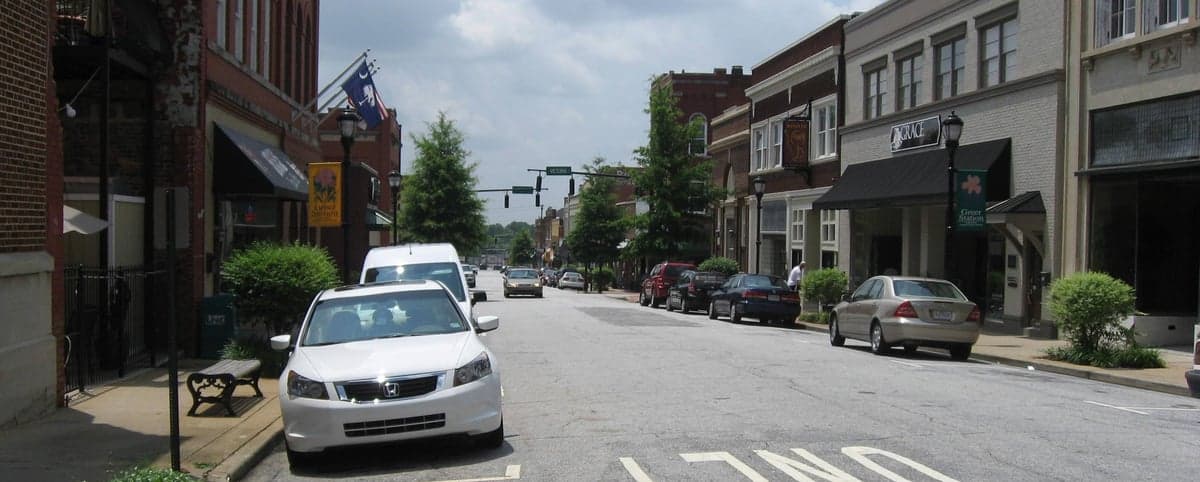
Photo: Wikipedia
Personal Sovereignty in Greer, SC
Viable for self-reliance. Generally workable, though some barriers may limit total independence.
What does Personal Sovereignty tell us?
Personal Sovereignty measures your capacity for self-reliance and independence with minimal government friction. Higher scores mean fewer barriers between you and the way you want to live... but it assumes you have the space you need and good neighbors.
What does this tell us?
Personal Sovereignty measures your capacity for self-reliance and independence with minimal government friction. Higher scores mean fewer barriers between you and the way you want to live... but it assumes you have the space you need and good neighbors.
State Policy
Energy independence: Importer (25% of energy produced in-state)
Personal Liberty
Homesteading

Personal Liberty Analysis
Greer, South Carolina, offers a notably high degree of personal sovereignty compared to much of the United States, particularly for those who prioritize minimal government interference in daily life, self-defense, and family autonomy. Nestled in the Upstate region, Greer benefits from South Carolina’s consistently low-tax, limited-government posture, which creates a legal environment where individuals can largely live as they see fit without excessive bureaucratic oversight. For a single person or parent operating from a survivalist or prepper mindset, the area presents a strategic balance of rural accessibility and small-city infrastructure, with state-level protections that shield residents from many of the overreaches seen in more heavily regulated states. This analysis examines the concrete factors that define personal sovereignty in Greer, from tax burden and gun laws to homesteading feasibility and parental rights, providing a data-grounded assessment for those considering relocation.
Tax burden and regulatory posture: how South Carolina’s low-tax environment protects autonomy
South Carolina’s tax structure is a cornerstone of personal sovereignty in Greer, directly reducing the financial leverage the state has over residents. The state levies a flat income tax rate of 6.2% (as of 2025, with scheduled reductions to 6.0% by 2026), which applies to all income brackets, meaning no progressive tax creep that penalizes self-reliance or increased earnings. Property taxes in Greer are among the lowest in the nation, with an effective rate around 0.55% of assessed value for owner-occupied homes, and the state offers a generous homestead exemption for those over 65 or disabled. Sales tax in Greer is 6% (state plus local), with no tax on groceries or prescription medications, which keeps the cost of daily provisioning low. From a regulatory standpoint, South Carolina operates under a “right-to-work” framework and has no state-level occupational licensing for many trades, allowing individuals to pursue side businesses or self-employment without excessive red tape. The state also has a constitutional carry law (permitless carry for adults 18+), which we’ll cover in detail below, but it’s worth noting here that the regulatory environment is designed to minimize friction for law-abiding citizens. For a prepper, this means fewer layers of government intrusion into how you earn, spend, and store resources.
Self-defense and gun law specifics: constitutional carry, castle doctrine, and stand your ground
Greer sits in a state with some of the strongest self-defense laws in the country, which is critical for anyone prioritizing personal security in an uncertain world. South Carolina is a constitutional carry state as of 2021, meaning any law-abiding adult 18 or older can carry a concealed or open firearm without a permit. This eliminates the need for government permission to exercise a fundamental right, a key distinction from states that require training courses, background checks, or waiting periods for carry. The state also has a robust castle doctrine (codified in S.C. Code § 16-11-440), which establishes a legal presumption that a homeowner who uses deadly force against an intruder acted in reasonable fear of death or great bodily injury, with no duty to retreat. Additionally, South Carolina’s stand your ground law (S.C. Code § 16-11-450) extends this protection to any place where a person has a legal right to be, removing the obligation to retreat before using force in self-defense. Magazine capacity is not restricted, and there are no state-level bans on specific firearm types (e.g., AR-15s or standard-capacity magazines). For a parent, this means the legal framework supports the ability to defend your home and family without fear of prosecution, a stark contrast to states like New York or California where self-defense laws are far more restrictive. The local sheriff’s office in Greenville County (which covers most of Greer) is known for a pro-Second Amendment stance, and permitless carry means no government database of gun owners is maintained.
Self-reliance and homesteading viability: lot sizes, zoning, and off-grid feasibility
For those seeking to reduce dependence on fragile supply chains and government services, Greer offers viable options for self-reliance, though the specifics depend heavily on which part of the city you choose. Within Greer’s city limits, zoning is relatively permissive for suburban homesteading: standard residential lots range from 0.25 to 1 acre, and backyard chickens are allowed with a permit (no roosters in most neighborhoods). However, if you’re looking for true off-grid capability—think solar panels, rainwater collection, or a large garden—the unincorporated areas of Greenville and Spartanburg counties surrounding Greer are far more accommodating. In these rural zones, lot sizes commonly start at 2 to 5 acres, with some parcels up to 20 acres available within a 15-minute drive of downtown Greer. Zoning in these areas typically allows for livestock (goats, sheep, up to a few head of cattle), and there are no county-level bans on rainwater harvesting or solar panel installation. The state of South Carolina has a net metering law that requires utilities to credit homeowners for excess solar power, though the rates have become less favorable in recent years. For a prepper, the key is to look at properties outside city limits—specifically in the Blue Ridge or Highway 14 corridors—where you can legally drill a well, install a septic system, and build a workshop or root cellar without a mountain of permits. The local climate (USDA zone 7b/8a) supports a long growing season of about 200 days, making serious food production feasible. The main regulatory hurdle is the SC Department of Health and Environmental Control (DHEC) for well and septic permits, but these are straightforward and not overly burdensome compared to states like Oregon or Washington.
Personal liberties: parental rights, medical autonomy, speech, and property
South Carolina has taken a strong stance on several key personal liberties that matter to conservative-leaning individuals and parents. Parental rights are explicitly protected under state law (S.C. Code § 63-5-350), which affirms that parents have the fundamental right to direct the upbringing, education, and healthcare of their children. This includes the ability to opt out of school curricula or medical treatments without government override, and the state has passed laws requiring parental consent for minors’ medical procedures (including vaccinations in some contexts). Medical autonomy is generally respected, with no state-level vaccine mandates for adults and a legal framework that allows for conscientious objection to medical treatments. The state does not have a “red flag” law, meaning your firearms cannot be seized without due process based on a complaint. Free speech is robustly protected, with no state-level hate speech laws that could be used to chill political or religious expression. Property rights are strong under South Carolina’s “right to farm” law, which protects agricultural activities from nuisance lawsuits if a farm was established before nearby residential development. Additionally, the state has no statewide rent control or rent stabilization, preserving the freedom of property owners to set their own terms. For a parent, this means you can homeschool without excessive state oversight (just a simple notification to the school district), and you can choose alternative medical care for your family without fear of state intervention. The one area where the state does assert authority is in building codes—new construction must meet the International Residential Code (IRC)—but existing structures are generally grandfathered in, and there is no state-level energy code enforcement for owner-occupied homes.
Overall, Greer offers a level of personal sovereignty that is rare in the modern United States, particularly for those who value self-defense, low taxes, and minimal government overreach. Compared to the Pacific Northwest, the Northeast, or even parts of the Midwest, South Carolina’s legal framework is deliberately designed to leave individuals alone unless they harm others. The combination of constitutional carry, castle doctrine, low property taxes, permissive homesteading zoning, and strong parental rights creates an environment where a survivalist or prepper can build a resilient, self-reliant life without constantly fighting the state. The main trade-off is that Greer is not a remote wilderness—it’s a growing suburb with access to hospitals, schools, and infrastructure—but for those who want to be prepared while still having a job and community, it’s one of the strongest options in the Southeast. If you’re looking for a place where the government stays out of your way and you can raise a family on your own terms, Greer deserves serious consideration.

* Values derived from national, state, county, city and local statistics and may differ in a specific area. Last updated: 2026-04-29T19:26:42.000Z
Narrative content on this page is AI-generated and may contain mistakes. Verify any details that matter before acting on them.
ReloMaps may earn a commission from affiliate links at no extra cost to you.

