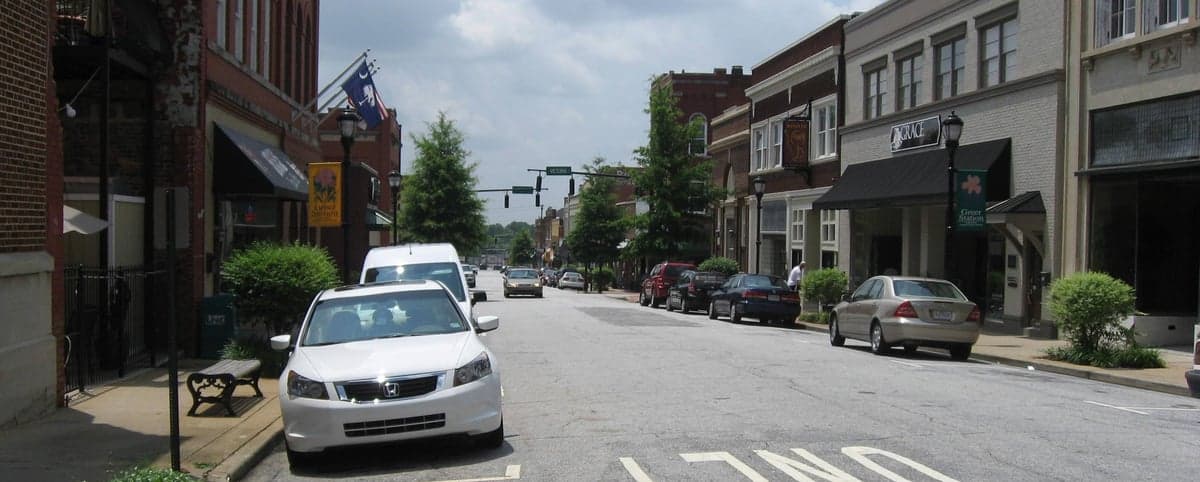
Photo: Wikipedia
Political ClimatePolitical Climate in Greer, SC
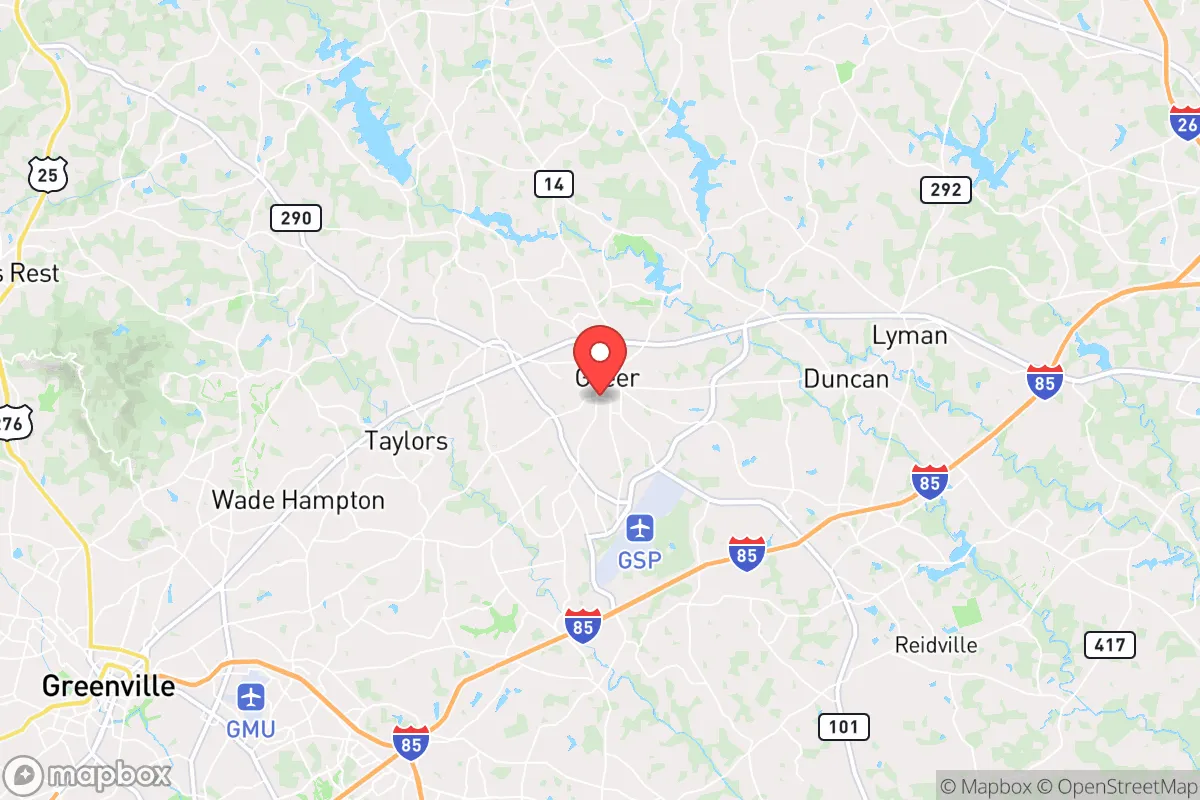
District shown is the primary district for this city’s centroid. Cities may span multiple districts.
Local Political AnalysisPolitical Analysis of Greer, SC
Greer, South Carolina, sits in a solidly conservative pocket of the Upstate, and that’s been the case for as long as most folks around here can remember. With a Cook Partisan Voting Index (PVI) of R+11, the area leans heavily Republican, and that’s not just a number on a map—it’s reflected in how people live, vote, and expect their government to stay out of their business. The political trajectory here has been steady, though you can feel a subtle tension as Greenville and Spartanburg grow and bring in new folks from more progressive parts of the country. For now, though, Greer remains a place where conservative values aren’t just tolerated—they’re the baseline.
How it compares
If you drive ten miles west into Greenville proper, you’ll start to see a different political flavor—more purple, with a younger, transplant-heavy population that’s nudged the city council left on zoning and social issues. Head east toward Spartanburg, and it’s still conservative, but not as reliably red as Greer. The real contrast is with places like Travelers Rest or Simpsonville, which lean conservative but have seen more progressive influence in local school board races and development debates. Greer, by contrast, has held the line. Surrounding Greenville County as a whole voted about 58% Republican in the 2024 presidential race, but Greer’s precincts routinely hit 65% or higher. That’s not an accident—it’s a community that’s been deliberate about keeping government small and local control strong.
What this means for residents
For someone living here, the political climate translates into a few concrete realities. First, taxes stay low—property tax rates in Greer are among the most favorable in the state, and there’s no appetite for the kind of bond referendums you see in more progressive suburbs. Second, school policy remains parent-driven; the local school board has resisted curriculum changes that push ideological agendas, and mask or vaccine mandates were non-starters during the pandemic. Third, gun rights are respected without fuss—concealed carry permits are straightforward, and you won’t find the kind of local ordinances that chip away at the Second Amendment in places like Charleston or Columbia. The downside? If you’re hoping for a bustling downtown with bike lanes and public art funded by new taxes, you’ll be disappointed. Greer’s growth is happening on its own terms, mostly through private development and family-owned businesses.
One cultural distinction worth noting: Greer has a strong sense of local identity that resists being swallowed up by either Greenville or Spartanburg. You see it in the annual Greer Family Fest, the support for the local police and fire departments, and the way people show up for school board meetings when they feel the state or federal government is overstepping. There’s a quiet but firm resistance to government overreach here, whether it’s zoning rules that would tell a homeowner what color they can paint their shutters or state-level mandates that override local decisions. Looking ahead, the biggest concern among long-time residents is the influx of out-of-state buyers and remote workers who might not share that ethos. If enough of them move in and start voting for the kind of progressive policies they left behind, Greer could shift. But for now, it’s still a place where the prevailing attitude is: leave us alone, and we’ll do just fine.

State Political ClimatePolitical Climate in South Carolina
State Political AnalysisPolitical Environment in the State
South Carolina has long been a reliably red state, but the flavor of that conservatism has shifted noticeably over the past 15-20 years. The old-school, establishment-friendly GOP that ran things in Columbia has given way to a more populist, culturally conservative coalition, driven by explosive growth in the coastal Lowcountry and the Upstate. While the state still votes +18 to +20 points Republican in presidential races, the real story is the internal tension between the fast-growing, transplant-heavy suburbs and the deeply traditional rural counties that form the party’s base. If you’re moving here expecting a uniform political landscape, you’ll find the reality is more layered than the electoral map suggests.
Urban vs. rural divide
The political map of South Carolina is a tale of three regions. The Upstate—anchored by Greenville, Spartanburg, and Anderson—is the state’s conservative engine room. Greenville County alone cast over 200,000 votes in 2024, with Trump winning it by 18 points. This area is booming with transplants from the Northeast and Midwest, many of whom are drawn by lower taxes and a family-friendly culture, and they tend to reinforce the red lean. The Lowcountry, centered on Charleston and Mount Pleasant, is the most politically interesting battleground. Charleston County itself is a blue island—Biden won it by 12 points in 2020—driven by the city’s historic district, the college vote, and a growing tech and tourism workforce. But the surrounding suburbs like Summerville and Goose Creek are ruby red, and the rural counties south of Charleston (Colleton, Beaufort) are deeply conservative. The Midlands, anchored by Columbia, are more purple, with Richland County (Columbia proper) voting reliably Democratic while Lexington County across the river is one of the most Republican counties in the state. The rural black belt counties along the I-95 corridor—Allendale, Bamberg, Orangeburg—vote overwhelmingly Democratic but have shrinking populations, which dilutes their electoral impact. The net effect is a state that’s red but with growing pockets of blue in the urban cores, while the exurbs and rural areas are getting redder.
Policy environment
South Carolina’s policy posture is broadly conservative, but with some notable wrinkles. The state has a flat income tax that was cut from 7% to 6.2% in 2023, with a scheduled phase-down to 6% by 2025. Property taxes are low, especially for owner-occupied homes, thanks to a 6% assessment cap. There’s no state estate tax. On education, the state passed a universal school choice law in 2023 (the Education Scholarship Trust Fund), which allows any family to use state funds for private school tuition, homeschooling expenses, or tutoring—a major win for parental rights. Healthcare is a mixed bag: South Carolina did not expand Medicaid under Obamacare, and the state has some of the most restrictive abortion laws in the country (a fetal heartbeat ban with no exceptions for rape or incest, only for the life of the mother). Election laws have tightened: the 2021 Voter ID law requires photo identification, limits drop boxes, and shortens the absentee ballot window. The state also passed a constitutional carry law in 2024, allowing permitless carry of handguns. On the regulatory side, the state is generally business-friendly, with a right-to-work law and no state-level OSHA plan, meaning workplace safety is enforced by the feds only. The biggest policy concern for conservatives is the growing influence of the Charleston and Columbia city councils, which have pushed local ordinances on paid leave, non-discrimination, and environmental regulations that sometimes conflict with state preemption laws.
Trajectory & freedom
Over the past five years, South Carolina has moved decisively in the direction of personal liberty on several fronts. The constitutional carry law (2024) was a major expansion of Second Amendment rights, eliminating the need for a permit to carry a concealed weapon. The Education Scholarship Trust Fund (2023) gave parents real control over their children’s education, breaking the public school monopoly. The state also passed a parental rights in education bill (2023) that requires schools to notify parents of any changes to a student’s health or well-being and prohibits instruction on sexual orientation or gender identity in K-5 classrooms. On the other hand, there are areas where freedom has contracted. The state’s abortion ban is among the strictest in the nation, which some residents see as a protection of life and others as government overreach. The Voter ID law has been criticized by progressives but upheld by courts. The biggest looming threat to freedom is the growth machine in the state legislature: as more people move in, there’s increasing pressure for more roads, more schools, and more regulations to manage the sprawl. The Greenville and Charleston metro areas are seeing local governments impose impact fees and zoning restrictions that raise housing costs. The state’s tax burden is still relatively low, but the flat income tax phase-down is scheduled to stop at 6%, not zero, and there’s no serious talk of eliminating it entirely. Property taxes are creeping up in high-growth counties as assessments rise with home values.
Civil unrest & political movements
South Carolina has not seen the kind of large-scale civil unrest seen in Portland or Seattle, but there have been flashpoints. The Confederate flag removal from the Statehouse grounds in 2015, after the Charleston church shooting, was a watershed moment that split the conservative coalition—some saw it as a necessary step for economic development, others as a surrender to political correctness. The Black Lives Matter protests in 2020 were relatively small and peaceful in Columbia and Charleston, but they did lead to calls for police reform that were largely ignored by the legislature. The Moms for Liberty movement has been very active in Lexington and Greenville counties, pushing for school board transparency and opposing critical race theory and LGBTQ curriculum. Immigration politics are less heated than in border states, but there’s a growing concern about the influx of migrants into the Lowcountry construction and hospitality industries. The state has a sanctuary city ban (2019) that prohibits local governments from adopting policies that limit cooperation with federal immigration enforcement. There’s also a small but vocal nullification movement among libertarian-leaning conservatives, particularly in the Upstate, who argue that the state should ignore federal gun laws and marijuana prohibition. The election integrity debate has been relatively quiet compared to Georgia or Arizona, but the 2020 audit of the state’s election found no widespread fraud, which satisfied most conservatives. The biggest visible political movement is the growth of Christian homeschooling and private school co-ops, especially in the Greenville and Spartanburg areas, which is reshaping the culture of the Upstate.
Projection
Over the next 5-10 years, South Carolina will likely become more Republican at the state level but more culturally divided locally. The in-migration from blue states—roughly 100,000 new residents per year—is overwhelmingly conservative-leaning, as people move for lower taxes, gun rights, and school choice. This will reinforce the red majority in the legislature and keep the governor’s mansion in GOP hands. However, the Charleston and Columbia city cores will continue to trend blue, and the Mount Pleasant and Summerville suburbs may shift purple as they densify. The biggest wildcard is the Greenville metro: if it continues to attract tech workers and corporate transplants, it could moderate over time, but for now it’s solidly red. The state’s school choice law will likely expand, possibly to include education savings accounts for all students. The constitutional carry law is here to stay. The biggest threat to the conservative project is housing affordability: as home prices rise in the coastal and Upstate metros, the state’s low-tax advantage is being eroded by higher property taxes and insurance costs. If the legislature doesn’t address this, it could create a backlash among working-class voters. The abortion ban will remain in place, but there may be pressure to add exceptions for rape and incest as public opinion shifts. The election laws will likely stay the same, with no move toward mail-in voting expansion or automatic registration. The state will probably not legalize marijuana, but medical cannabis may eventually pass in a limited form.
Bottom line for a new resident: South Carolina is a good bet if you want a state that respects gun rights, parental control over education, and low taxes, and where the political trajectory is still moving in a conservative direction. But don’t expect a libertarian paradise—the state has a strong tradition of local government control, and the fast-growing suburbs are starting to see the same zoning and tax pressures that plague other booming states. If you’re moving to Greenville or Lexington, you’ll find a deeply conservative community that’s welcoming to families. If you’re moving to Charleston or Columbia, you’ll need to navigate a more mixed political environment, especially at the city level. The key is to pick your county carefully—the political culture varies more by county than by state. And keep an eye on the legislature: the next big fights will be over property tax reform, school choice expansion, and whether to preempt local ordinances that try to regulate guns or housing. If those go the right way, South Carolina will remain one of the freest states in the Southeast. If not, the freedom gap between the Upstate and the Lowcountry will only widen.
* Values derived from national, state, county, city and local statistics and may differ in a specific area. Last updated: 2026-04-29T19:26:42.000Z
Narrative content on this page is AI-generated and may contain mistakes. Verify any details that matter before acting on them.
ReloMaps may earn a commission from affiliate links at no extra cost to you.

