Photo: Wikipedia
Demographics of Grimes, IA
Affluence Level in Grimes, IA
A middle-class area roughly in line with national averages across income, home values, education, and employment.
People of Grimes, IA
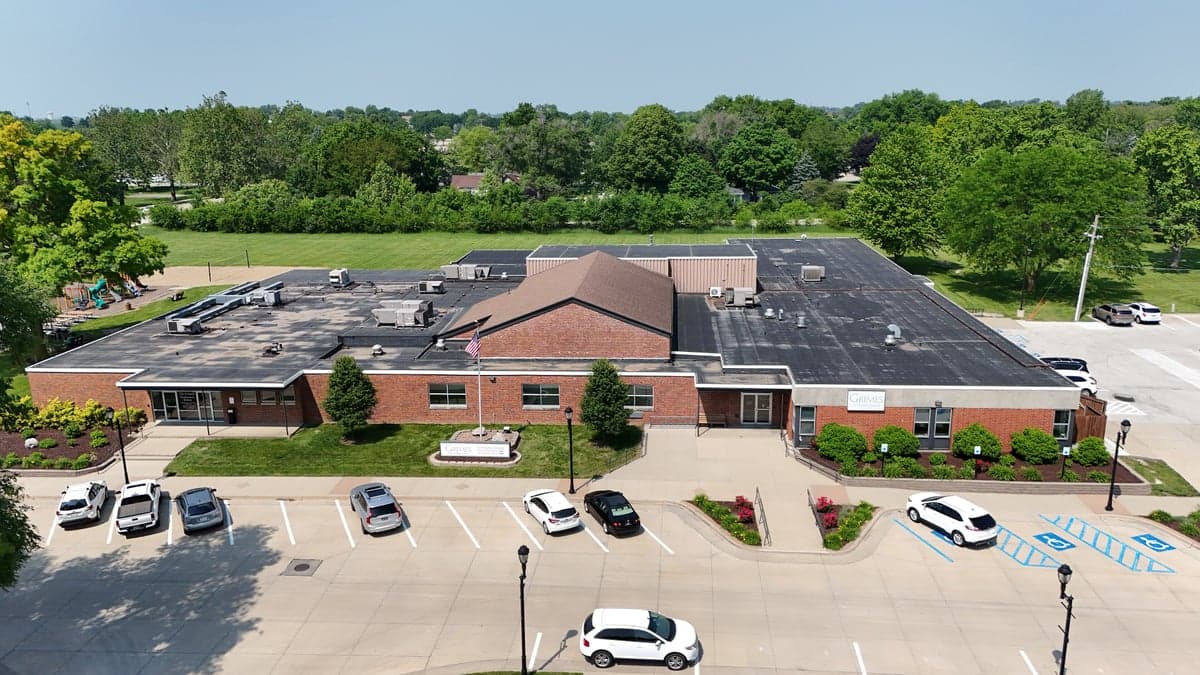
The people of Grimes, Iowa, today number 15,810 and form a rapidly growing, predominantly white, family-oriented suburb of Des Moines. With a population that is 85.0% white, 6.5% Hispanic, 2.7% Indian (subcontinent), and 2.3% Black, the city is notably more diverse than its rural Dallas County surroundings, yet remains less diverse than the Des Moines metro core. Nearly half of residents (47.6%) hold a college degree, reflecting a professional-class character that distinguishes Grimes from older, more agricultural towns in the region.
How the city was settled and grew
Grimes began as a railroad town, platted in 1882 along the Chicago, Rock Island and Pacific line. The original settlers were predominantly Midwestern farmers of German and Scandinavian descent, drawn by cheap land and rail access to the Des Moines market. The town was named for a local railroad official, and its early economy revolved around grain elevators and a small downtown commercial district. The historic Downtown Grimes neighborhood, centered on Main Street and First Street, still contains the original commercial blocks and modest frame houses built by these first families. A second wave arrived during the 1920s and 1930s, when the construction of the nearby Saylorville Dam and the expansion of the Des Moines waterworks brought Irish and Czech laborers. These workers settled in what is now the Old Town area, south of the railroad tracks, where smaller bungalows and worker cottages remain common. Grimes remained a sleepy agricultural village of fewer than 500 people through the 1950s, with little in-migration beyond the children of existing families.
Modern era (post-1965)
The modern transformation of Grimes began in the 1990s, when the completion of the Highway 141 bypass and the expansion of the Des Moines western suburbs pushed development westward. The city's population exploded from 1,200 in 1990 to over 15,000 by 2025, driven almost entirely by domestic in-migration of white, college-educated families seeking newer, larger homes at lower prices than West Des Moines or Waukee. The Beaver Creek neighborhood, platted in the early 2000s along the creek of the same name, became the primary landing zone for these families, featuring large single-family homes on cul-de-sacs and a highly rated elementary school. A second major development, Waterford Crossing, built from 2010 onward, attracted a slightly more diverse mix, including a small but visible Indian-subcontinent professional population employed in Des Moines's insurance and technology sectors. The Indian community, now 2.7% of the city, is concentrated in Waterford Crossing and the newer Prairie Trail subdivision, where many families bought homes between 2015 and 2023. The Hispanic population (6.5%) is more dispersed, with a notable cluster in the South Grimes area near the railroad tracks, where older, more affordable housing stock and rental properties are located. The East/Southeast Asian community (0.9%) and Black community (2.3%) are small and scattered, without a single dominant neighborhood. The foreign-born share of 3.0% is low by national standards but represents a significant increase from near-zero in 1990, driven almost entirely by the Indian and Hispanic arrivals.
The future
Grimes is likely to continue its trajectory as a predominantly white, upper-middle-class suburb, but with increasing internal diversity. The Indian-subcontinent community, while small, is growing steadily through professional migration and chain migration from existing families; it is expected to reach 4-5% of the population by 2035. The Hispanic share is also rising, driven by service-sector employment in the broader Des Moines metro, but at a slower pace than in neighboring Perry or Adel. The city is not tribalizing into distinct ethnic enclaves — the newer subdivisions are largely integrated by income rather than ethnicity — but the older South Grimes area may become more Hispanic as white families move to newer developments. The white share, while still dominant, will likely decline to around 80% by 2040 as the city absorbs more diverse in-migrants. The biggest demographic wildcard is whether Grimes can maintain its current rate of new housing construction; if development slows, the population will age in place and become less diverse, as younger families are priced out.
For a conservative-leaning family or individual moving to Grimes today, the city offers a stable, safe, and increasingly diverse community where the dominant culture remains Midwestern, family-focused, and politically moderate-to-conservative. The population is growing, educated, and economically secure, with the Indian and Hispanic communities adding cultural texture without fundamentally altering the city's character. The bottom line: Grimes is becoming a more varied version of what it already was — a prosperous, family-oriented suburb where newcomers are welcomed but expected to assimilate into the existing social fabric.

* Values derived from national, state, county, city and local statistics and may differ in a specific area. Last updated: 2026-10-10T16:27:33.000Z
Narrative content on this page is AI-generated and may contain mistakes. Verify any details that matter before acting on them.
ReloMaps may earn a commission from affiliate links at no extra cost to you.

