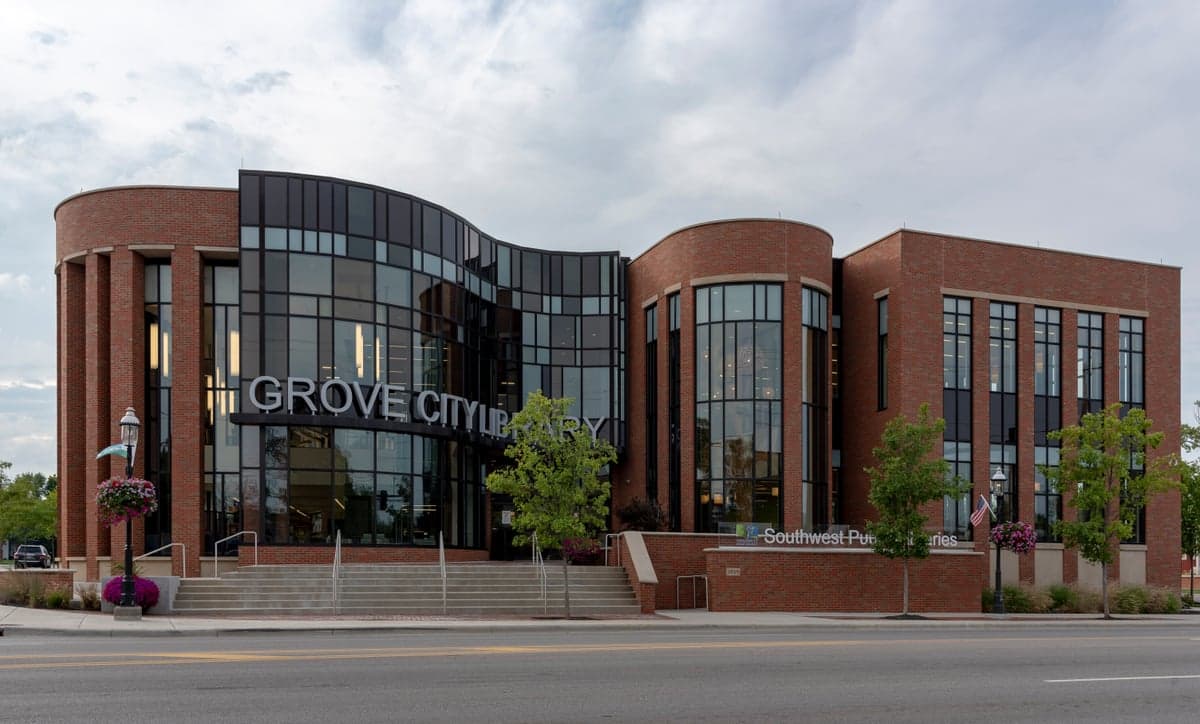
Photo: Wikipedia
Demographics of Grove City, OH
Affluence Level in Grove City, OH
An upper-middle-class area. Household wealth, education levels, and homeownership run ahead of national benchmarks.
People of Grove City, OH
Grove City, Ohio, is a predominantly white, middle-class suburb of Columbus with a population of 41,831 that retains a distinctly Midwestern, family-oriented character. The city is notably more homogeneous than Franklin County as a whole, with 86.0% of residents identifying as white, a foreign-born population of just 1.8%, and a college-educated rate of 35.3% that sits below the national suburban average. Its people are largely rooted in multi-generational Ohio families, with a growing but still small Hispanic (3.8%) and Black (3.7%) presence, and a nearly even split between East/Southeast Asian (1.1%) and Indian-subcontinent (1.0%) communities. The city feels like a stable, slow-changing place where newcomers are often drawn by affordable housing, good schools, and proximity to Columbus jobs rather than by ethnic or cultural diversity.
How the city was settled and grew
Grove City was founded in 1852 as a farming village along the new Columbus and Xenia Railroad, drawing its earliest residents from German and Scotch-Irish families who had already settled central Ohio in the early 1800s. These original settlers were small-scale farmers and tradesmen who built the town around the railroad depot, with the historic Old Village District (centered on Park Street and Broadway) still containing many of their 19th-century homes and storefronts. A second wave arrived in the 1910s and 1920s as Columbus expanded outward, bringing working-class families—many of them second-generation German and Irish Americans from the city's near south side—who built modest bungalows in the Southwest Grove City area near the railroad tracks. The town remained a small agricultural hub of roughly 2,000 people through World War II, with virtually no non-white population; the 1940 census recorded fewer than 10 Black residents. The post-war boom of the 1950s and 1960s brought a third wave: returning veterans and young families from Appalachia and rural Ohio, drawn by manufacturing jobs at the new Columbus Westland Mall area and at nearby defense plants. These families filled the ranch-style homes of Parkview Estates and Grove City Estates, subdivisions that remain overwhelmingly white and owner-occupied today.
Modern era (post-1965)
The 1965 Hart-Cellar Act had minimal immediate effect on Grove City, as the city's housing stock, schools, and job base did not attract the immigrant streams that reshaped Columbus proper. Instead, the major demographic shift of the 1970s through 1990s was domestic: white flight from Columbus's near south and west sides, as Black and Appalachian families moved into those neighborhoods, pushed Grove City's population from 9,000 in 1970 to over 27,000 by 2000. These new residents—overwhelmingly white, often with some college education or skilled trades—settled in the sprawling Stringtown area along Hoover Road and in the Buckeye Park subdivision near the city's southern edge. The Hispanic population began a slow increase in the 2000s, reaching 3.8% by 2020, concentrated in rental apartments along Broadway near I-71, where Mexican and Central American families work in construction and warehousing. The Black population (3.7%) is more dispersed but slightly clustered in the Westpark neighborhood, a 1990s subdivision near the city's western boundary. The East/Southeast Asian and Indian-subcontinent communities—each about 1% of the population—are almost entirely professional families who moved in after 2010, drawn by the South-Western City School District's reputation and the proximity to Honda's Marysville plant and Ohio State University. These groups tend to settle in newer construction in the Grove City Farms area near the Franklin-Madison county line, where homes built after 2015 average 2,500 square feet.
The future
Grove City's population is projected to grow modestly to roughly 45,000 by 2035, driven by continued infill development on the city's western and southern fringes. The white share is likely to decline slowly—perhaps to 80-82% by 2040—as the Hispanic and Black populations each edge toward 5-6%, but the city shows no signs of rapid diversification. The East/Southeast Asian and Indian-subcontinent communities are growing from a tiny base and will likely remain below 2% each, as most Asian professionals in central Ohio choose Dublin, Westerville, or New Albany. The foreign-born share may rise to 3-4% but will remain far below the Columbus metro average (9.5%). The city is not tribalizing into distinct ethnic enclaves; rather, it is slowly absorbing small numbers of non-white families into predominantly white subdivisions, with most new Hispanic and Black residents settling in the same Stringtown and Westpark areas where earlier waves of white families arrived. The biggest demographic pressure is generational: the median age is 38.5, and many long-time residents are aging in place, while younger families—still mostly white and from Ohio—are drawn by home prices roughly 20% below the Columbus metro median.
For a conservative-leaning mover considering Grove City, the bottom line is that this is a stable, slow-growing suburb where the population is becoming slightly more diverse but remains overwhelmingly white, family-oriented, and rooted in Midwestern values. The city is not experiencing the rapid ethnic change or cultural friction seen in some Columbus suburbs; instead, it offers a predictable, low-drama environment where new arrivals—whether from elsewhere in Ohio or from immigrant backgrounds—are likely to assimilate into existing neighborhoods rather than form distinct enclaves. The trade-off is limited diversity and a slower pace of change, which many relocating families will find reassuring.

* Values derived from national, state, county, city and local statistics and may differ in a specific area. Last updated: 2026-04-19T05:12:10.000Z
Narrative content on this page is AI-generated and may contain mistakes. Verify any details that matter before acting on them.
ReloMaps may earn a commission from affiliate links at no extra cost to you.

