
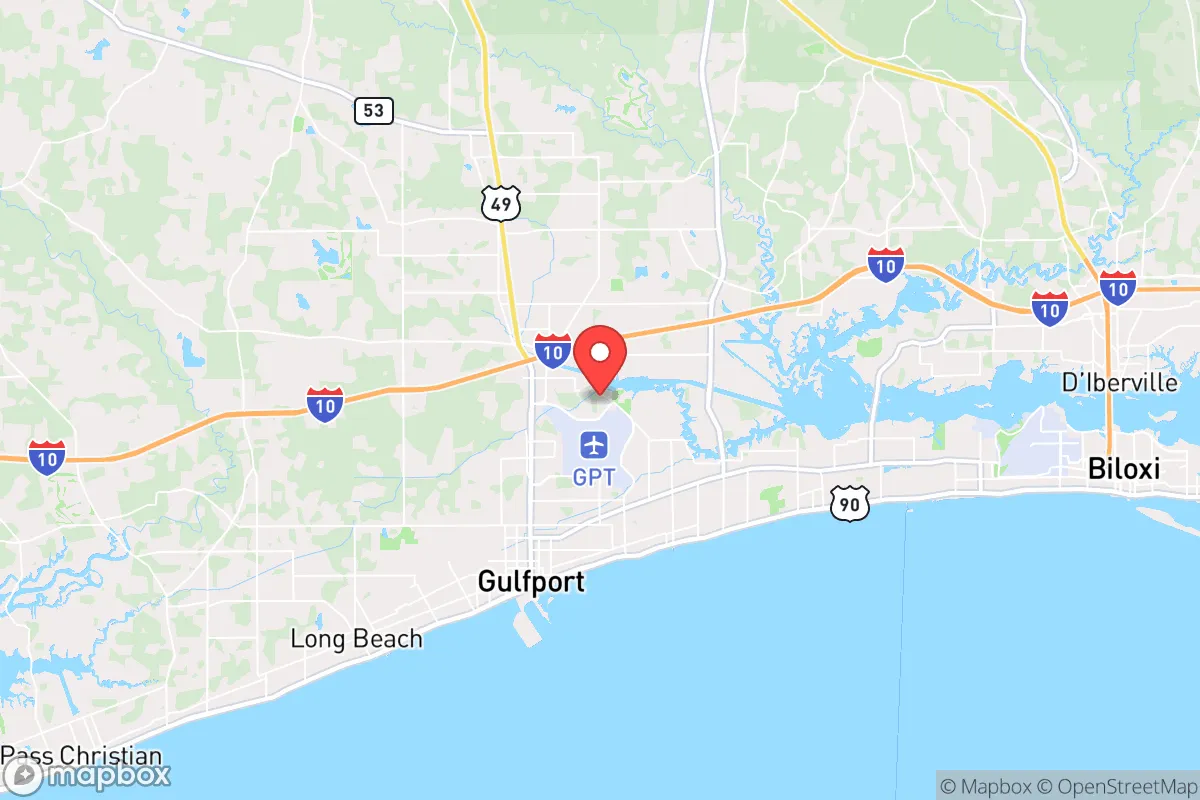
Photo: Wikipedia
Personal Sovereignty in Gulfport, MS
Viable for self-reliance. Generally workable, though some barriers may limit total independence.
What does Personal Sovereignty tell us?
Personal Sovereignty measures your capacity for self-reliance and independence with minimal government friction. Higher scores mean fewer barriers between you and the way you want to live... but it assumes you have the space you need and good neighbors.
What does this tell us?
Personal Sovereignty measures your capacity for self-reliance and independence with minimal government friction. Higher scores mean fewer barriers between you and the way you want to live... but it assumes you have the space you need and good neighbors.
State Policy
Energy independence: Importer (50% of energy produced in-state)
Personal Liberty
Homesteading

Personal Liberty Analysis
Gulfport, Mississippi, offers a notably high degree of personal sovereignty compared to much of the coastal South, largely because Mississippi’s state-level preemption laws and constitutional protections create a buffer against local government overreach. For a prepper or survivalist-minded individual, this means fewer layers of bureaucracy between you and your decisions about property, self-defense, and daily life. The state’s legal framework leans heavily on individual liberty, but the practical reality in Gulfport is shaped by a mix of local zoning quirks, hurricane-driven building codes, and a culture that still values self-reliance over state dependency.
Tax burden and regulatory posture: how Mississippi’s low-tax environment affects daily autonomy
Mississippi’s tax structure is one of the most favorable in the nation for those seeking to keep more of their own money. There is no state income tax on Social Security benefits, and the state’s flat income tax rate of 4.0% (as of 2026) is among the lowest in the country. Property taxes in Harrison County, where Gulfport sits, average around 0.75% of assessed value—well below the national average. This low tax burden directly translates into greater personal autonomy: less money siphoned to the state means more capital for land, supplies, and emergency reserves. On the regulatory side, Mississippi is a “right-to-work” state with minimal business licensing requirements for small-scale operations like home-based food production or repair services. However, Gulfport’s coastal location means the city enforces strict FEMA floodplain regulations and building codes tied to wind mitigation. These are not ideological restrictions—they are practical necessities for surviving hurricane season—but they do impose a layer of state-mandated compliance that a prepper must factor into any homesteading or construction plan. The state’s overall regulatory posture is light, but the local overlay of disaster-preparedness rules is non-negotiable.
Self-defense and gun law specifics: what the Second Sanctuary status means for carry and storage
Mississippi is a constitutional carry state, meaning no permit is required to carry a concealed firearm for anyone legally allowed to possess one. Gulfport and Harrison County have both passed Second Amendment Sanctuary resolutions, signaling local law enforcement’s unwillingness to enforce federal gun restrictions that might be deemed unconstitutional. This is a concrete advantage for the survivalist: you can keep a firearm in your vehicle, on your person, or in your home without worrying about local ordinances that might otherwise restrict magazine capacity or storage methods. The state also has strong “stand your ground” and “castle doctrine” laws, with no duty to retreat in any place you are lawfully present. For parents, this extends to the home: you are legally justified in using deadly force to protect yourself or your family from an intruder. The only notable restriction is that firearms are prohibited in K-12 school zones (unless you have an enhanced permit), and open carry is technically legal but can draw unwanted attention in more urban parts of Gulfport. For a prepper, the legal environment is about as permissive as it gets in the continental U.S., though you should still be aware that federal laws on NFA items (suppressors, short-barreled rifles) still apply.
Self-reliance and homesteading viability: lot sizes, zoning, and off-grid feasibility in Gulfport
Gulfport’s zoning is a mixed bag for serious homesteading. Within city limits, standard residential lots are typically 6,000 to 10,000 square feet—enough for a substantial garden and a few chickens, but not for livestock or large-scale food production. The city allows backyard chickens (hens only, no roosters) with a permit, and beekeeping is permitted with registration. However, off-grid living is effectively impossible inside city limits: Gulfport requires connection to municipal water and sewer, and solar panels must be tied to the grid unless you obtain a special variance. The real opportunity lies in the unincorporated areas of Harrison County, just north of Gulfport near the DeSoto National Forest. There, lot sizes of one to five acres are common, zoning is minimal, and there are no county-level restrictions on rainwater collection, composting toilets, or alternative energy systems. The county does not enforce building codes outside city limits (though the state’s wind-borne debris standards still apply), so a determined prepper can build a self-sufficient compound with relative ease. The trade-off is distance: these areas are 15-30 minutes from Gulfport’s grocery stores and hospitals, which matters for daily convenience but is ideal for those prioritizing autonomy over access.
Personal liberties: parental rights, medical autonomy, speech, and property protections
Mississippi has some of the strongest parental rights laws in the country. The “Parental Bill of Rights” (SB 2696) explicitly affirms that parents have the fundamental right to direct their child’s education, medical care, and moral upbringing. This means no local school board can mandate vaccines or curriculum content that overrides parental objection without a court order. Homeschooling is deregulated: you simply file a notice of intent with the state, and there are no standardized testing requirements or curriculum approvals. On medical autonomy, Mississippi is a mixed environment. The state has not expanded Medicaid, which limits low-income healthcare access, but it also means fewer federal strings attached to medical decisions. There is no state-level vaccine mandate for adults, and religious exemptions are broadly recognized. However, the state’s strict abortion laws (a near-total ban) are a double-edged sword for personal sovereignty: they restrict one form of medical choice while reinforcing the state’s stance on life. Free speech is robustly protected under the state constitution, and there are no local hate speech ordinances or social media content restrictions that go beyond federal law. Property rights are strong: Mississippi has no statewide rent control, no forced inclusionary zoning, and eminent domain is rarely used for private development. For a prepper, the key takeaway is that the state’s legal culture respects the individual’s right to make decisions about family, health, and land—within the bounds of state-level moral legislation.
Overall, Gulfport offers a sovereignty profile that is strong on tax freedom, gun rights, and parental control, but weaker on off-grid feasibility due to coastal regulations and municipal utility requirements. Compared to a place like Portland or Denver, where local ordinances can override state-level liberties, Gulfport’s legal environment is far more predictable and permissive. For a conservative-leaning individual or family looking to maximize personal autonomy while still living near a mid-sized city with a port and airport, Gulfport is a solid choice—provided you are willing to either work within city limits or buy land in the county to achieve full self-reliance. The biggest threat to that sovereignty is not local government but the federal government’s ability to impose disaster-related mandates after hurricanes, which is a reality of living on the Gulf Coast that no amount of prepping can fully eliminate.

* Values derived from national, state, county, city and local statistics and may differ in a specific area. Last updated: 2026-04-29T18:49:47.000Z
Narrative content on this page is AI-generated and may contain mistakes. Verify any details that matter before acting on them.
ReloMaps may earn a commission from affiliate links at no extra cost to you.

