Photo: Wikipedia
Demographics of Hamilton, MT
Affluence Level in Hamilton, MT
A middle-class area roughly in line with national averages across income, home values, education, and employment.
People of Hamilton, MT
The people of Hamilton, Montana today form a predominantly white, family-oriented community of 4,949 residents, with a strong conservative character and a 94.3% white population. The city’s identity is rooted in its agricultural and timber history, with a growing number of remote workers and retirees drawn by the Bitterroot Valley’s scenery and lower cost of living. Foreign-born residents make up just 4.1% of the population, and the Hispanic share sits at 2.1%, reflecting limited recent immigration. The city remains culturally homogeneous, with a notable absence of Black (0.0%) or Indian subcontinent (0.0%) populations, and a small East/Southeast Asian community at 0.7%.
How the city was settled and grew
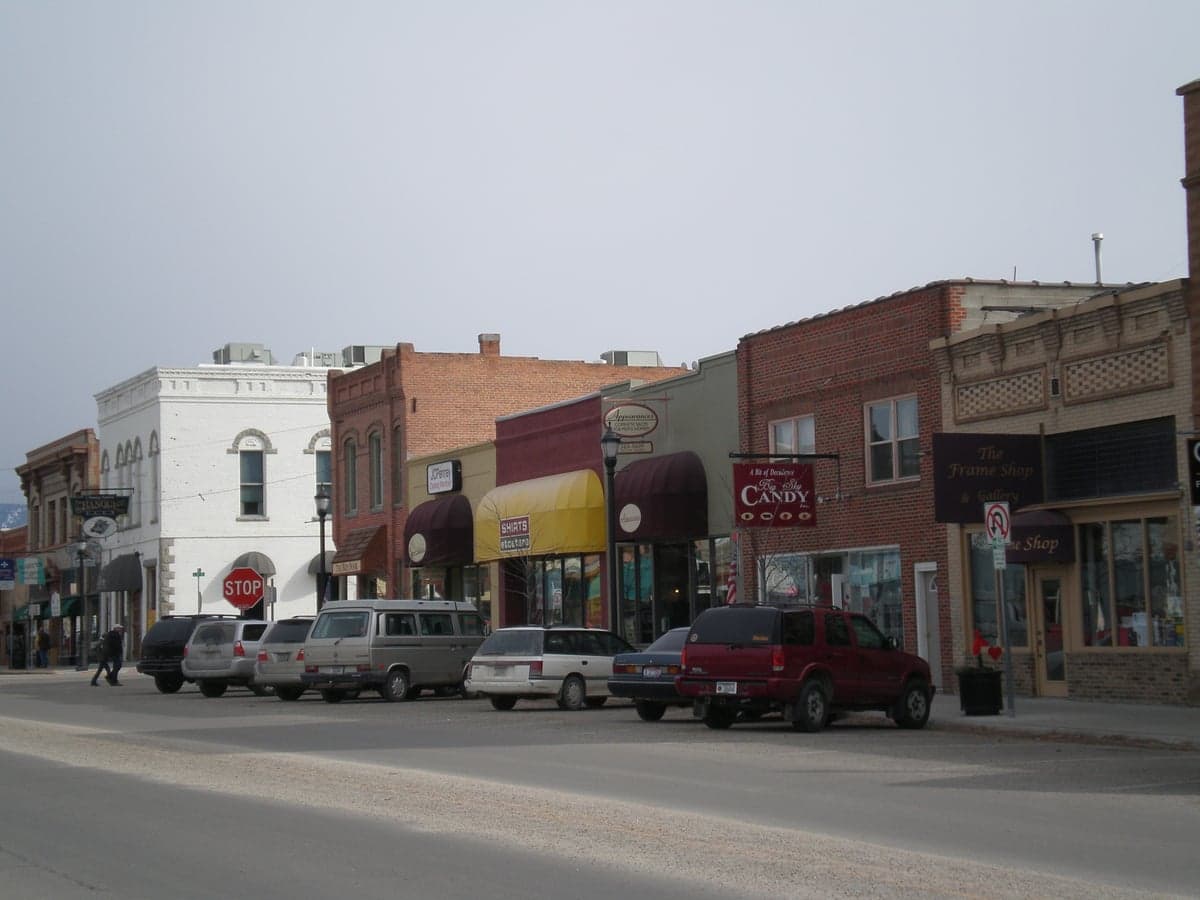
Hamilton was founded in 1890 as a planned railroad town by Marcus Daly, the copper magnate, who established the Bitterroot Stock Farm and drew settlers with promises of irrigated farmland and timber jobs. The original population was almost entirely white, composed of Midwestern farmers, Scandinavian loggers, and Irish laborers who built the early neighborhoods around Main Street and the railroad depot. The Historic Daly District, centered on Marcus Daly’s original mansion and the surrounding blocks, became the heart of the town’s early professional class—doctors, merchants, and ranchers. Working-class families settled in Riverview, a neighborhood along the Bitterroot River where mill workers and railroad employees built modest homes. By 1900, the population had reached 1,000, and the city grew steadily through the 1920s as the timber industry expanded, with new arrivals filling Westside, a district of craftsman bungalows built for sawmill foremen and shop owners. The Great Depression slowed growth, but World War II brought a modest influx of veterans and their families, who settled in the South Hills area, where small ranchettes and starter homes were built on former orchard land.
Modern era (post-1965)
After the 1965 Immigration and Nationality Act, Hamilton saw almost no change in its racial composition—the foreign-born share remained below 5% through the 1970s and 1980s. The major demographic shift was domestic: a steady stream of white retirees and second-home buyers from California and the Pacific Northwest, drawn by the valley’s recreational opportunities and lower taxes. These newcomers concentrated in Bitterroot River Estates, a planned subdivision of larger homes on acreage built in the 1990s and 2000s, and in Horseshoe Bend, a newer development of custom homes popular with remote workers. The Hispanic population grew slightly from near-zero to 2.1% by 2020, largely through seasonal agricultural labor in the surrounding orchards and nurseries, but these families tend to live in rental housing near the industrial corridor on the city’s east side, not in established neighborhoods. The East/Southeast Asian community (0.7%) is almost entirely composed of medical professionals working at the Marcus Daly Memorial Hospital or the nearby Rocky Mountain Laboratories, and they are scattered across the city rather than forming a distinct enclave. The Black and Indian subcontinent populations remain at zero, reflecting the city’s lack of economic pull for those groups.
The future
Hamilton’s population is projected to grow slowly, reaching roughly 5,500 by 2035, driven by continued domestic in-migration of white retirees and remote workers rather than international immigration. The city is not tribalizing into distinct ethnic enclaves—it is homogenizing further, as the small Hispanic and Asian populations are likely to assimilate into the broader white-majority culture rather than forming separate communities. The South Hills and Horseshoe Bend areas will absorb most new housing, while the Historic Daly District and Riverview will remain stable, older neighborhoods with little turnover. The foreign-born share is unlikely to rise above 5% in the next decade, as Hamilton lacks the industrial or service-sector jobs that attract immigrant labor. The college-educated share (31.4%) will increase as more remote professionals arrive, but the city’s political and cultural character will remain deeply conservative and family-oriented.
For someone moving in now, Hamilton is becoming a quieter, more affluent version of its former self—a white, aging community where newcomers are expected to fit into existing social norms rather than diversify them. The city offers stability and predictability, but little ethnic or cultural variety, and the housing market increasingly favors those with out-of-state equity or remote-work incomes over local wage earners.

* Values derived from national, state, county, city and local statistics and may differ in a specific area. Last updated: 2026-04-30T02:58:11.000Z
Narrative content on this page is AI-generated and may contain mistakes. Verify any details that matter before acting on them.
ReloMaps may earn a commission from affiliate links at no extra cost to you.

