 Popular
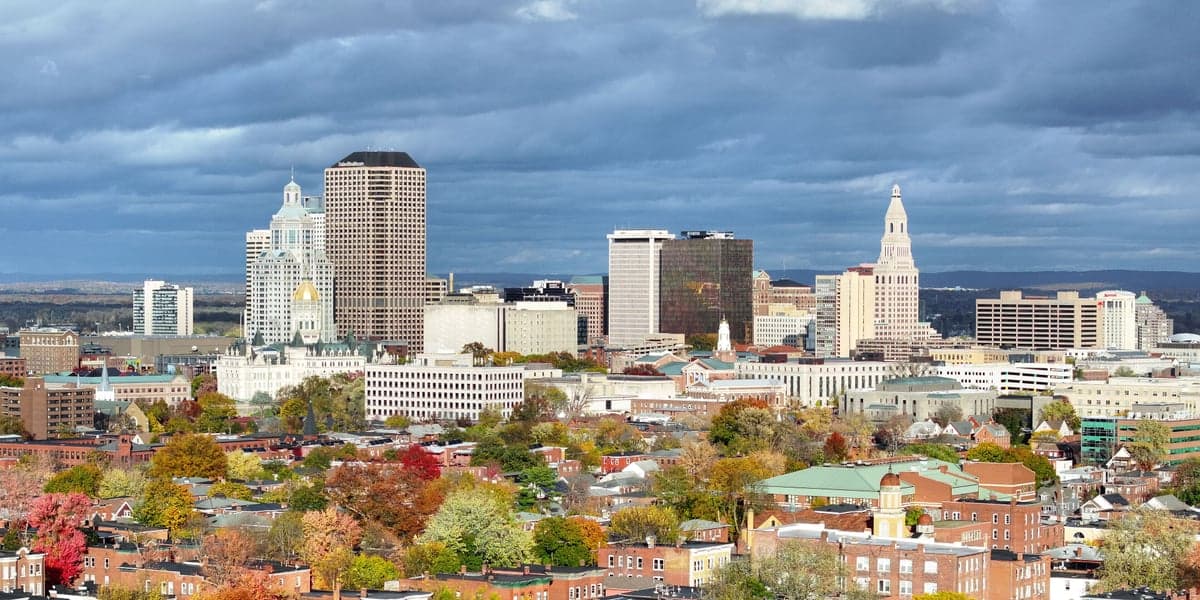
Photo: Wikipedia
Demographics of Hartford, CT
Affluence Level in Hartford, CT
A below-average socioeconomic profile. Incomes, home values, and educational attainment trail the U.S., with higher poverty and unemployment.
People of Hartford, CT
The people of Hartford, Connecticut today form one of the most densely concentrated urban populations in New England, with 119,970 residents packed into just 18 square miles. The city is overwhelmingly non-white — 44.8% Hispanic, 33.8% Black, and only 15.9% white — and notably less educated than the surrounding suburbs, with just 18.3% holding a bachelor’s degree or higher. Foreign-born residents make up 12.6% of the population, a figure that has held steady for two decades, giving Hartford a character of established immigrant communities rather than a rapidly churning gateway city. The city’s identity is shaped by a sharp divide: a small, largely white professional class in the West End and downtown, a large Puerto Rican and Dominican population in the South End and Frog Hollow, and a historically Black community concentrated in the North End and Blue Hills.
How the city was settled and grew
Hartford was founded in 1635 by English Puritan colonists led by Thomas Hooker, who migrated from the Massachusetts Bay Colony seeking religious autonomy and fertile Connecticut River farmland. The original settlement clustered around what is now the Sheldon/Charter Oak neighborhood, named for the legendary oak where the colony’s charter was hidden in 1687. Through the 18th and 19th centuries, Hartford grew as a shipping and insurance hub — by 1850 it was one of the wealthiest cities in America, drawing Irish immigrants to build the canals and railroads, followed by German and Italian immigrants who settled in the South End and Frog Hollow. The insurance industry, centered on what is now the Downtown business district, attracted a steady stream of white-collar Yankees and later Jewish professionals from Eastern Europe. By 1900, Hartford was roughly 85% white, with small Black and Irish enclaves in the North End and along the riverfront. The Great Migration brought Southern Black families to the North End and Blue Hills between 1910 and 1950, while Puerto Ricans began arriving in the 1940s as contract laborers for tobacco farms and factories, settling initially in Frog Hollow and the South Green area.
Modern era (post-1965)
The 1965 Hart-Celler Immigration Act and simultaneous deindustrialization reshaped Hartford’s population dramatically. Puerto Rican migration accelerated through the 1970s and 1980s, transforming Frog Hollow and the South End into predominantly Hispanic neighborhoods — today those areas are over 80% Hispanic, mostly Puerto Rican and Dominican. The 1968 riots in the North End accelerated white flight to suburbs like West Hartford and Glastonbury, and by 1980 Hartford’s white population had fallen from 60% to 30%. The Black population, concentrated in the North End and Blue Hills, grew to roughly 40% by 1990 before stabilizing. A smaller wave of East/Southeast Asian immigrants — primarily Vietnamese and Chinese — arrived in the 1980s and 1990s, settling in the West End and Asylum Hill, where they now make up about 1% of the city. Indian-subcontinent residents (1.3%) are a distinct, newer group, largely professionals drawn to the insurance and healthcare sectors, living mostly in the West End and downtown condos. The foreign-born share peaked around 14% in 2000 and has since plateaued at 12.6%, as immigration from Puerto Rico (U.S. citizens, not counted as foreign-born) has slowed and domestic out-migration to suburbs has continued.
The future
Hartford’s population is slowly declining — down from 124,775 in 2010 — and is projected to fall below 115,000 by 2035 if current trends hold. The city is not homogenizing; rather, it is tribalizing into distinct ethnic enclaves that show little integration. The Hispanic share is rising steadily (from 38% in 2000 to 44.8% today), driven by higher birth rates and continued migration from Puerto Rico and the Dominican Republic, while the Black share is stable and the white share continues to erode. The small East/Southeast Asian and Indian populations are growing slowly, but from a tiny base, and are unlikely to reshape the city’s character. The biggest demographic wildcard is the Downtown area, where luxury apartment construction and state-government job growth have attracted a small but visible cohort of young white professionals — but this group remains a thin veneer over a deeply poor, minority-majority city. For a conservative-leaning mover, the key takeaway is that Hartford is becoming more uniformly Hispanic and Black, with a shrinking tax base and a public school system that serves a student body that is 90% non-white and 80% low-income.
Hartford is a city of entrenched ethnic neighborhoods — Frog Hollow (Hispanic), the North End (Black), the West End (mixed professional) — with little of the suburban assimilation or upward mobility that defined earlier immigrant waves. For someone moving in now, the city offers affordable housing and proximity to insurance-industry jobs, but the demographic trajectory points toward continued poverty concentration and racial isolation rather than revitalization.

* Values derived from national, state, county, city and local statistics and may differ in a specific area. Last updated: 2026-04-24T11:51:31.000Z
Narrative content on this page is AI-generated and may contain mistakes. Verify any details that matter before acting on them.
ReloMaps may earn a commission from affiliate links at no extra cost to you.

