Photo: Wikipedia
Political ClimatePolitical Climate in Hedgesville, WV
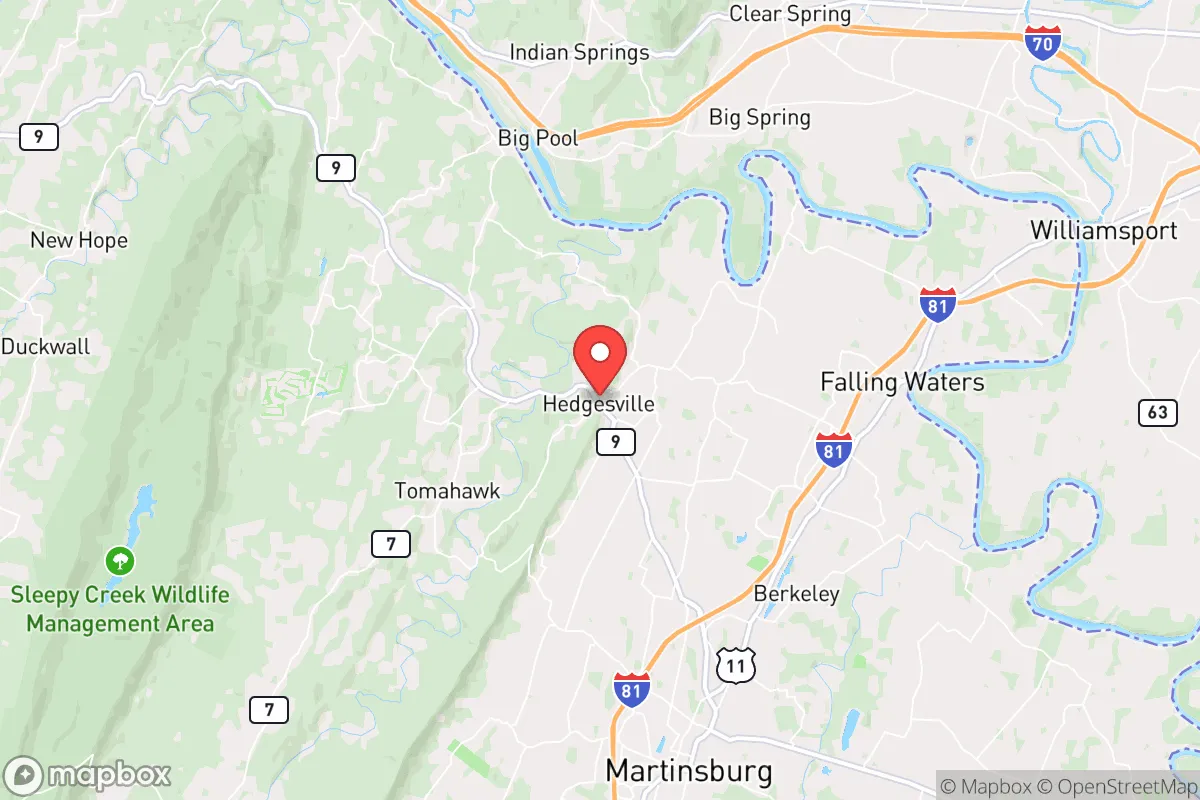
District shown is the primary district for this city’s centroid. Cities may span multiple districts.
Local Political AnalysisPolitical Analysis of Hedgesville, WV
Hedgesville, West Virginia, sits in a deeply conservative pocket of the Eastern Panhandle, and it’s been that way for as long as anyone around here can remember. The Cook PVI rating of R+20 tells you the math—this area votes Republican by a landslide margin, and that’s not changing anytime soon. But if you’ve lived here a while, you’ve seen the political climate shift from a quiet, live-and-let-live conservatism into something a lot more defensive, especially as folks from the D.C. suburbs have started trickling in. The old guard still holds the line, but there’s a real unease about whether that can last.
How it compares
Drive ten miles south to Martinsburg, and you’ll feel the difference immediately. Martinsburg has been trending bluer over the last decade, with younger transplants and commuters pulling it toward the center—some precincts there even went blue in the 2020 presidential race. Hedgesville, by contrast, is still solidly red, and it’s not just a matter of party registration. The local culture here is more rural, more rooted, and people are suspicious of any government overreach, whether it’s zoning rules, school mandates, or gun laws. Berkeley Springs, about 20 minutes west, leans conservative too, but it’s got a noticeable artsy, libertarian streak that Hedgesville doesn’t share. Out here, it’s straight-ticket Republican, and the few progressive signs you see in yards are usually met with a raised eyebrow or a muttered comment at the feed store.
What this means for residents
For the people who actually live here—not the weekenders or the remote workers—the political climate means a lot of things stay the way they are, and that’s mostly by design. Property taxes are low, there’s no county income tax, and the local school board fights hard to keep curriculum decisions local. You won’t find mask mandates or vaccine passports being enforced in Hedgesville; the county commission has made it clear they’ll push back against any state or federal overreach. That said, there’s a growing worry that the influx of new residents from Northern Virginia and Maryland could tip the scales in the next few election cycles. These folks bring different priorities—more density, more regulation, more government involvement in daily life—and that’s a real concern for anyone who moved here to get away from exactly that. The local Republican committee is active, but they’re fighting an uphill battle against demographic change.
One thing that sets Hedgesville apart is the quiet, almost stubborn resistance to anything that feels like progressive ideology creeping in. The county’s gun culture is strong—open carry is common, and there’s no appetite for red flag laws or waiting periods. The local churches are conservative, and the community events—like the annual Hedgesville Apple Butter Festival—are about as traditional as it gets. If you’re looking for a place where the government stays out of your business and your neighbors share your values, this is still it. But keep an eye on the school board meetings and the county planning commission; that’s where the real fights are happening now, and they’re only going to get louder as the area grows.

State Political ClimatePolitical Climate in West Virginia
State Political AnalysisPolitical Environment in the State
West Virginia has long been one of the most reliably Republican states in the nation, but that wasn’t always the case. As recently as the 1990s, the Mountain State was a Democratic stronghold at the state and local level, voting for Bill Clinton twice. The shift began in earnest around 2000, accelerated by the national Democratic Party’s move left on energy, gun rights, and cultural issues. By 2024, Donald Trump carried West Virginia by nearly 40 points, and Republicans now hold supermajorities in both chambers of the legislature, all three U.S. House seats, and every statewide office. The state’s political DNA is now defined by a populist, culturally conservative, and pro-coal coalition that views the federal government with deep skepticism.
Urban vs. rural divide
The political map of West Virginia is starkly divided between a handful of small urban centers and the vast rural expanse. The state’s largest city, Charleston, and its surrounding Kanawha County lean more moderate, with Democrats occasionally winning local races there—though even Charleston voted for Trump in 2024 by a narrow margin. Morgantown, home to West Virginia University, is the state’s most liberal enclave, with Monongalia County often voting within single digits of the national average. Huntington and Wheeling in the northern panhandle are more conservative than their populations might suggest, driven by working-class voters in manufacturing and healthcare. The real engine of the state’s Republican dominance is the rural south and central regions—counties like Mingo, Logan, and McDowell routinely deliver 80%+ margins for GOP candidates. The eastern panhandle, including Martinsburg and Charles Town, has seen an influx of former D.C. area residents, making it a purple-to-red zone where local races can be competitive but presidential votes remain solidly Republican.
Policy environment
West Virginia’s policy environment is among the most conservative in the country, with a strong emphasis on low taxes and limited regulation. The state has no personal or corporate income tax on most business structures, and the legislature has been phasing down the personal income tax—it’s currently at 3.99% with a flat rate target of 3.5% by 2028. Property taxes are among the lowest in the nation, capped by the state constitution at 1% of assessed value for owner-occupied homes. Education policy has been a flashpoint: in 2021, the legislature passed a universal school choice law allowing Education Savings Accounts (ESAs) for all students, one of the most expansive such programs in the country. The state also has a near-total ban on abortion (trigger law effective June 2022) with no exceptions for rape or incest. Election laws are strict: voter ID is required, early voting is limited to 10 days, and no-excuse absentee voting was eliminated after 2020. The state has no sanctuary city policies—in fact, a 2024 law requires local law enforcement to cooperate with federal immigration authorities.
Trajectory & freedom
West Virginia has been moving decisively toward greater personal freedom in the conservative sense, particularly on gun rights, parental rights, and economic liberty. In 2024, the legislature passed a permitless carry law, allowing any adult who can legally possess a firearm to carry it concealed without a license. The same year, a “Parental Bill of Rights” was enacted, requiring schools to notify parents of any curriculum involving sexuality or gender identity and to obtain parental consent before any mental health screening. Medical freedom saw a win with the 2023 passage of a law prohibiting COVID-19 vaccine mandates by private employers and government entities. On the economic side, the state has aggressively cut business regulations, including a 2022 law that eliminated the state’s certificate of need program for healthcare facilities. However, there are concerns: the state’s heavy reliance on federal funding (over 40% of the state budget comes from Washington) creates a vulnerability that some see as a hidden leash on true independence. Additionally, a 2023 law banning most forms of public camping has raised civil liberties questions among homeless advocates, though supporters argue it’s about public safety.
Civil unrest & political movements
West Virginia has a history of labor militancy, but modern political movements are dominated by the right. The 2018 teachers’ strike was a rare moment of cross-ideological unity, but since then, the energy has shifted to conservative grassroots groups. The West Virginia Family Foundation and Moms for Liberty chapters in Berkeley County and Kanawha County have been highly active in school board races, pushing for curriculum transparency and book challenges. The state saw a surge in “Second Amendment Sanctuary” resolutions in 2020, with over 40 counties passing symbolic measures. On the left, the West Virginia Democratic Party has been reduced to a rump, with most activism centered on environmental justice in the coalfields and LGBTQ+ advocacy in Morgantown. Immigration politics are largely absent—the state’s foreign-born population is under 2%—but a 2024 law banning “sanctuary” policies passed with bipartisan support. Election integrity remains a live issue: the 2020 election saw no major fraud cases, but the legislature nonetheless passed a 2021 law requiring signature verification on absentee ballots and limiting drop boxes. A new resident would notice that political conversations are less about protests and more about church potlucks and county commission meetings—the activism is quiet, local, and deeply rooted.
Projection
Over the next 5-10 years, West Virginia is likely to become even more Republican and more culturally conservative, but with a growing tension between its native populist base and an influx of remote workers from blue states. The eastern panhandle, particularly Jefferson County and Berkeley County, is seeing the fastest growth in the state, driven by former D.C. residents seeking lower taxes and more space. These newcomers tend to be fiscally conservative but socially moderate, which could create friction with the state’s more traditionalist southern counties. The state’s demographic decline—West Virginia is one of the few states losing population overall—means that the political influence of the remaining population will be amplified. Expect continued tax cuts, further expansion of school choice, and a hardening of the state’s position on abortion and gun rights. The wild card is the energy transition: if coal continues to decline, the state’s economy will need to diversify, and that could shift the political calculus. For now, the trajectory is clear: West Virginia is doubling down on its identity as a red-state outlier in an increasingly blue region.
For someone moving to West Virginia, the bottom line is this: you’ll find a state that largely leaves you alone, with low taxes, strong gun rights, and a government that shares your cultural values. The trade-off is a limited economy, aging infrastructure, and a healthcare system that struggles in rural areas. If you’re looking for a place where your kids can go to school without political indoctrination, where you can carry a firearm without a permission slip, and where your tax dollars aren’t funding progressive social experiments, West Virginia delivers. Just be prepared for a slower pace of life and a population that’s as fiercely independent as it is welcoming.
* Values derived from national, state, county, city and local statistics and may differ in a specific area. Last updated: 2026-04-23T06:09:08.000Z
Narrative content on this page is AI-generated and may contain mistakes. Verify any details that matter before acting on them.
ReloMaps may earn a commission from affiliate links at no extra cost to you.

