Photo: Wikipedia
Demographics of Hobart, IN
Affluence Level in Hobart, IN
A middle-class area roughly in line with national averages across income, home values, education, and employment.
People of Hobart, IN
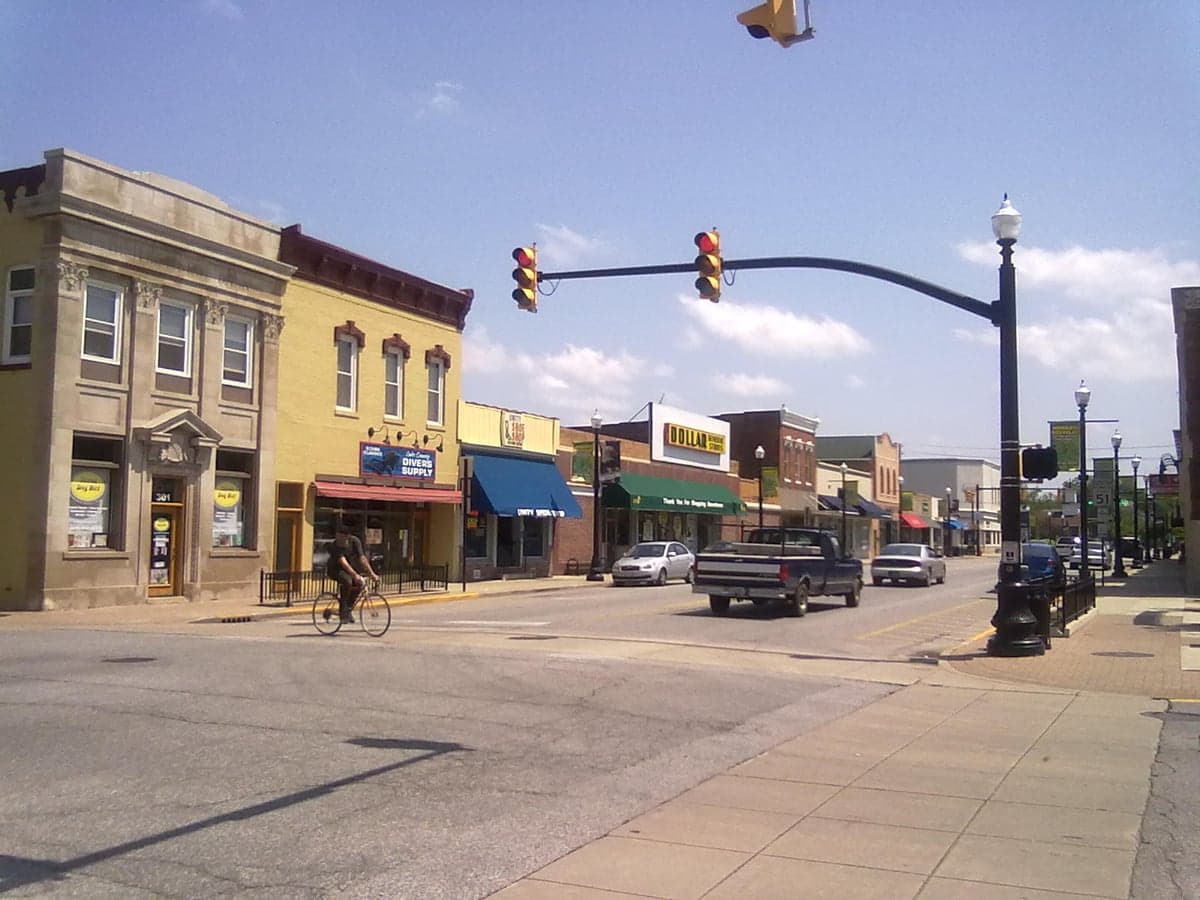
The people of Hobart, Indiana today form a predominantly white, working- and middle-class community of roughly 29,646 residents, with a notably low foreign-born share of just 1.5%. The city’s character is shaped by its historic roots as a Lake County industrial and railroad hub, now blended with suburban commuters heading to Chicago or Gary. Distinctive identity markers include a strong sense of local pride centered on Lake George and the city’s independent school system, alongside a population that is 65.6% white, 16.9% Hispanic, 14.0% Black, and small but growing East/Southeast Asian (0.8%) and Indian-subcontinent (0.7%) communities. The city feels more insular and slower-changing than neighboring Crown Point or Valparaiso, with a density of about 1,200 people per square mile that keeps it comfortably suburban.
How the city was settled and grew
Hobart’s original population was drawn by the Lake Erie and Western Railroad in the 1850s, with the town platted in 1853 by George Earle. Early settlers were predominantly German and Irish immigrants who built the railroad and worked in the surrounding farmlands. By the 1880s, the discovery of limestone and clay deposits spurred a brick-making industry, attracting a second wave of Polish and Slovak laborers who settled in what is now the Old Town district near the original railroad depot. The Ainsworth neighborhood, just east of downtown, became a hub for second-generation German families who established small farms and businesses. Through the early 20th century, Hobart remained a small, ethnically European enclave—overwhelmingly white, with a 1920 census showing less than 1% non-white population. The post-World War II boom brought returning veterans and their families into new subdivisions like Lake Hills and Valley Forge, expanding the city’s footprint south and west along State Road 51. By 1960, Hobart’s population had reached 8,000, still nearly all white, with a strong blue-collar identity tied to nearby steel mills in Gary and East Chicago.
Modern era (post-1965)
The 1965 Hart-Cellar Act opened immigration channels, but Hobart’s foreign-born share remained negligible—just 1.5% today—because the city lacked the industrial job base or ethnic networks that drew newcomers to larger Lake County cities. Instead, the post-1965 story is one of domestic in-migration and suburbanization. White flight from Gary and East Chicago accelerated in the 1970s and 1980s, with Black families also moving into Hobart as part of broader regional desegregation. The South Hobart neighborhood, developed in the 1980s and 1990s, absorbed many of these new residents, shifting the city’s Black population from under 2% in 1970 to 14.0% today. Hispanic growth began in the 1990s, driven by Mexican and Puerto Rican families seeking affordable housing and construction jobs; they concentrated in the Lake George area and along 37th Avenue. The East/Southeast Asian community (0.8%) is small and scattered, with no distinct ethnic enclave, while the Indian-subcontinent population (0.7%) is similarly dispersed, often tied to professional roles at local hospitals or the Purdue University Northwest campus. College attainment remains low at 22.6%, reflecting the city’s persistent blue-collar base, though newer subdivisions like Hidden Lake have attracted some white-collar commuters.
The future
Hobart’s population is slowly homogenizing in terms of race, but tribalizing by income and lifestyle. The white share has declined from 85% in 2000 to 65.6% today, while Hispanic and Black shares have risen steadily. The Hispanic population, now 16.9%, is the fastest-growing segment, driven by natural increase and continued in-migration from the Chicago metro area; it is likely to reach 20-22% by 2035. The Black population has plateaued near 14%, with little new migration from Gary. East/Southeast Asian and Indian-subcontinent communities remain tiny and are unlikely to grow significantly without a major employer or university expansion. The foreign-born share (1.5%) is among the lowest in Lake County and will likely stay below 3% for the next decade. The city is not tribalizing into distinct ethnic enclaves—neighborhoods like Old Town and South Hobart are increasingly mixed—but income segregation is rising, with newer subdivisions like Hidden Lake drawing higher-earning families while older areas near the railroad tracks see stagnant property values. The next 10-20 years will likely see Hobart become more Hispanic and slightly more diverse overall, but remain a predominantly white, working-class suburb with a stable population near 30,000.
For someone moving in now, Hobart is becoming a more diverse but still insular community where newcomers are expected to integrate into existing social structures rather than form separate enclaves. The low foreign-born share means limited cultural friction, but also fewer ethnic amenities or institutions. The city’s future is one of gradual demographic change, not rapid transformation—a place where the old industrial roots still show, even as the economy shifts toward healthcare and logistics.

* Values derived from national, state, county, city and local statistics and may differ in a specific area. Last updated: 2026-04-22T10:53:03.000Z
Narrative content on this page is AI-generated and may contain mistakes. Verify any details that matter before acting on them.
ReloMaps may earn a commission from affiliate links at no extra cost to you.

