
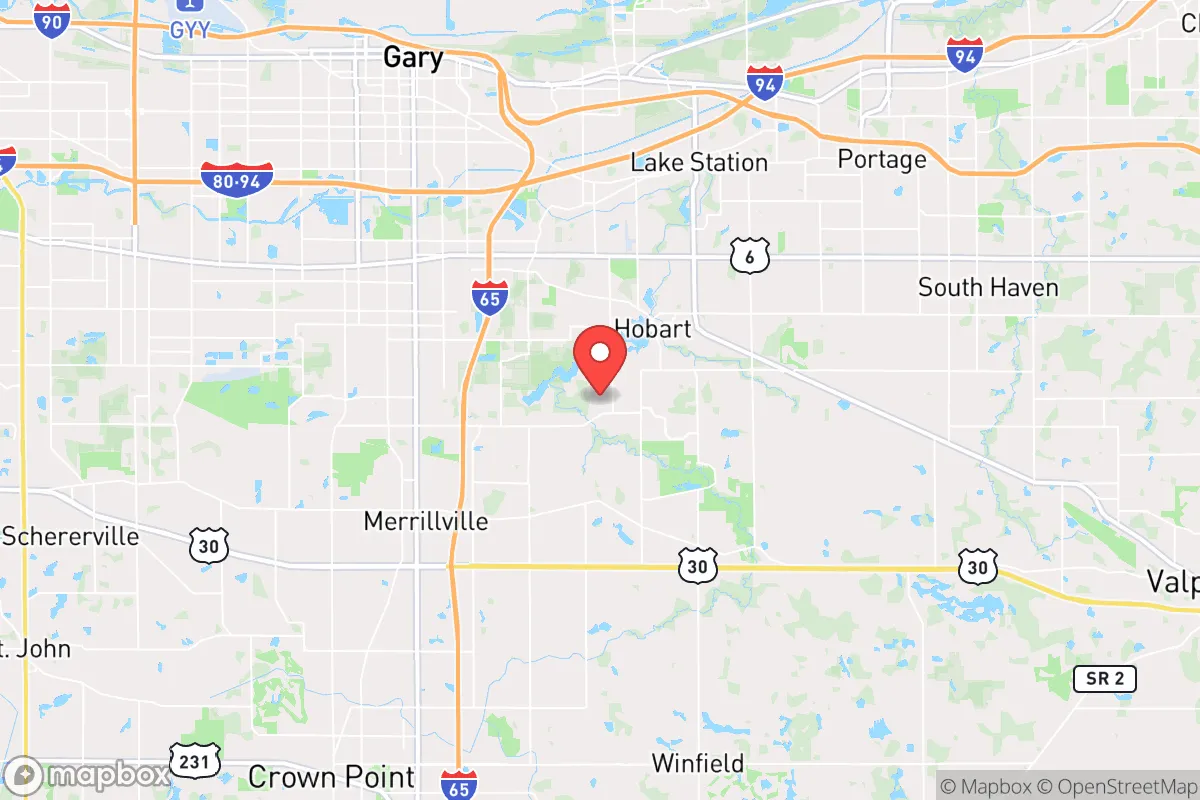
Photo: Wikipedia
Personal Sovereignty in Hobart, IN
Viable for self-reliance. Generally workable, though some barriers may limit total independence.
What does Personal Sovereignty tell us?
Personal Sovereignty measures your capacity for self-reliance and independence with minimal government friction. Higher scores mean fewer barriers between you and the way you want to live... but it assumes you have the space you need and good neighbors.
What does this tell us?
Personal Sovereignty measures your capacity for self-reliance and independence with minimal government friction. Higher scores mean fewer barriers between you and the way you want to live... but it assumes you have the space you need and good neighbors.
State Policy
Energy independence: Importer (35% of energy produced in-state)
Personal Liberty
Homesteading

Personal Liberty Analysis
Hobart, Indiana, offers a mixed bag for those prioritizing personal sovereignty, where the state’s generally conservative legal framework meets the practical realities of a Lake County suburb. For individuals and families seeking to minimize government overreach, the key battlegrounds here are tax policy, self-defense laws, and the ability to live self-reliantly. While Indiana provides a stronger foundation for autonomy than neighboring Illinois, Hobart’s proximity to Chicago’s regulatory gravity and its own municipal codes require careful navigation. The overall environment leans toward personal freedom, but it is not without significant compromises that a survivalist or prepper must weigh.
Tax burden and regulatory posture in Hobart and Lake County
Indiana’s state-level tax structure is relatively friendly to personal sovereignty, with a flat income tax rate of 3.15% as of 2025 and no inheritance or estate taxes. However, Hobart sits in Lake County, where property taxes are among the highest in the state, averaging roughly 1.8% of assessed home value—a notable burden for those seeking to hold land free from government claims. The state’s regulatory posture is generally light-touch compared to the coasts, but local zoning and building codes in Hobart can be restrictive, particularly for non-standard housing or intensive homesteading. Indiana does not have a state-level property tax cap on owner-occupied homes, though local caps exist; still, the cumulative tax load can erode the financial independence that sovereignty-minded individuals prioritize. For a prepper, the key takeaway is that while state taxes are manageable, local property taxes in Lake County are a persistent drain that demands careful budgeting.
Self-defense and gun law specifics in Hobart and Indiana
Indiana is a constitutional carry state, meaning no permit is required to carry a handgun openly or concealed for anyone legally allowed to possess a firearm. This is a strong point for personal sovereignty, as it removes a bureaucratic hurdle to self-defense. Hobart itself has no additional firearm restrictions beyond state law, though local police have been known to enforce "no gun" signs on private property with more vigor than in rural counties. The state also has a "stand your ground" law, codified in Indiana Code 35-41-3-2, which eliminates any duty to retreat before using deadly force in self-defense. For preppers, this legal clarity is critical: you can defend your home, vehicle, or person without fear of prosecution for failing to flee. However, magazine capacity and "assault weapon" bans are not on the books in Indiana, but federal proposals could preempt state law—a risk that sovereignty-minded residents monitor closely. The overall environment is favorable, but the proximity to Illinois’s draconian gun laws means that any federal shift could quickly change the landscape.
Self-reliance and homesteading viability in Hobart
Hobart’s residential lots typically range from 0.25 to 0.5 acres in established neighborhoods, with some larger parcels near the city’s outskirts. Zoning codes in Lake County generally allow for backyard chickens and small gardens, but livestock like goats or pigs are prohibited within city limits, and beekeeping requires a permit. Off-grid living is effectively illegal in Hobart proper—the city requires connection to municipal water and sewer, and solar panels must comply with building codes that often mandate grid-tied systems. For a prepper seeking true self-reliance, this means looking outside city limits, where unincorporated Lake County or neighboring Porter County offers larger lots (1-5 acres) with fewer restrictions. Even there, well and septic permits are required, and the county health department has authority to deny them based on soil conditions. The viability of homesteading in Hobart is thus limited; it is a suburb, not a frontier. Those serious about food security and energy independence should target rural parcels at least 15-20 minutes from downtown Hobart, where zoning loosens and property taxes drop.
Personal liberties in Hobart: parental rights, medical autonomy, speech, and property
Indiana has strong parental rights protections, including a 2023 law that requires schools to notify parents of any changes in a child’s mental, emotional, or physical health, and a ban on gender transition procedures for minors. This aligns with conservative values of family sovereignty. Medical autonomy is more contested: Indiana does not have a state-level vaccine mandate for adults, but employers and hospitals can impose their own requirements, and the state’s emergency powers during the COVID era were used to restrict elective surgeries and mandate masks. For preppers, the lesson is that medical freedom is not absolute, and a major public health crisis could trigger state overreach again. Free speech is protected under the Indiana Constitution, which is more explicit than the U.S. Constitution on this point, and Hobart has no local ordinances restricting political speech or assembly. Property rights are generally strong, with Indiana’s "right to farm" law protecting agricultural uses from nuisance lawsuits, though this applies more to rural areas than suburban Hobart. The city’s zoning board has broad discretion to deny permits for non-conforming uses, which can frustrate those wanting to build a bunker or operate a home-based survival business. Overall, personal liberties in Hobart are above average for the Midwest, but the shadow of Lake County’s Democratic-leaning governance means that local officials can be less friendly to individual autonomy than state law suggests.
Compared to other areas in the Rust Belt, Hobart offers a decent baseline for personal sovereignty, but it is not a haven. The state’s constitutional carry, parental rights, and flat tax are strong positives, while the high property taxes, restrictive zoning, and proximity to Chicago’s political influence are clear negatives. For a survivalist or prepper, Hobart works as a compromise location—close to urban resources but with enough legal space to maintain a low-profile, self-reliant lifestyle. However, those seeking maximum autonomy should look to more rural Indiana counties like Jasper or Newton, where taxes are lower, zoning is looser, and the regulatory footprint is smaller. In Hobart, you can live free, but you must stay vigilant against the creeping reach of local government and the ever-present risk of federal overreach. It is a place to hold the line, not to retreat entirely.

* Values derived from national, state, county, city and local statistics and may differ in a specific area. Last updated: 2026-04-22T10:53:03.000Z
Narrative content on this page is AI-generated and may contain mistakes. Verify any details that matter before acting on them.
ReloMaps may earn a commission from affiliate links at no extra cost to you.

