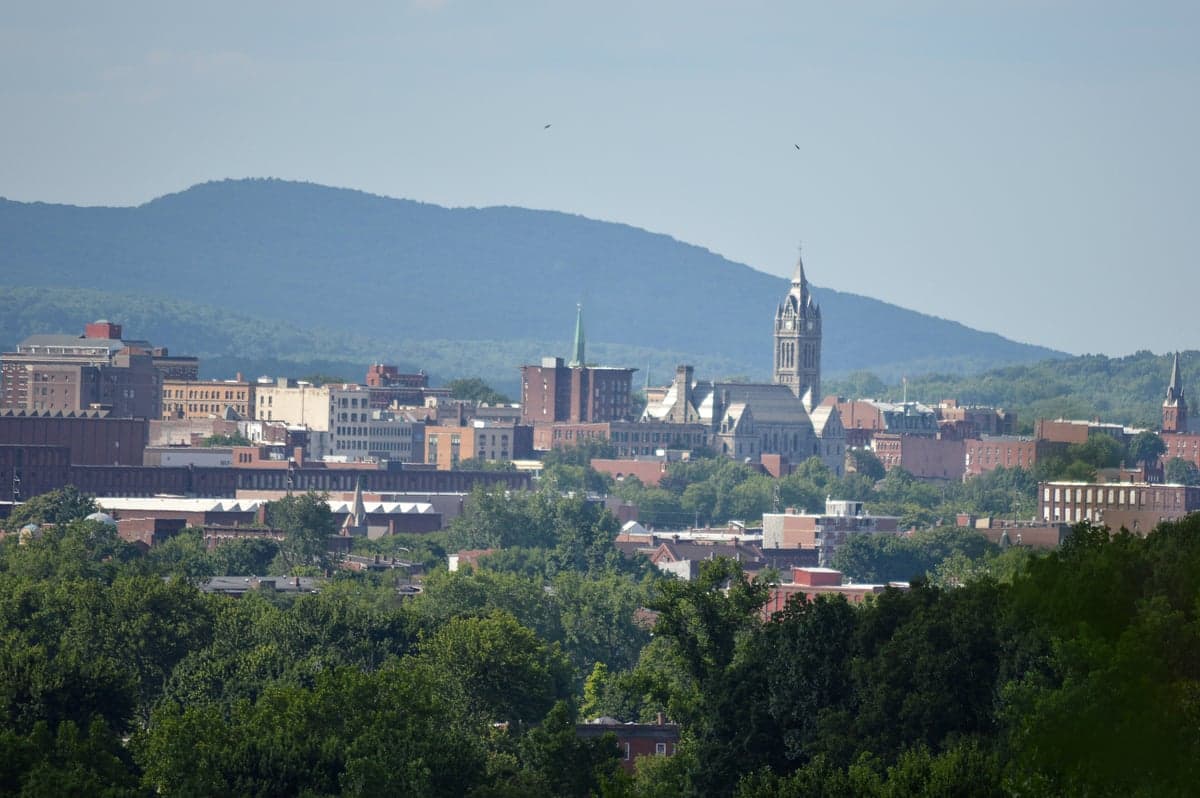
Photo: Wikipedia
Personal Sovereignty in Holyoke, MA
Viable for self-reliance. Generally workable, though some barriers may limit total independence.
What does Personal Sovereignty tell us?
Personal Sovereignty measures your capacity for self-reliance and independence with minimal government friction. Higher scores mean fewer barriers between you and the way you want to live... but it assumes you have the space you need and good neighbors.
What does this tell us?
Personal Sovereignty measures your capacity for self-reliance and independence with minimal government friction. Higher scores mean fewer barriers between you and the way you want to live... but it assumes you have the space you need and good neighbors.
State Policy
Energy independence: Importer (5% of energy produced in-state)
Personal Liberty
Homesteading

Personal Liberty Analysis
Holyoke, Massachusetts, presents a challenging environment for personal sovereignty, where state-level policies heavily constrain individual autonomy in ways that will concern anyone prioritizing self-reliance and minimal government overreach. As a mid-sized city in Western Massachusetts, Holyoke sits within a state that consistently ranks among the most restrictive in the nation for gun rights, tax burden, and regulatory control, meaning your ability to live life on your own terms is significantly limited compared to states like New Hampshire or Texas. For the survivalist or prepper mindset, Holyoke demands a clear-eyed assessment: the legal and fiscal framework here is designed to prioritize collective mandates over individual choice, and any relocation decision must account for these structural realities.
Tax burden and regulatory posture: How Massachusetts compares to freer states
Massachusetts imposes one of the heaviest tax burdens in the country, and Holyoke residents feel it directly. The state’s flat income tax rate of 5% (with a surtax on income over $1 million) combines with a statewide sales tax of 6.25% and property taxes that, while lower than the national average in Holyoke specifically (around $2,500 annually on a median home), are still a fixed cost you cannot escape. More concerning for the prepper mindset is the regulatory posture: Massachusetts has some of the strictest building codes, environmental regulations, and land-use laws in the Northeast. If you want to build a root cellar, install a backup generator, or modify your property for self-sufficiency, you will likely face permitting hurdles and inspections that a state like New Hampshire would not require. The state also mandates auto inspections, emissions testing, and a host of licensing requirements for trades and home businesses that add layers of bureaucracy to daily life. For someone seeking to minimize government entanglement, this is a significant drag on personal sovereignty.
Self-defense and gun law specifics: What the Second Amendment landscape looks like
Massachusetts is one of the most hostile states in the country for Second Amendment rights, and Holyoke offers no refuge from that reality. The state requires a License to Carry (LTC) for any handgun, which involves a background check, fingerprinting, a firearms safety course, and approval from your local police chief—who has significant discretion to deny the license. Magazine capacity is capped at 10 rounds, and the state maintains a restrictive approved firearms roster that limits what you can purchase. "Assault weapons" are banned by name and feature, including many common AR-15 platforms. Open carry is effectively illegal, and even licensed concealed carry is subject to "may issue" discretion in some jurisdictions, though Holyoke’s police department is generally considered more reasonable than Boston’s. For the survivalist, this means your ability to defend your home and family with standard-capacity firearms is legally crippled. Stockpiling ammunition or building a defensive rifle is not just difficult—it can land you in legal trouble. If self-defense is a priority, Massachusetts is a state to avoid, and Holyoke does not change that calculus.
Self-reliance and homesteading viability: Lot sizes, zoning, and off-grid feasibility
Holyoke’s urban and suburban character makes serious homesteading or off-grid living a non-starter for most. The city’s zoning is largely residential with small lots—typically a quarter-acre or less in the core neighborhoods—and agricultural use is limited to a few pockets near the Connecticut River. Raising chickens is allowed with a permit, but larger livestock like goats or pigs is prohibited in most zones. Off-grid feasibility is nearly zero: Massachusetts requires connection to the electrical grid for any habitable structure, and solar panels must be grid-tied unless you jump through expensive permitting hoops. Rainwater collection is legal but regulated, and composting toilets face strict health codes. For the prepper looking to build a self-sufficient compound with a well, septic, and solar backup, Holyoke is the wrong place. You would need to look to rural towns like Chesterfield or Worthington, 20–30 minutes west, where acreage is available and zoning is looser. Even there, state building codes and environmental regulations will still apply, making true off-grid independence a legal gray area.
Personal liberties: Parental rights, medical autonomy, speech, and property
Massachusetts has a strong record of prioritizing state authority over parental rights, which is a red flag for families seeking to raise children without government interference. The state mandates comprehensive sex education in public schools, requires vaccination for school attendance with limited opt-out provisions, and has a robust child protective services system that can intervene in family decisions more aggressively than in many other states. Medical autonomy is similarly constrained: the state has strict vaccine mandates for healthcare workers and schoolchildren, and during the COVID-19 pandemic, Massachusetts was among the most aggressive in enforcing lockdowns, mask mandates, and business closures. Free speech is legally protected, but the state’s political culture is overwhelmingly progressive, meaning conservative viewpoints—especially on guns, taxes, or family structure—can face social ostracism in many circles. Property rights are also limited: the state has strong eminent domain powers, and environmental regulations can restrict what you do with your land, from cutting trees to building structures. For the individualist who values the right to make medical decisions for their family, speak their mind without social penalty, and control their property, Holyoke’s environment is restrictive.
Overall, Holyoke offers a low level of personal sovereignty compared to most of the country, ranking near the bottom for gun rights, tax freedom, and regulatory flexibility. If you are a single individual or parent with a survivalist or prepper mindset, the state of Massachusetts as a whole is a poor fit for maximizing autonomy, and Holyoke’s urban setting only compounds the limitations. For those willing to accept a trade-off—perhaps for a job in the region’s healthcare or education sectors—the city’s lower cost of living relative to Boston provides some breathing room, but the legal and fiscal framework remains a constant constraint. The most sovereignty-minded relocators should look to New Hampshire, Maine, or the rural Midwest, where state-level policies align more closely with individual liberty. Holyoke is a place to live within the system, not to escape it.

* Values derived from national, state, county, city and local statistics and may differ in a specific area. Last updated: 2026-05-01T09:07:15.000Z
Narrative content on this page is AI-generated and may contain mistakes. Verify any details that matter before acting on them.
ReloMaps may earn a commission from affiliate links at no extra cost to you.

