Photo: Wikipedia
Demographics of Homer, AK
Affluence Level in Homer, AK
A middle-class area roughly in line with national averages across income, home values, education, and employment.
People of Homer, AK
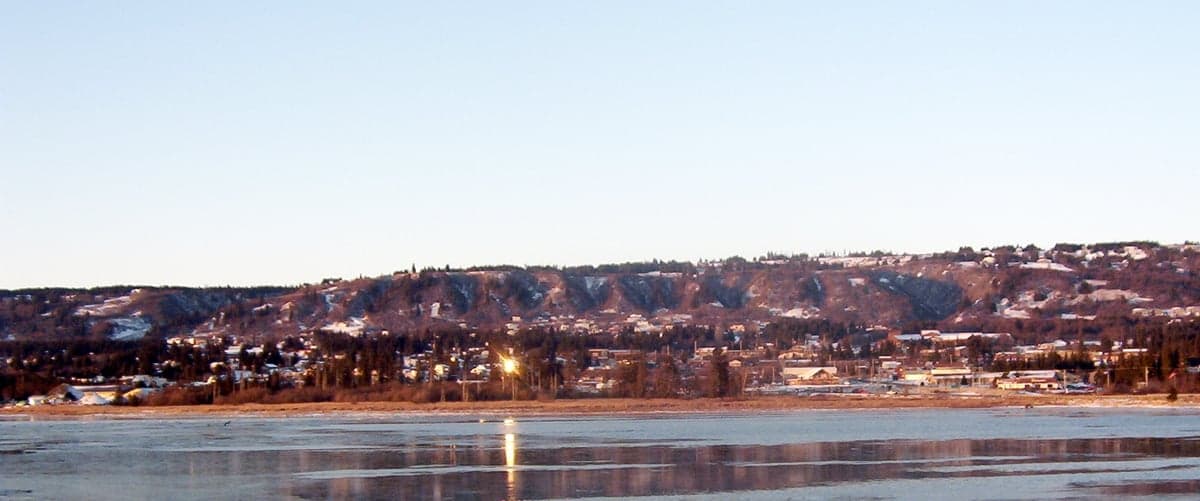
The people of Homer, Alaska, today number roughly 5,750, forming a community that is notably older and more homogenous than the national average, with a strong independent streak shaped by its remote coastal location. The population is 76.9% white, with a very small foreign-born share of just 1.4%, and a college-educated rate of 40.6% that is significantly higher than the state average. This is a place where a working waterfront, a vibrant arts scene, and a libertarian-leaning ethos coexist, creating a distinct identity that is both resourceful and insular. For a conservative-leaning individual or family, Homer offers a tight-knit, low-diversity environment where self-reliance is a core value.
How the city was settled and grew
Homer’s human history is a story of successive waves of opportunity-seekers, each drawn by a specific resource. The Dena’ina Athabascan people were the original inhabitants, using the area as a seasonal fishing and hunting camp for centuries before European contact. The first permanent American settlement began in the 1890s, when gold prospectors and homesteaders arrived, but the town’s true founding came in 1896 with the establishment of a coal mining camp on the bluffs above the spit. The original settlers clustered in what is now the Old Town neighborhood, a historic district along the Homer Spit Road where the first docks, saloons, and general stores were built. The coal industry collapsed by the 1920s, but a second wave arrived during the Great Depression, drawn by the federal Homestead Act of 1862, which offered 160 acres of land. These homesteaders, predominantly of Northern European descent, settled the East End and West End road systems, clearing land for small farms and trapping lines. A third wave came during and after World War II, when the military built the Alaska Highway and established bases, bringing a mix of service members and construction workers who later stayed. Many of these post-war families settled in the Kachemak City area, a more affordable, unincorporated subdivision inland from the spit, where they built modest homes and raised families. By 1950, Homer’s population was still under 1,000, overwhelmingly white and native-born, with a strong frontier character.
Modern era (post-1965)
The post-1965 period brought two major shifts: the rise of commercial fishing as the dominant industry and the arrival of the “back-to-the-land” counterculture. The 1970s saw a wave of young, educated migrants from the Lower 48, many with college degrees, who were drawn by Homer’s remote beauty and the promise of a simpler life. These newcomers, often referred to as “spit rats,” settled in the Homer Spit itself, living in boats, tents, and makeshift cabins while working the fishing boats or starting small businesses. This group significantly raised the town’s college-educated rate, which now stands at 40.6%, and infused the community with an arts and environmentalist ethos that persists today. Simultaneously, the commercial fishing boom attracted a smaller but notable wave of Southeast Asian immigrants, primarily Vietnamese and Filipino, who came to work in the canneries and on fishing vessels. These East/Southeast Asian communities, now comprising 1.6% of the population, concentrated in the Mile 0 area near the harbor and the lower spit, where they established a few small markets and churches. The Hispanic population, at 5.9%, grew more recently, largely from Mexican and Central American families arriving in the 1990s and 2000s to work in the seafood processing plants and the service industry. They have settled primarily in the West End and the Beluga Lake area, where more affordable rental housing is available. The Indian subcontinent population remains negligible at 0.2%, and the Black population at 0.3%, reflecting the city’s very limited diversity. Overall, Homer’s modern era has been one of gradual, selective in-migration that has reinforced its white, educated, and independent character, with ethnic enclaves remaining small and geographically contained.
The future
Homer’s population is likely to continue its slow, steady growth, but the character of that growth is shifting. The city is not homogenizing into a single melting pot; rather, it is tribalizing into distinct enclaves based on lifestyle and economic status. The Old Town and Homer Spit areas are becoming increasingly gentrified, with rising property values pushing out younger fishermen and artists in favor of wealthy retirees and second-home owners from Anchorage and the Lower 48. The East End and West End remain the domain of long-term homesteader families and newer conservative-leaning families seeking acreage and privacy. The Hispanic community, while small, is growing steadily and is likely to become a more visible presence in the service and processing sectors, but it shows no signs of rapid expansion or assimilation into the broader white population. The East/Southeast Asian population is plateauing, as the cannery industry automates and younger generations move to Anchorage or Seattle for broader opportunities. The foreign-born share, at just 1.4%, is unlikely to rise significantly given the high cost of living and limited job diversity. The next 10-20 years will likely see Homer become more economically stratified, with a wealthier, older, and whiter population on the waterfront and a younger, more diverse, and less affluent population in the inland subdivisions.
For someone moving in now, Homer is becoming a place of clear trade-offs: a stunning natural environment and a strong, self-reliant community, but also a high cost of living, limited ethnic diversity, and a growing economic divide between the waterfront haves and the inland have-nots. It is a city that rewards those who arrive with capital and a clear plan, and it remains a deeply conservative, independent place where newcomers are expected to pull their own weight.

* Values derived from national, state, county, city and local statistics and may differ in a specific area. Last updated: 2026-04-19T19:20:39.000Z
Narrative content on this page is AI-generated and may contain mistakes. Verify any details that matter before acting on them.
ReloMaps may earn a commission from affiliate links at no extra cost to you.

