
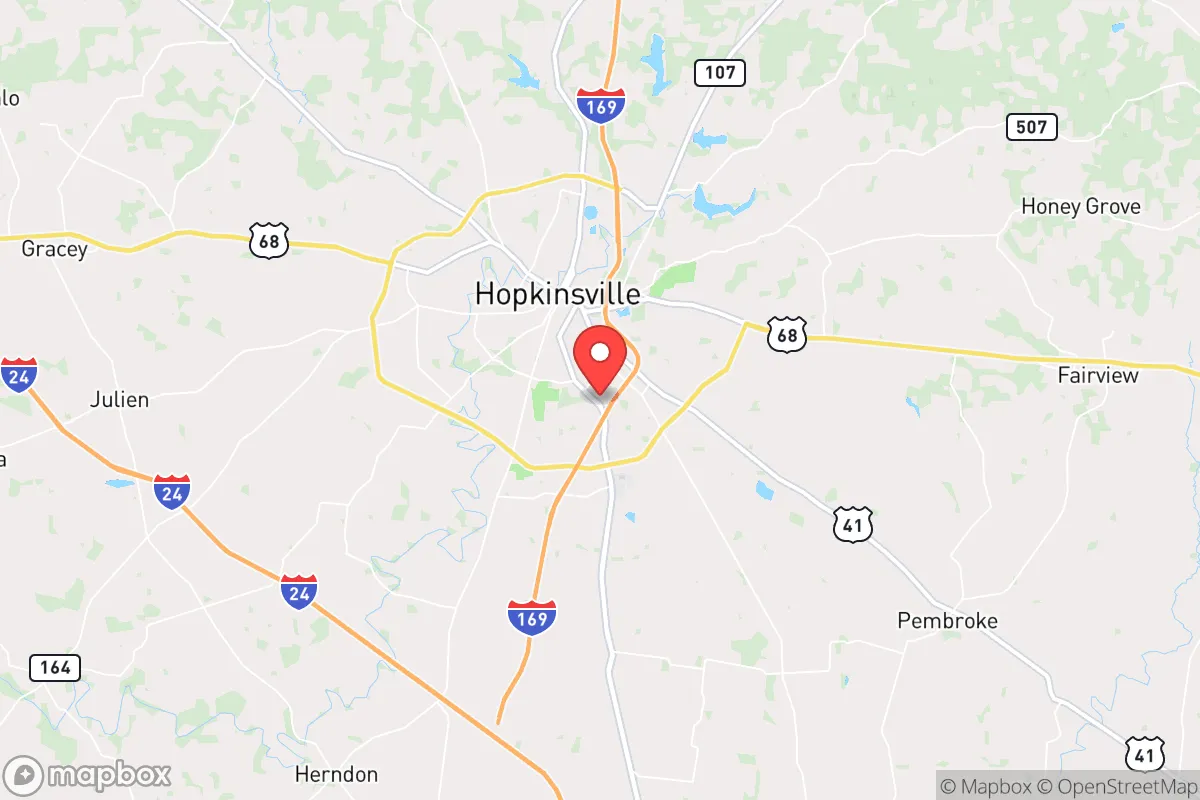
Photo: Wikipedia
Personal Sovereignty in Hopkinsville, KY
Viable for self-reliance. Generally workable, though some barriers may limit total independence.
What does Personal Sovereignty tell us?
Personal Sovereignty measures your capacity for self-reliance and independence with minimal government friction. Higher scores mean fewer barriers between you and the way you want to live... but it assumes you have the space you need and good neighbors.
What does this tell us?
Personal Sovereignty measures your capacity for self-reliance and independence with minimal government friction. Higher scores mean fewer barriers between you and the way you want to live... but it assumes you have the space you need and good neighbors.
State Policy
Energy independence: Importer (60% of energy produced in-state)
Personal Liberty
Homesteading

Personal Liberty Analysis
For the individual or family prioritizing maximum personal sovereignty—meaning minimal government intrusion, strong self-defense rights, and the ability to live by your own rules—Hopkinsville, Kentucky presents a compelling, if nuanced, case. Located in Christian County, this small city sits in a state that has aggressively pushed back against federal overreach in recent years, but the local reality requires a careful look at both the legal framework and the practical, day-to-day autonomy you can expect. While Kentucky is not a free-for-all, its constitutional carry law, low property taxes, and relatively lax zoning in the county make it a serious contender for those looking to unplug from the more restrictive coastal or Midwestern environments.
Tax burden and regulatory posture: How Kentucky's fiscal climate affects your freedom
Kentucky’s tax structure is a mixed bag for the sovereignty-minded. On the plus side, the state has a flat income tax rate of 4.5% (as of 2025, with a scheduled phase-down to 4.0% by 2026), which is moderate but not negligible. More importantly, property taxes are very low—the state rate is just $0.12 per $100 of assessed value, and Christian County adds roughly another $0.10, keeping your annual bill on a $200,000 home under $500. This is a major win for long-term wealth retention and reduces the leverage the government has over your property. Sales tax is a flat 6%, with no local add-ons, and groceries are exempt. The regulatory posture in Hopkinsville itself is business-friendly but not libertarian; the city has a modest building code and requires permits for major renovations, but the county is far more hands-off. For a prepper or survivalist, the key takeaway is that Kentucky has no state-level property tax on tangible personal property (like vehicles or equipment), and there is no state inventory tax for small businesses. This means you can stockpile supplies, own multiple vehicles, or run a home-based business without the government taking a cut of your assets every year. The state’s right-to-work status and lack of a state-level minimum wage above the federal floor also mean you can negotiate your own labor terms without union or government interference.
Self-defense and gun law specifics: Constitutional carry and castle doctrine in practice
This is where Hopkinsville and Kentucky shine for the sovereignty-focused individual. Kentucky is a constitutional carry state—no permit is required to carry a concealed firearm for any law-abiding adult 21 or older. This right is enshrined in state law and has survived multiple legal challenges. The state also has a strong castle doctrine with no duty to retreat, meaning you are legally presumed to have acted in self-defense if someone unlawfully enters your home, vehicle, or occupied structure. The law extends to your place of business and, critically, to your vehicle—you can keep a loaded firearm in your car without a permit. For the prepper mindset, this means you can legally keep a rifle or shotgun in your truck while running errands in town. Hopkinsville itself has a local police department that generally respects these rights, though the city has a higher crime rate than the surrounding county, so situational awareness is still key. The only real limitation is that Kentucky does not allow open carry of a firearm in a vehicle without a permit (concealed is fine), and there are standard prohibited places (schools, government buildings, bars). For the survivalist, the legal framework here is about as good as you’ll find in the eastern half of the U.S., short of moving to Alaska or Idaho.
Self-reliance and homesteading viability: Lot sizes, zoning, and off-grid feasibility
If your goal is to become as self-sufficient as possible—growing food, harvesting rainwater, generating your own power—Hopkinsville’s rural-urban mix offers real opportunities, but with important caveats. Within the city limits of Hopkinsville, zoning is standard: minimum lot sizes are around 6,000 to 10,000 square feet, and you will need permits for structures like sheds, chicken coops, or solar panels. The city also has a building code that requires electrical and plumbing work to be permitted, which can be a headache for the off-grid purist. However, Christian County outside the city limits is a different world. Unincorporated areas have no zoning at all, and minimum lot sizes can be as small as one acre in some subdivisions, but you can easily find 5- to 20-acre parcels for under $5,000 per acre. On these parcels, you can build a cabin, install a septic system, drill a well, and put up solar panels without any county approval—as long as you meet basic state health codes for water and sewage. Rainwater collection is legal and unregulated. Raising livestock (chickens, goats, even a cow) is allowed on any parcel over one acre in the county. The main limitation is that Kentucky does not have a strong off-grid legal framework; the state still requires a connection to the grid for new construction in many areas, though enforcement is lax in rural parts. For the serious prepper, the best bet is to buy land in the county, build a pole barn or shipping container home, and keep a low profile. The local Amish and Mennonite communities in nearby Todd County also demonstrate that self-reliant, off-grid living is culturally accepted here.
Personal liberties: Parental rights, medical autonomy, speech, and property
On the broader spectrum of personal liberties, Hopkinsville sits in a state that has made some strong moves in favor of individual freedom, but with notable gaps. Parental rights are protected by Kentucky law, which requires parental consent for minors to receive most medical treatments, including vaccinations, and the state has passed laws prohibiting school districts from hiding a child’s gender identity or medical decisions from parents. This is a significant plus for conservative parents concerned about government overreach into family matters. Medical autonomy is more mixed: Kentucky has a strict abortion ban (no exceptions for rape or incest), which aligns with many conservative values, but the state also has a vaccine mandate for school attendance (with medical and religious exemptions that are easy to obtain). The state does not have a broad medical freedom law, so you cannot legally use ivermectin or hydroxychloroquine off-label without a prescription, but enforcement is minimal. Free speech is well-protected; there are no local hate speech ordinances, and the city has not attempted to restrict political signs or public gatherings. Property rights are strong: Kentucky is a “Dillon’s Rule” state, meaning local governments only have powers explicitly granted by the state, which limits the ability of Hopkinsville to impose draconian land-use restrictions. The state also has a strong eminent domain law that requires just compensation and a public purpose. For the survivalist, the biggest concern is that Christian County does have a noise ordinance and a burning ban during dry months, so you cannot run a generator or burn trash at all hours without risking a fine. Overall, the legal environment here is one of the most liberty-respecting in the South, but it is not a free state in the libertarian sense—you still have to deal with the state’s alcohol control laws (county is wet, but some dry precincts remain) and a state income tax.
In the final analysis, Hopkinsville offers a strong, workable balance of personal sovereignty for the conservative-leaning prepper or family seeking to minimize government entanglement. The combination of constitutional carry, low property taxes, and lax county zoning puts it ahead of most of the Midwest and Northeast, and it compares favorably to other Kentucky towns like Bowling Green (which has more restrictive city ordinances) or Paducah (higher property taxes). The main trade-offs are the state income tax and the need to stay outside city limits for true off-grid freedom. For someone willing to buy a few acres in Christian County, build a modest home, and keep a low profile, Hopkinsville provides a legal and cultural environment where you can live largely on your own terms—without the constant fear of government overreach that plagues more urbanized or coastal areas. It is not a sovereign citizen’s paradise, but it is a solid, practical choice for those serious about self-reliance.

* Values derived from national, state, county, city and local statistics and may differ in a specific area. Last updated: 2026-04-21T09:53:58.000Z
Narrative content on this page is AI-generated and may contain mistakes. Verify any details that matter before acting on them.
ReloMaps may earn a commission from affiliate links at no extra cost to you.

