
Photo: Wikipedia
Political ClimatePolitical Climate in Hopkinsville, KY
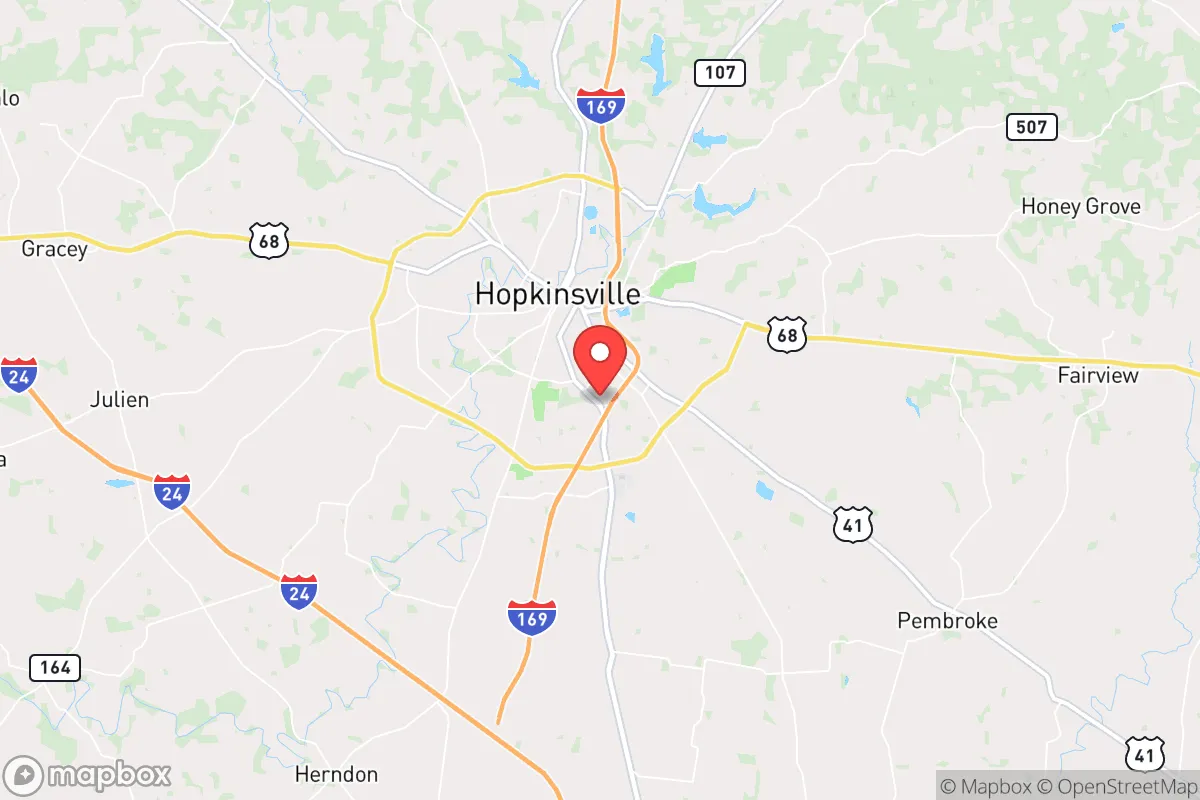
District shown is the primary district for this city’s centroid. Cities may span multiple districts.
Local Political AnalysisPolitical Analysis of Hopkinsville, KY
Hopkinsville is about as solidly conservative as they come in Kentucky, with a Cook PVI of R+23 that tells you pretty much everything you need to know about the local voting patterns. This isn't a place that's suddenly flipped or drifted—it's been reliably red for as long as anyone can remember, and the trajectory is holding steady, maybe even hardening a bit as folks here get more wary of what they see coming out of Frankfort and Washington. The surrounding Christian County leans the same way, though you'll find a few more moderate pockets near the Fort Campbell area where military families bring in some outside perspectives. But overall, if you're looking for a place where the old-school values of personal responsibility and limited government still hold sway, this is it.
How it compares
Drive an hour east to Bowling Green, and you'll notice a slightly different vibe—more college-town energy from Western Kentucky University, a younger demographic, and a bit more tolerance for progressive ideas, though it's still conservative overall. Head north to Hopkinsville's neighbor, Oak Grove, and you'll find a similar conservative tilt but with a heavier military influence that can sometimes lean more libertarian on social issues. The real contrast is with Louisville or Lexington, which are blue islands in a red state—places where government overreach into personal freedoms, like mask mandates or business closures during the pandemic, were embraced. Here in Hopkinsville, that kind of top-down control was met with serious skepticism. People remember when the state tried to impose stricter gun laws or business regulations, and the local pushback was immediate and loud. The R+23 rating isn't just a number; it reflects a deep-seated belief that the government that governs least governs best.
What this means for residents
For someone moving here, the political climate means you can expect a community that values individual rights—especially the Second Amendment, which is taken very seriously—and a general distrust of any policy that smacks of overreach. Property taxes are low, zoning is minimal, and there's a strong "live and let live" attitude as long as you're not trying to impose a progressive agenda on everyone else. The local schools and county government tend to reflect these values, with school board meetings that get heated over curriculum content or library books, but in a way that most residents see as protecting their kids from outside influence. The downside? If you're hoping for rapid change on things like public transit or environmental regulations, you'll be frustrated. The pace here is slow, deliberate, and resistant to anything that feels like a federal mandate. But for those who value freedom from government intrusion, that's a feature, not a bug.
One cultural distinction worth noting: Hopkinsville has a strong military presence thanks to Fort Campbell, which brings in families from all over the countryhol. That tends to reinforce the conservative lean, since military personnel often prioritize national security and personal responsibility. But it also means you get a mix of folks who've seen how other places handle things—and many of them chose to stay here because they prefer the local approach. The long-term outlook? I'd expect Hopkinsville to stay the course, maybe even drift a little further right as younger generations here grow up watching the chaos in blue cities and decide they want no part of it. If you're looking for a place where your rights aren't up for debate, this is a safe bet.

State Political ClimatePolitical Climate in Kentucky
State Political AnalysisPolitical Environment in the State
Kentucky has been a reliably red state for decades, but it’s not the deep-red monolith outsiders often assume. The state leans Republican by about 15-20 points in presidential elections, with Donald Trump winning by 26 points in 2020 and by a similar margin in 2024. However, the political landscape is far more nuanced than that top-line number suggests. Over the last 20 years, the state has shifted rightward in presidential races, but local and state-level politics remain a fascinating mix of old-school Blue Dog Democrats, populist Republicans, and a growing conservative grassroots movement that’s increasingly skeptical of both parties. The real story is the urban-rural split, the rise of a new generation of liberty-minded legislators, and the cultural tug-of-war between the state’s historic Appalachian roots and its modern suburban growth.
Urban vs. rural divide
The political map of Kentucky is a textbook case of the urban-rural divide. Louisville (Jefferson County) and Lexington (Fayette County) are the two blue anchors, with Louisville voting about 60% Democratic and Lexington around 55%. These cities drive the state’s progressive energy, with Louisville’s mayor and city council pushing policies like sanctuary city rhetoric and local minimum wage hikes. But drive 20 minutes outside either city, and you’re in deep-red territory. Bowling Green, Owensboro, and Paducah are reliably conservative, while the eastern coalfields — places like Pikeville, Hazard, and Prestonsburg — have flipped from solidly Democratic to overwhelmingly Republican over the past decade. The real battleground is the suburban ring around Louisville, particularly Oldham County and Shelby County, which are among the fastest-growing and most conservative areas in the state. These suburbs are where the fight for Kentucky’s future is happening: they’re full of families fleeing Louisville’s crime and taxes, and they vote accordingly.
Policy environment
Kentucky’s policy environment has shifted dramatically toward conservative governance since 2016. The state now has a flat income tax rate of 4% (down from 6% in 2018), with a scheduled phase-down to zero by 2030 if revenue targets are met. There’s no state property tax on vehicles, and property taxes on real estate are among the lowest in the nation. The regulatory posture is business-friendly, with right-to-work laws and a tort reform system that caps non-economic damages. On education, the state passed a school choice bill in 2022 that created education opportunity accounts, though it was struck down by the state Supreme Court in 2023 — a major disappointment for conservatives. The legislature is currently working on a constitutional amendment to allow school choice, which will be on the ballot in 2026. Healthcare is a mixed bag: the state expanded Medicaid under the Affordable Care Act, but the legislature has pushed work requirements and privatization of the managed care system. Election laws have been tightened: voter ID is required, absentee voting is restricted, and the state purged inactive voters from rolls in 2024. Kentucky is one of the few states that still allows straight-ticket voting, which tends to benefit Republicans in rural areas.
Trajectory & freedom
On the freedom front, Kentucky is moving in a decidedly positive direction for conservatives, but it’s not without its frustrations. Gun rights are strong: Kentucky is a constitutional carry state (no permit needed to carry concealed), and the legislature passed a "Second Amendment Sanctuary" resolution in 2021. The state also has a strong Castle Doctrine and Stand Your Ground law. Parental rights have been a major focus: in 2022, the legislature passed a bill requiring schools to notify parents of any changes to a student’s health or well-being, effectively banning transgender policies without parental consent. The state also passed a ban on gender transition procedures for minors in 2023, overriding the governor’s veto. Medical autonomy is a mixed bag: the state has a strong conscience clause for healthcare workers, but it also has one of the highest rates of opioid prescriptions per capita, and the government has been aggressive in prosecuting doctors over pain management. Property rights are generally strong, but the state’s use of eminent domain for pipeline projects has been a flashpoint in rural areas. The biggest freedom concern is taxation: while the income tax is dropping, the state has one of the highest sales tax rates in the region at 6%, and local governments can add up to 2% more. Overall, Kentucky is trending more free, but the fight is far from over — especially on school choice and medical freedom.
Civil unrest & political movements
Kentucky has seen its share of political turbulence, but it’s been more about organized movements than widespread civil unrest. The 2020 protests in Louisville over the Breonna Taylor shooting were the most visible flashpoint, with weeks of demonstrations, property damage, and a heavy police response. That event galvanized both the progressive movement in Louisville and the conservative backlash across the state. The Kentucky State Police were deployed, and the legislature responded with a series of police reform bills that were largely seen as weak by both sides. On the right, the most organized movement is the Kentucky Freedom Coalition, which has been instrumental in pushing school choice, gun rights, and election integrity legislation. Immigration politics are relatively quiet — Kentucky is not a border state, and the immigrant population is small — but there have been local skirmishes over sanctuary policies in Louisville, which the state legislature has tried to preempt with a bill banning sanctuary cities. Election integrity remains a hot topic: the 2020 election saw widespread distrust in the state’s mail-in voting expansion, and the legislature has since rolled back those provisions. The most visible political movement right now is the fight over school choice, which has mobilized thousands of parents and activists on both sides.
Projection
Over the next 5-10 years, Kentucky is likely to become more conservative, but not uniformly so. The in-migration pattern is key: people are moving to Kentucky from blue states like Illinois, California, and New York, but they’re not moving to Louisville or Lexington. They’re moving to the conservative suburbs of Oldham County, Shelby County, and Warren County (Bowling Green), as well as the Lake Cumberland region and the Lexington exurbs. These newcomers tend to be more conservative than the average Kentuckian, often citing taxes, crime, and school choice as their reasons for moving. The urban centers will continue to drift left, but their political power is diluted by the state’s rural-heavy legislative map. The biggest wildcard is the state Supreme Court, which has been a check on the legislature’s more aggressive conservative moves. If the court flips to a more originalist majority in the next few years, expect a wave of school choice, abortion restrictions, and tax cuts. Someone moving to Kentucky now should expect a state that is increasingly red, increasingly suburban, and increasingly focused on individual liberty — but with a persistent blue urban core that will keep the culture war alive.
For a new resident, the bottom line is this: Kentucky offers a strong conservative policy environment with low taxes, strong gun rights, and a growing school choice movement, but it’s not a libertarian paradise. The state government is still heavily involved in healthcare, education, and local land use, and the urban-rural divide means you’ll see very different political realities depending on where you live. If you’re looking for a place where your values are reflected in state law and your neighbors share your worldview, the suburbs of Louisville, Lexington, and Bowling Green are your best bet. Just be prepared for the occasional frustration with the state’s entrenched bureaucracy and the ongoing fight to keep the progressive tide from washing over the Bluegrass.
* Values derived from national, state, county, city and local statistics and may differ in a specific area. Last updated: 2026-04-21T09:53:58.000Z
Narrative content on this page is AI-generated and may contain mistakes. Verify any details that matter before acting on them.
ReloMaps may earn a commission from affiliate links at no extra cost to you.

