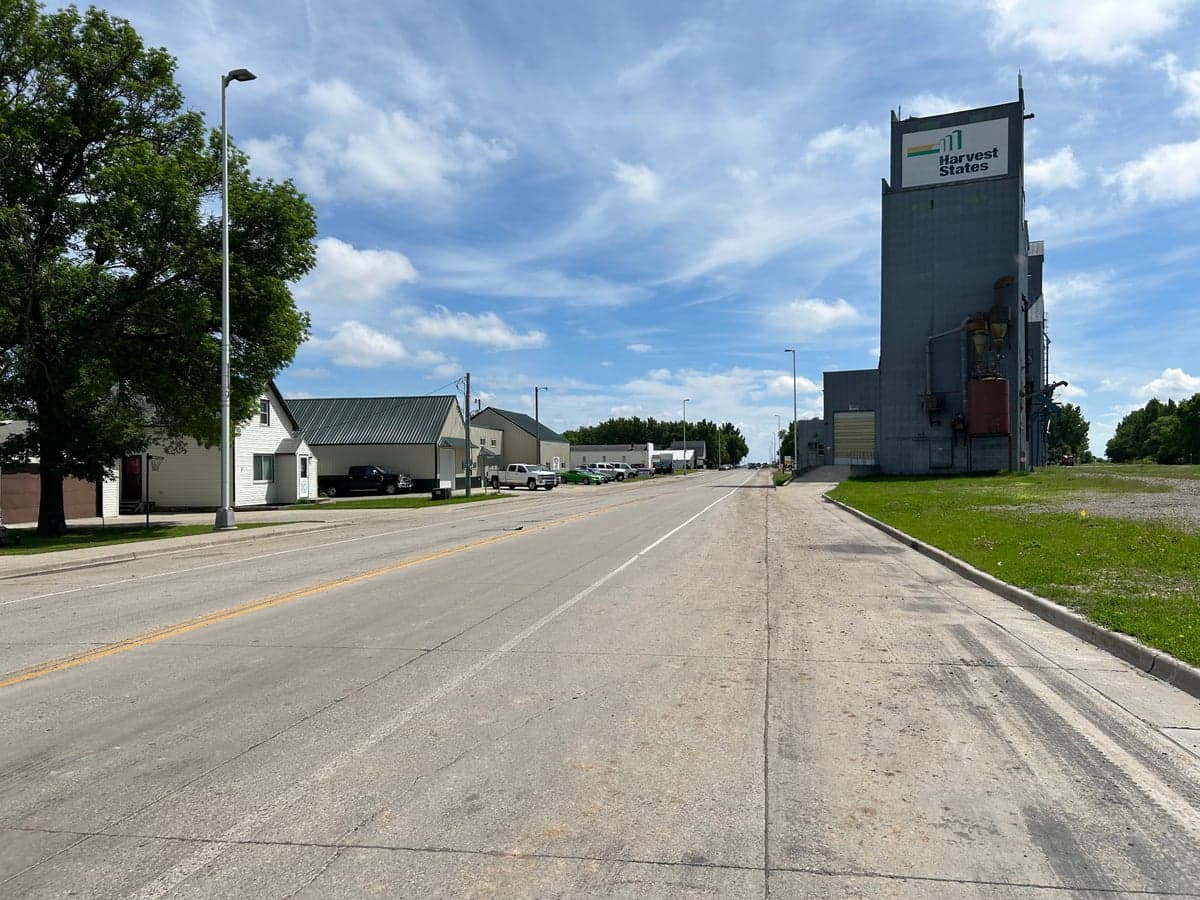
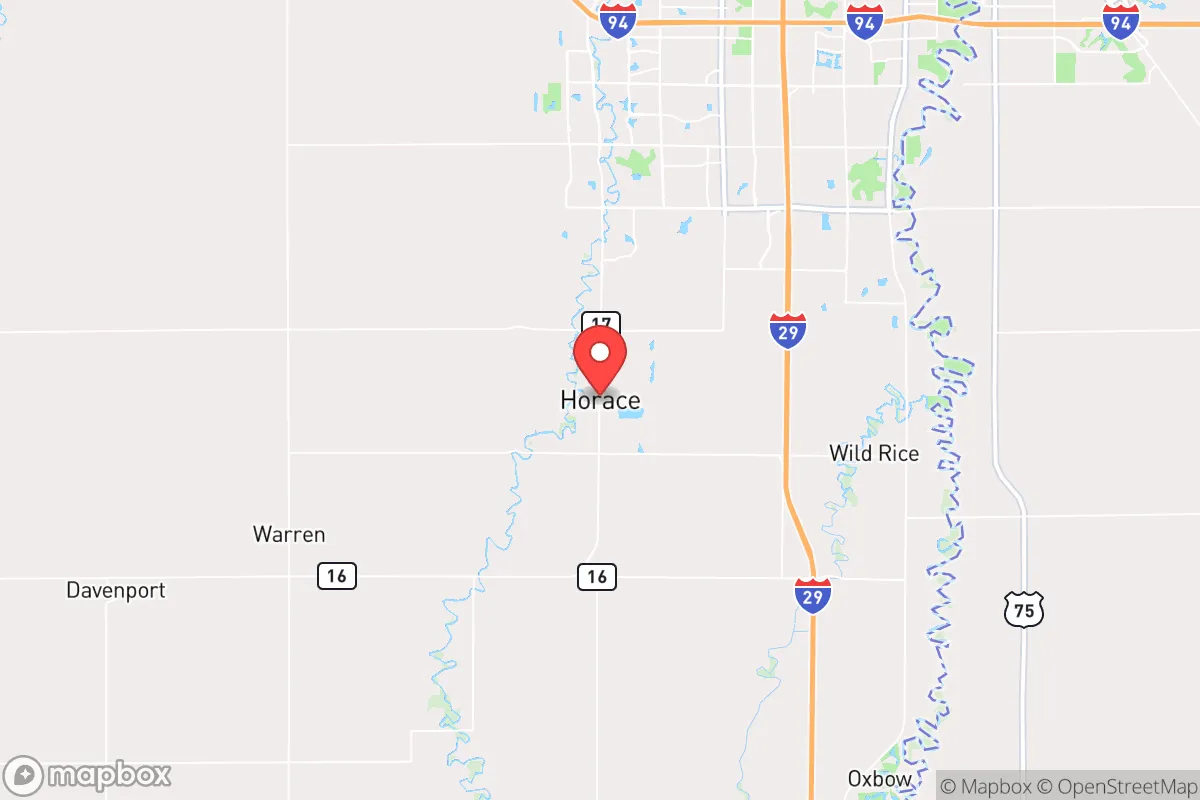
Photo: Wikipedia
Strategic Assessment of Horace, ND
Workable tactical position. Some exposure to population density or targets, but generally defensible in a crisis.
What does the Strategic Assessment tell us?
Our Strategic Assessment grades tactical survivability of an area. Major population centers, military targets, fallout zones, natural disasters, and border exposure all drive risk — lower exposure means a more defensible position in a crisis.
This is heavily inspired by Joel Skousen's Strategic Relocation book. Highly recommended you checkout the book ($)What does this tell us?
Our Strategic Assessment grades tactical survivability of an area. Major population centers, military targets, fallout zones, natural disasters, and border exposure all drive risk — lower exposure means a more defensible position in a crisis.
This is heavily inspired by Joel Skousen's Strategic Relocation book. Highly recommended you checkout the book ($)Strategic Pillars

Key Distances
Regional Safe Places
Below is our recommended "safe zones" in North Dakota and the surrounding area based on our strategic heuristics. For most people, it's unrealistic to live in a “safe zone” full-time due to work, family or other personal reasons. They tend to be more rural. However, many of these areas are perfect for second homes and retreat properties that double as a vacation home or even a short-term rental.
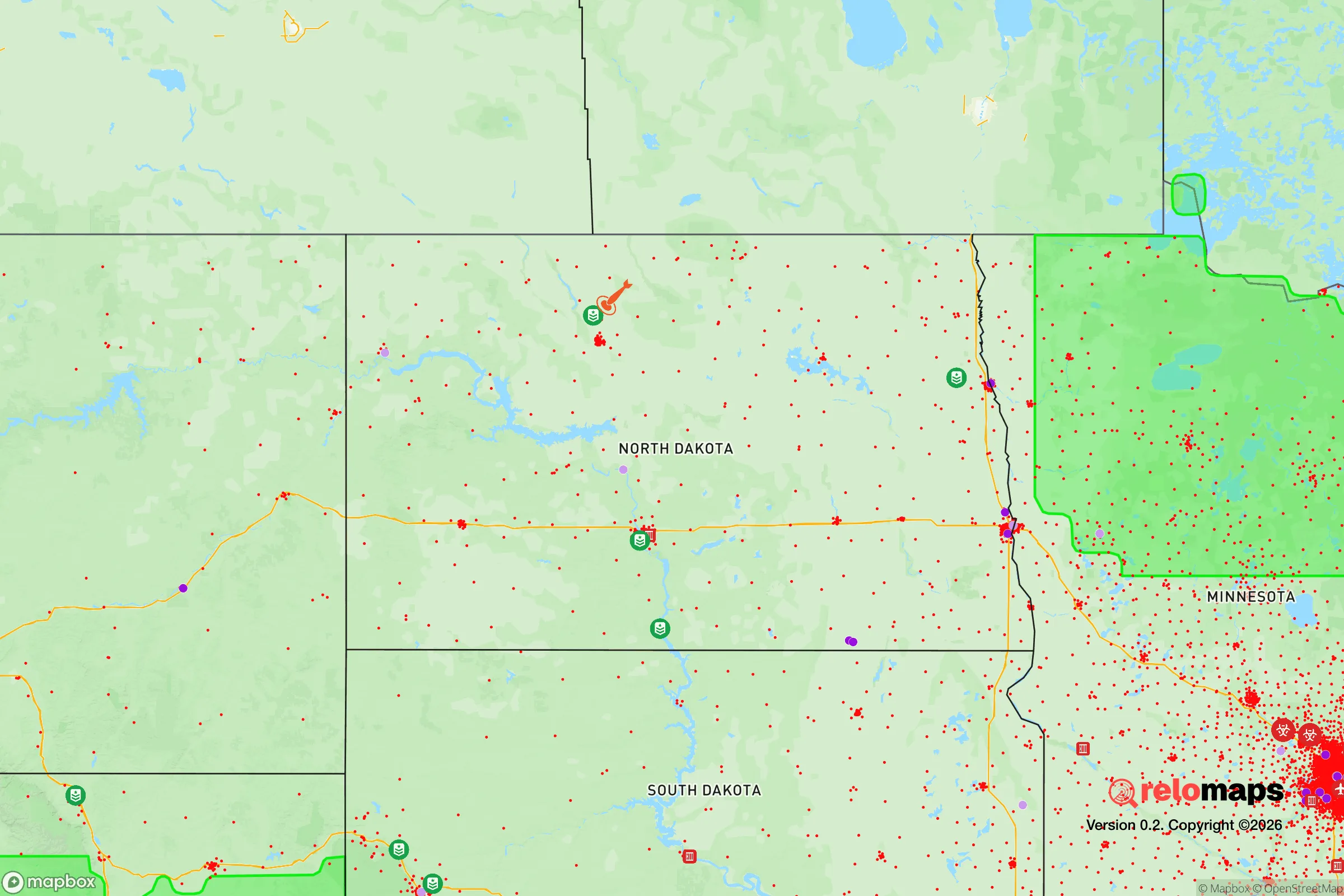
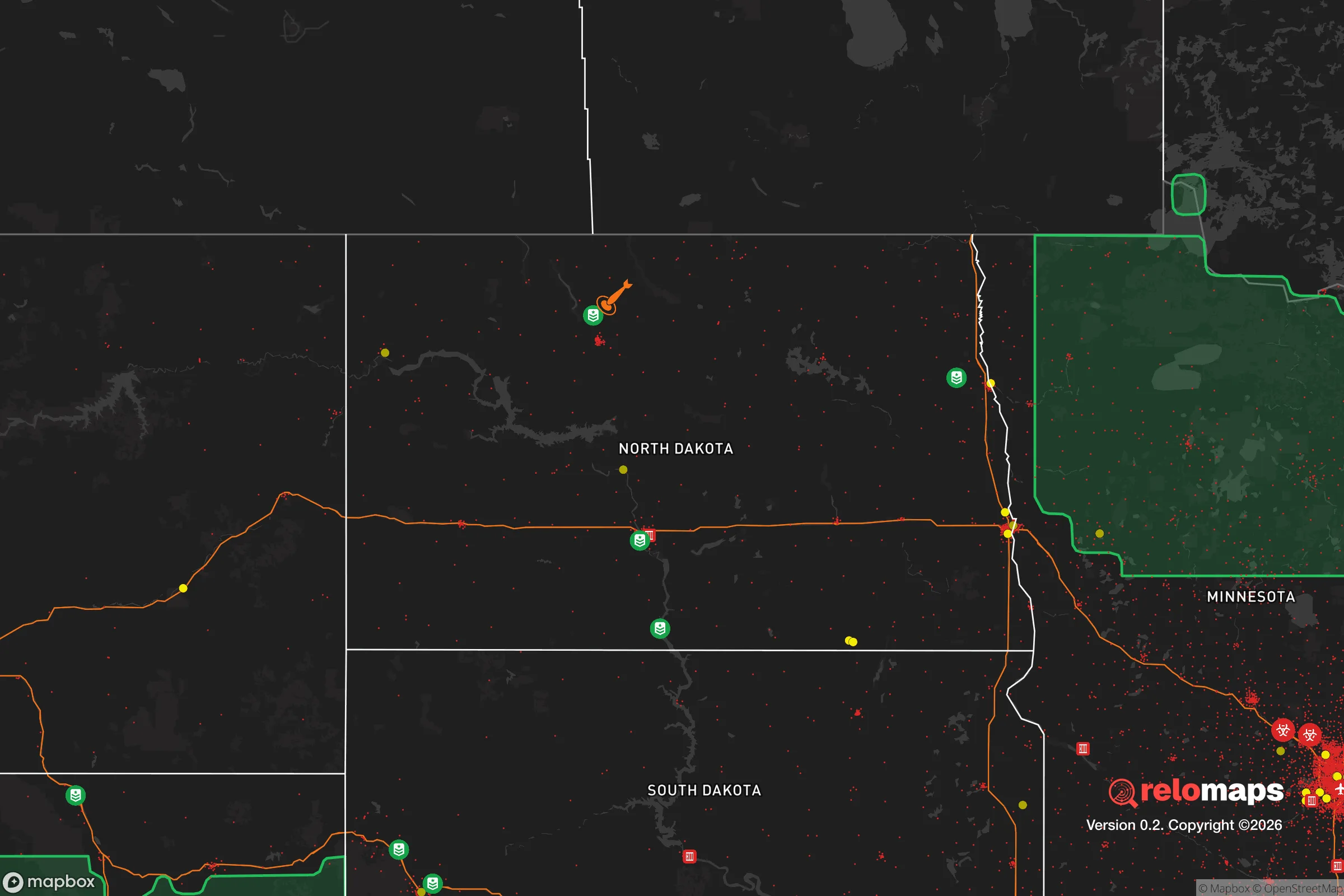


Important Note: For informational purposes only. This does not mean nothing bad ever happens in the green zones. Please use common sense. This is based on public data and modeled with AI. We tried to take a conservative approach but mistakes happen. We update this regularly as new information becomes available.
Solar Generator Recommendations
Backup power matters more here than in safer locations. We've picked three solar generators across budgets and capacity tiers — start with the budget unit if you only need a few essentials, or step up if you want to run a fridge and HVAC for days at a time.

Jackery Portable Power Station Explorer 300
Budget OptionPower on the Go: Weighing only 11 lbs, it's convenient to set up and store with book-sized foldable solar panels

BLUETTI Portable Power Station AC180
Designed for both indoor and outdoor scenarios, AC180 is highly capable as it has a robost capacity and continuous output power.

EF ECOFLOW DELTA Pro Ultra Power Station
Upgraded PickEcoFlow DELTA Pro Ultra is a whole-home energy system designed to grow with your family. Integrated with the Smart Home Panel 2, it scales to meet your evolving energy needs — keeping your home powered, intelligent, and secure through every stage of life.
We earn a commission, at no additional cost to you.
Strategic Assessment Analysis
Horace, North Dakota, sits in a sweet spot that few relocation analysts fully appreciate: close enough to Fargo’s infrastructure to be practical, yet far enough to dodge the worst of urban collapse scenarios. With a population hovering around 3,000 and growing steadily, this Cass County community offers a rare combination of agricultural self-sufficiency, low crime, and geographic insulation from the kind of cascading failures that plague larger metros. For a conservative-minded prepper or survivalist, Horace isn’t just a bedroom suburb—it’s a strategic foothold in the northern plains, where the Red River Valley’s fertile soil and the region’s sparse population density create a buffer against both civil unrest and supply chain disruptions.
Geographic position and natural advantages for long-term security
Horace’s location at the intersection of Interstate 94 and the Sheyenne River gives it a dual advantage: rapid evacuation routes and a reliable freshwater source. The town sits roughly 10 miles south of Fargo’s urban core, which means you can access medical facilities, hardware stores, and bulk suppliers in under 20 minutes, but you’re not living in the blast radius of a major metropolitan target. The surrounding Cass County is flat, open farmland—ideal for line-of-sight security and agricultural production. The Red River Valley’s rich topsoil, among the best in the nation, means that even a modest homestead can produce substantial food yields. Winters are brutal, with average January lows around -2°F, but that cold acts as a natural deterrent to transient populations and limits the viability of long-term grid-down scenarios for unprepared outsiders. The area’s low elevation (around 900 feet) and lack of major geological fault lines mean you’re not worrying about earthquakes or tsunamis—your primary natural threats are blizzards and the occasional spring flood, both of which are predictable and manageable with proper planning.
Risks, exposures, and proximity to fallout-relevant landmarks
No location is without vulnerabilities, and Horace’s primary risk stems from its proximity to Fargo, which sits roughly 40 miles north of the town center. Fargo is a regional transportation hub with an international airport, major rail lines, and a population of 130,000—making it a plausible target for both conventional and asymmetric threats. In a mass casualty event or grid-down scenario, you’d see a surge of refugees heading south along I-29, and Horace lies directly in that path. The town itself has no major military installations, chemical plants, or nuclear facilities within 50 miles, which is a net positive—but the nearby Hector International Airport could be a secondary target in a broader conflict. The Red River’s floodplain also presents a seasonal risk: major floods in 1997, 2009, and 2011 inundated large swaths of Cass County, and while Horace sits on slightly higher ground than downtown Fargo, any prolonged power outage during a flood event would complicate evacuation and supply runs. On the plus side, the region’s low population density (about 50 people per square mile in Cass County) means that fallout from a distant event would dissipate quickly, and the prevailing westerly winds would carry any airborne contaminants away from the area in most scenarios.
Practical resilience for a relocator: food, water, energy, and defensibility
For a single individual or family looking to hunker down, Horace offers a surprisingly robust baseline for self-sufficiency. The town’s water supply comes from the Sheyenne River and local aquifers, and most homes in the area have private wells—a critical advantage over municipal systems that fail during grid outages. The surrounding farmland supports cattle, corn, soybeans, and wheat, and the Fargo-Moorhead area has a thriving network of local butchers, grain mills, and farmers’ markets that would remain operational in all but the worst scenarios. Energy-wise, North Dakota is the nation’s second-largest oil producer, and while Horace itself isn’t on the Bakken shale, the state’s energy infrastructure means that natural gas and propane are readily available and relatively cheap. Solar panels are viable here—the region gets about 200 sunny days per year—but you’ll need battery storage to handle the long winter nights. Defensibility is where Horace really shines: the town’s layout is compact, with a grid of residential streets that can be easily barricaded, and the surrounding flat terrain offers clear sightlines for miles. Most homes sit on lots of a quarter-acre or more, giving you room for a garden, a chicken coop, and a rainwater catchment system without drawing attention. The local law enforcement presence is minimal—Cass County has about 60 deputies for the entire county—but the community is tight-knit, and neighbors tend to look out for each other in ways you don’t see in suburban sprawl. Property crime rates in Horace are negligible, with fewer than 10 reported incidents per year, which speaks to both the low population and the cultural norms of the area.
Overall strategic picture: why Horace works for the prepared relocator
Horace isn’t a bug-out location for the lone wolf—it’s a long-term sustainment community for people who want to ride out the storm without going completely off-grid. The town’s growth has been steady but controlled, with new developments catering to families and retirees rather than transient renters, which keeps the demographic stable and the social fabric intact. You’re close enough to Fargo to maintain a job, access healthcare, and stockpile supplies, but far enough that you won’t be caught in the initial wave of urban chaos. The biggest trade-off is the climate: winter survival skills are non-negotiable here, and anyone who underestimates a North Dakota blizzard won’t last a season. But for a conservative-minded individual or family who values self-reliance, low taxes, and a community that still waves at strangers, Horace offers a strategic depth that most relocation guides overlook. The land is affordable—average home prices are around $350,000, well below national medians—and the regulatory environment is light, with no zoning restrictions on backyard gardens, livestock, or alternative energy systems. If you’re looking for a place to plant roots, build a resilient homestead, and wait out the turbulence, Horace deserves a serious look. Just bring a good parka and a plan for the flood season.

* Values derived from national, state, county, city and local statistics and may differ in a specific area. Last updated: 2026-04-19T05:14:30.000Z
Narrative content on this page is AI-generated and may contain mistakes. Verify any details that matter before acting on them.
ReloMaps may earn a commission from affiliate links at no extra cost to you.

