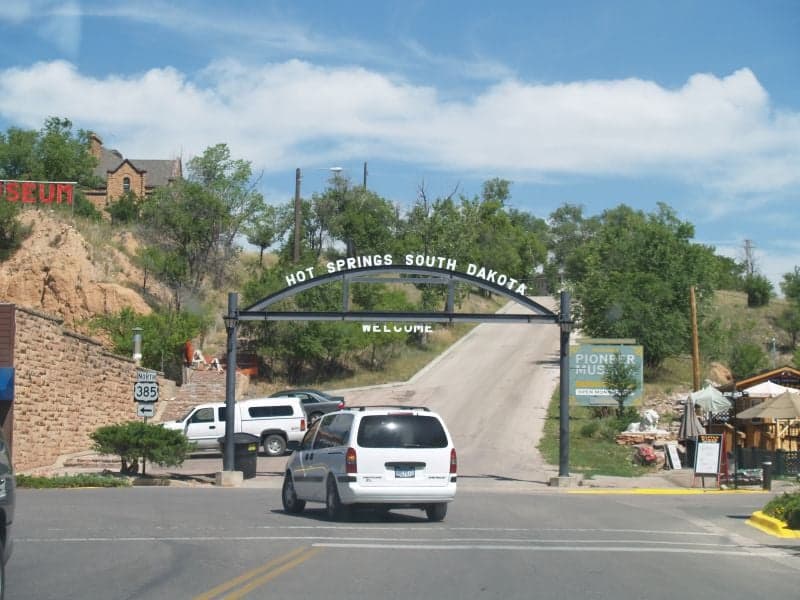
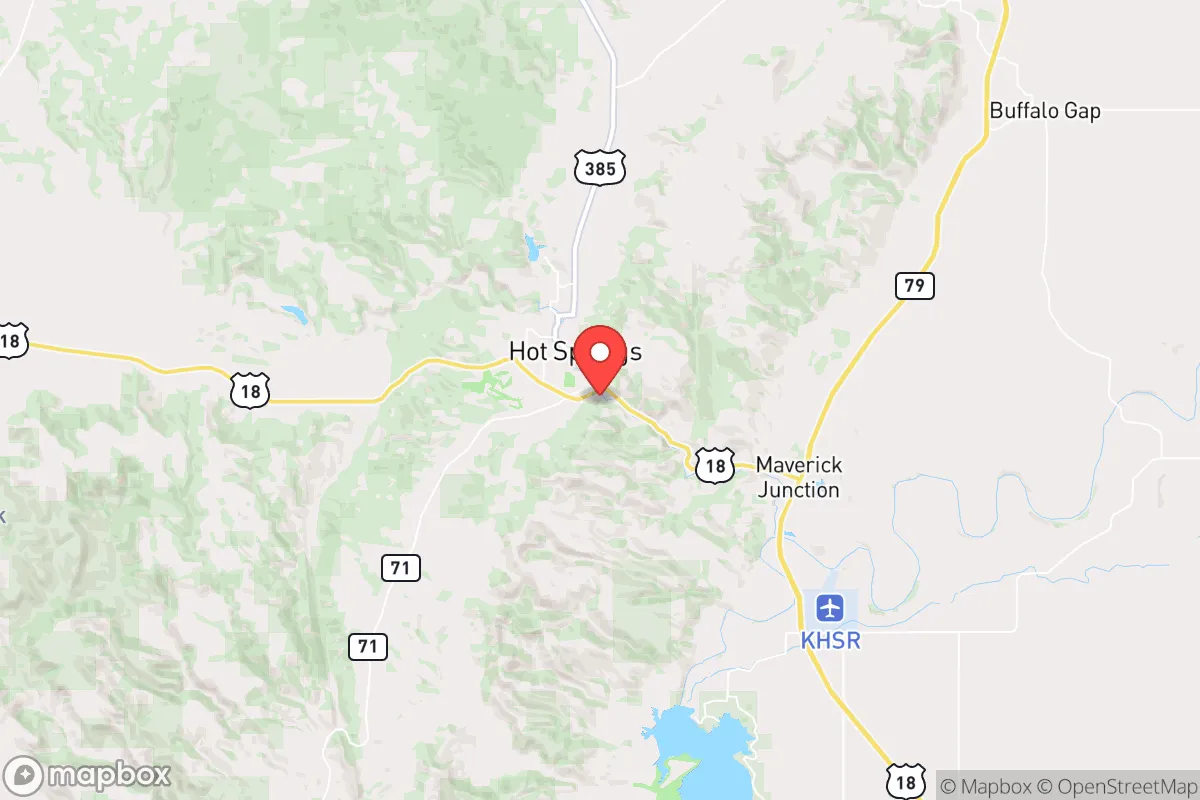
Photo: Wikipedia
Demographics of Hot Springs, SD
Affluence Level in Hot Springs, SD
A middle-class area roughly in line with national averages across income, home values, education, and employment.
People of Hot Springs, SD
The people of Hot Springs, South Dakota, today number 3,506, forming a small, predominantly white community with a distinctive character shaped by its history as a health and wellness destination. The population is notably older and less diverse than the national average, with 81.3% identifying as white alone, a foreign-born share of just 1.6%, and a college education rate of 18.2%. This is a place where a strong sense of local heritage and a slower pace of life define daily existence, with residents often connected by generations of family history in the southern Black Hills.
How the city was settled and grew
Hot Springs was officially founded in 1886, not by homesteaders but by speculators and health-seekers drawn to the area's 87 natural warm springs, which were believed to have therapeutic properties. The city's early growth was fueled by the arrival of the Chicago, Burlington and Quincy Railroad in 1890, which brought tourists and patients to the newly built bathhouses and sanatoriums. The original population was overwhelmingly of Northern European descent—German, Irish, and English settlers—who built the first homes in the Historic District around the springs and along Minnekahta Avenue. A second wave arrived in the early 1900s as the Battle Mountain Sanitarium (now the VA Black Hills Health Care System) opened, drawing Civil War veterans and later, veterans of World War I and II, many of whom settled in the South Hot Springs neighborhood near the facility. The city's population peaked at around 4,000 in the 1930s, driven by the sanitarium's expansion and the local timber and sandstone quarrying industries.
Modern era (post-1965)
After the 1965 Immigration and Nationality Act, Hot Springs saw almost no influx of new immigrant groups, a pattern that continues today. The foreign-born population remains at just 1.6%, with the largest share being East/Southeast Asian (0.9%) and Indian subcontinent (0.1%) residents, likely professionals associated with the VA hospital or regional healthcare. The city's white population share has remained stable at over 80% since the 1970s, as domestic in-migration has been minimal and mostly limited to retirees and healthcare workers. The Northside neighborhood, developed in the 1960s and 1970s, absorbed most of the new single-family home construction, while the West Side along the Fall River saw infill of smaller homes. The Hispanic population is just 1.2%, and the Black population is recorded at 0.0%, reflecting the city's lack of economic diversification beyond healthcare and tourism. The college education rate of 18.2% is well below the national average of roughly 34%, indicating a workforce concentrated in service, healthcare support, and manual trades.
The future
Demographic projections for Hot Springs point toward continued homogeneity and gradual population decline, mirroring trends across rural South Dakota. The city's population has fallen from a post-war high of 4,300 in 1960 to 3,506 today, and the median age is likely rising as younger residents leave for larger job markets. The foreign-born population is not expected to grow significantly, as the city lacks the industrial or agricultural employment that attracts immigrants to other parts of the state. The Evans Addition and Hillcrest neighborhoods, developed in the 1990s and 2000s, have seen only modest new construction, mostly for retirees. The next 10-20 years will likely see the city become even more of a retirement and healthcare hub, with the VA hospital remaining the anchor employer. There is no evidence of tribalization into distinct ethnic enclaves; instead, the population is homogenizing around an older, white, native-born core.
For someone moving to Hot Springs today, the city offers a stable, low-crime environment with a strong sense of community, but it is not a place of demographic change or diversity. The population is aging, shrinking slightly, and deeply rooted in local history, making it best suited for those seeking a quiet, predictable lifestyle in a small-town setting. New residents will find a welcoming but insular community where connections are built slowly, and where the past—from the warm springs to the veterans' hospital—still shapes daily life.

* Values derived from national, state, county, city and local statistics and may differ in a specific area. Last updated: 2026-04-23T10:33:01.000Z
Narrative content on this page is AI-generated and may contain mistakes. Verify any details that matter before acting on them.
ReloMaps may earn a commission from affiliate links at no extra cost to you.

