
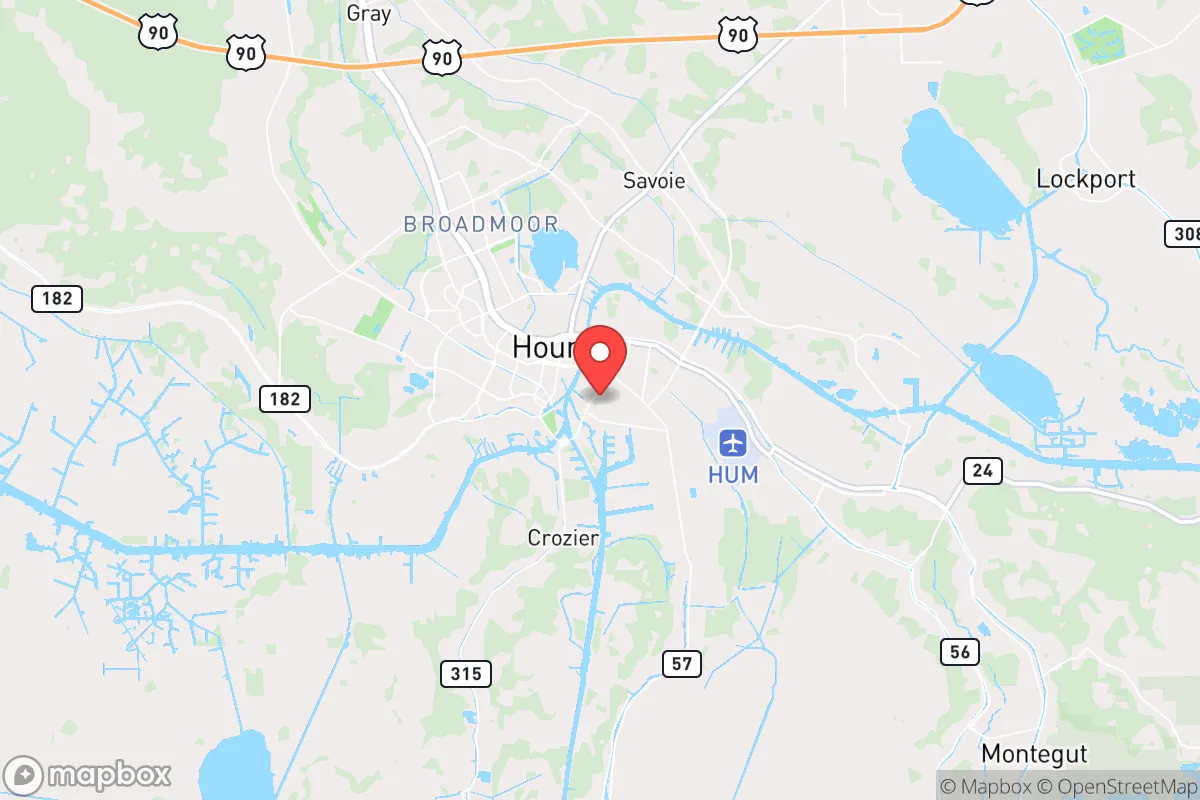
Photo by Joshua J. Cotten on Unsplash
Strategic Assessment of Houma, LA
Meaningful friction. Expect exposure to either population pressure, blast zones, or natural disaster risk. Consider buying a retreat property.
What does the Strategic Assessment tell us?
Our Strategic Assessment grades tactical survivability of an area. Major population centers, military targets, fallout zones, natural disasters, and border exposure all drive risk — lower exposure means a more defensible position in a crisis.
This is heavily inspired by Joel Skousen's Strategic Relocation book. Highly recommended you checkout the book ($)What does this tell us?
Our Strategic Assessment grades tactical survivability of an area. Major population centers, military targets, fallout zones, natural disasters, and border exposure all drive risk — lower exposure means a more defensible position in a crisis.
This is heavily inspired by Joel Skousen's Strategic Relocation book. Highly recommended you checkout the book ($)Strategic Pillars

Key Distances
Regional Safe Places
Below is our recommended "safe zones" in Louisiana and the surrounding area based on our strategic heuristics. For most people, it's unrealistic to live in a “safe zone” full-time due to work, family or other personal reasons. They tend to be more rural. However, many of these areas are perfect for second homes and retreat properties that double as a vacation home or even a short-term rental.

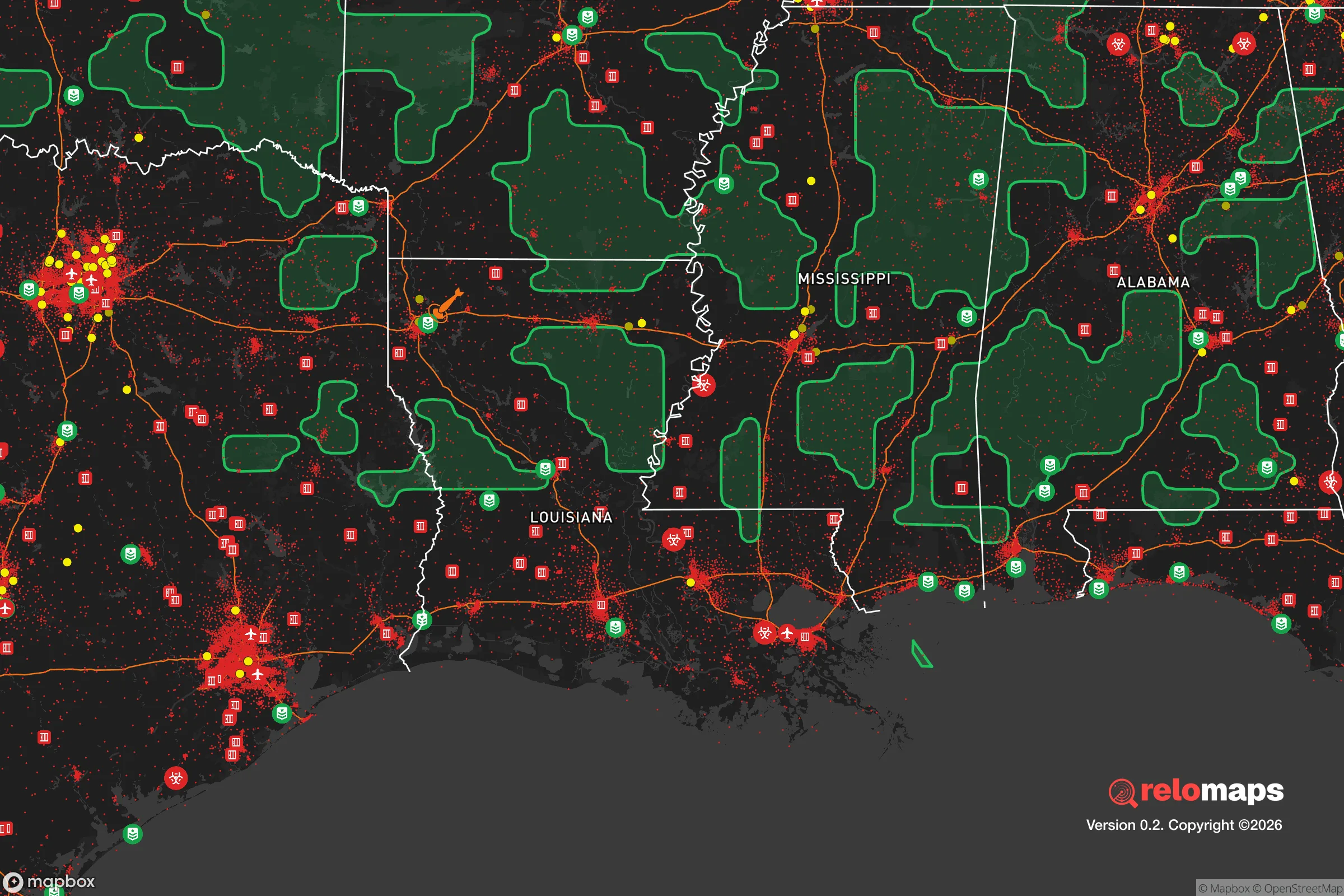


Important Note: For informational purposes only. This does not mean nothing bad ever happens in the green zones. Please use common sense. This is based on public data and modeled with AI. We tried to take a conservative approach but mistakes happen. We update this regularly as new information becomes available.
Solar Generator Recommendations
Backup power matters more here than in safer locations. We've picked three solar generators across budgets and capacity tiers — start with the budget unit if you only need a few essentials, or step up if you want to run a fridge and HVAC for days at a time.

Jackery Portable Power Station Explorer 300
Budget OptionPower on the Go: Weighing only 11 lbs, it's convenient to set up and store with book-sized foldable solar panels

BLUETTI Portable Power Station AC180
Designed for both indoor and outdoor scenarios, AC180 is highly capable as it has a robost capacity and continuous output power.

EF ECOFLOW DELTA Pro Ultra Power Station
Upgraded PickEcoFlow DELTA Pro Ultra is a whole-home energy system designed to grow with your family. Integrated with the Smart Home Panel 2, it scales to meet your evolving energy needs — keeping your home powered, intelligent, and secure through every stage of life.
We earn a commission, at no additional cost to you.
Strategic Assessment Analysis
Houma, Louisiana, offers a strategic paradox for the conservative prepper: it sits in a hurricane-prone delta, yet its geographic isolation from major population centers and its deep-rooted, self-sufficient Cajun culture make it a surprisingly resilient fallback position. The city’s location roughly 50 miles southwest of New Orleans and 60 miles south of Baton Rouge places it outside the immediate blast radius of those major targets, while its network of bayous and swamps provides a natural barrier against both casual foot traffic and large-scale civil unrest. For the relocator thinking in terms of long-term sustainability and avoiding the fallout of a collapsing urban core, Houma presents a mixed bag of genuine advantages and serious, non-negotiable risks.
Geographic isolation and natural defensive advantages
Houma’s primary strategic asset is its position within the Terrebonne Parish bayou country, a region defined by water. The city is not on a major interstate; access is primarily via US-90 and a handful of two-lane state highways that cross numerous bridges and causeways. In a scenario where civil unrest or a mass casualty event triggers a mass exodus from New Orleans or Baton Rouge, these chokepoints become highly defensible. A single disabled vehicle or a small group can effectively block the main routes into town. The surrounding marsh and swamp are impassable to vehicles and difficult for anyone without local knowledge to navigate on foot. This natural moat means Houma is not a destination for panicked urbanites fleeing on foot—they simply cannot get here easily. For the prepper, this drastically reduces the risk of encountering large, desperate crowds. The local population is also heavily involved in the maritime and oilfield industries, meaning a high percentage of residents own boats, have mechanical skills, and are accustomed to operating in austere, self-reliant conditions. This is not a bedroom community of white-collar commuters; it is a working-class town where practical knowledge is the norm.
Risk exposure, hurricane threats, and proximity to fallout-relevant targets
The elephant in the room is hurricane risk. Houma is extremely vulnerable to storm surge and catastrophic wind events. Hurricane Ida (2021) caused widespread, long-term power outages and structural damage across the region. Any strategic assessment must acknowledge that a major hurricane is not a question of if, but when. This risk is partially mitigated by the fact that the local population is hardened to it—most homes have generators, and the community has a well-practiced evacuation plan. However, for a relocator, this means you must build or buy a home that is elevated, storm-rated, and equipped with its own power and water systems. On the plus side, the area is far from any major military or government command centers that would be primary nuclear targets. The nearest strategic target is the Mississippi River chemical corridor between Baton Rouge and New Orleans, but prevailing winds would carry fallout east or northeast, away from Houma. The city’s proximity to the Gulf of Mexico also means it is far from any inland nuclear power plants or major dam failures. The primary threat is natural, not man-made, which is a trade-off many preppers accept.
Practical resilience: food, water, energy, and defensibility for a relocator
For the individual or family looking to be self-sufficient, Houma offers strong fundamentals. Water is abundant—the area sits on a massive aquifer, and the bayous provide a surface water source that, with proper filtration (reverse osmosis or distillation), can be made potable. The high water table means shallow wells are viable in many areas. Food security is excellent by modern American standards. The local culture is built around hunting, fishing, and trapping. Venison, duck, wild hog, and seafood (shrimp, crab, redfish, speckled trout) are available year-round to anyone with a basic fishing rod or a shotgun. The growing season is long (March through November), and the soil in raised beds is fertile. There are also numerous small farms and roadside stands selling produce, eggs, and meat, creating a local food network that bypasses the industrial supply chain. Energy resilience is a challenge but manageable. The grid is unreliable during storms, so a whole-house propane or diesel generator with a 500-gallon fuel tank is a necessity, not a luxury. Solar is possible but less effective due to frequent cloud cover from the Gulf. Defensibility is high for a small group. The aforementioned chokepoints on the roads, combined with the fact that most properties back up to a bayou or canal, mean you can control access to your immediate area. The local sheriff’s office is also well-funded from oil and gas tax revenue and maintains a visible presence, which is a deterrent to opportunistic crime during normal times. During a breakdown, the community tends to band together rather than turn on itself—a cultural trait that cannot be overstated.
The overall strategic picture for Houma is that of a high-risk, high-reward fallback location. It is not a place for the prepper who wants to sit out a hurricane in comfort, nor is it a place for someone who cannot handle humidity, mosquitoes, and the constant threat of flooding. But for the relocator who is serious about long-term sustainability, who values a community of self-reliant, gun-friendly, and neighborly people, and who wants to be far enough from the major target cities to avoid the initial chaos, Houma deserves a hard look. The key is to buy elevated, invest in serious storm hardening, and build relationships with locals before the balloon goes up. If you do that, you will be in one of the few places in the Lower 48 where you can realistically feed your family from the water and the woods while being effectively insulated from the collapse of the urban corridors. The trade-off is that you will be living in a swamp, and Mother Nature will test you every single year. If that is a price you are willing to pay, Houma is a viable strategic option.

* Values derived from national, state, county, city and local statistics and may differ in a specific area. Last updated: 2026-05-01T09:22:37.000Z
Narrative content on this page is AI-generated and may contain mistakes. Verify any details that matter before acting on them.
ReloMaps may earn a commission from affiliate links at no extra cost to you.

