Demographics of Hurricane, WV
Affluence Level in Hurricane, WV
A middle-class area roughly in line with national averages across income, home values, education, and employment.
People of Hurricane, WV
The people of Hurricane, West Virginia, today form a predominantly white, native-born community of roughly 6,900 residents, characterized by a strong sense of local identity and a family-oriented lifestyle. With a foreign-born population of just 0.5% and a 94.7% white demographic, the city is notably homogenous, even by regional standards. Distinctive markers include a high rate of homeownership, a median age slightly above the national average, and a population that values proximity to both the Ohio River Valley's industrial heritage and the outdoor recreation of the Appalachian foothills. This is a community where generational roots run deep, and newcomers are often drawn by the promise of safe neighborhoods, good schools, and a slower pace of life.
How the city was settled and grew
Hurricane's settlement history is tied to the early 19th-century expansion of European-descended settlers into the Kanawha Valley. The area was originally part of a land grant to Revolutionary War veterans, and the first permanent settlers arrived around 1800, drawn by fertile bottomlands along the Kanawha River and the potential for salt production. The city's name itself derives from a local legend about a violent storm that cleared the land, a story that reflects the frontier character of its founding. The arrival of the Chesapeake and Ohio Railway in the late 1800s spurred the first significant growth, transforming Hurricane from a rural crossroads into a small commercial hub. The historic Main Street district and the area around Olde Town were the original centers of settlement, where merchants, railroad workers, and farmers built the town's early homes and businesses. The population remained overwhelmingly of British Isles and German ancestry through the early 20th century, with little in-migration from other groups.
Modern era (post-1965)
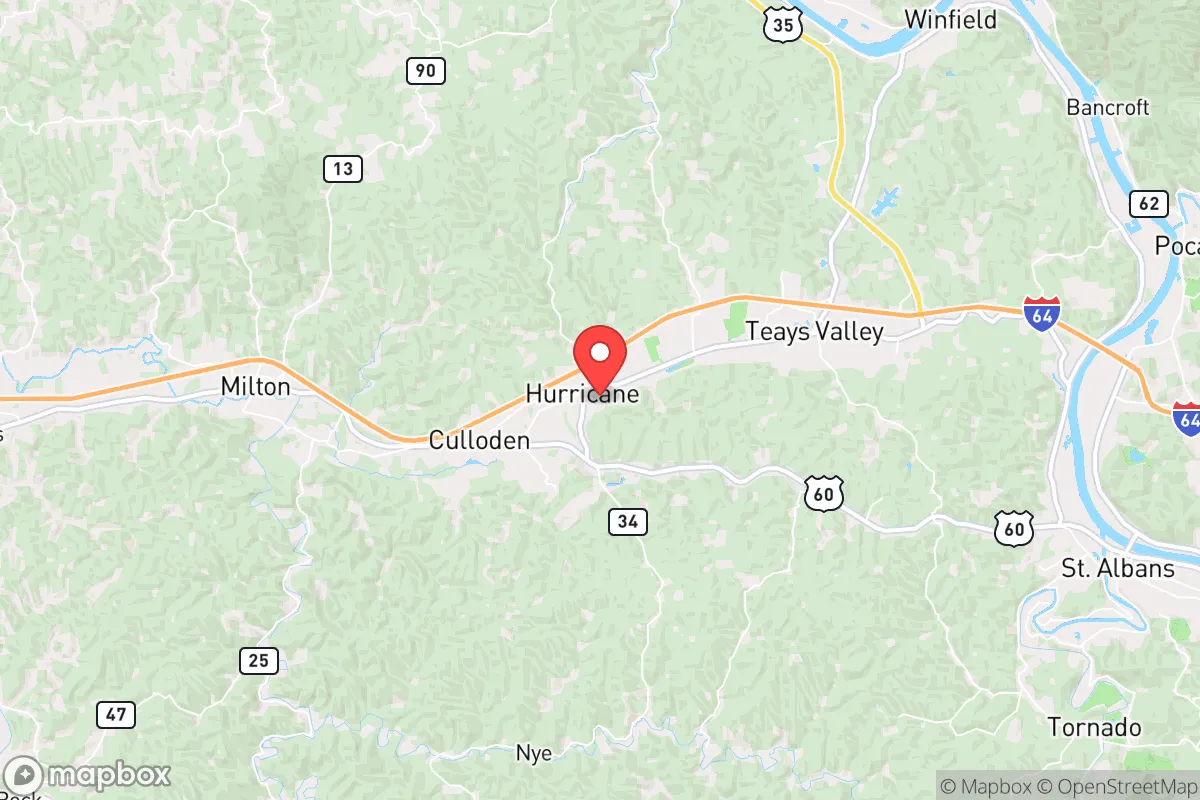
The post-1965 era in Hurricane is defined not by international immigration, but by domestic suburbanization and the expansion of the greater Charleston metropolitan area. The completion of Interstate 64 in the 1970s was the single most transformative event, making Hurricane a viable bedroom community for commuters to Charleston and Huntington. This triggered a wave of domestic in-migration, primarily from other parts of West Virginia and neighboring states, as families sought larger lots and newer homes. The Teays Valley area, which straddles the Putnam County line, became the primary destination for these new residents, developing into a sprawling suburban corridor of subdivisions and shopping centers. Within Hurricane proper, neighborhoods like Greenwood Village and Forest Hills were built during this period, attracting middle-class families with their affordable housing and access to the new interstate. The city's racial and ethnic composition remained remarkably stable during this boom; the 0.1% Black and 0.5% Hispanic populations reflect very limited diversification, even as the city's overall population more than doubled between 1970 and 2000. The small Indian (0.7%) and East/Southeast Asian (0.5%) communities are largely composed of professionals—engineers, doctors, and academics—who moved to the area for employment at nearby chemical plants or Marshall University, and they tend to reside in the newer subdivisions of Teays Valley rather than in Hurricane's older core.
The future
The demographic trajectory for Hurricane points toward continued homogeneity, with a slowly aging population and limited in-migration from outside the region. The city's foreign-born share is negligible and shows no signs of significant growth, as the local economy—anchored by healthcare, education, and retail—does not attract the large-scale immigration seen in coastal or Sun Belt metros. The Indian and East/Southeast Asian communities, while small, are likely to remain stable or grow modestly through professional recruitment, but they are not expected to alter the city's overall character. The most notable demographic shift is internal: a gradual movement of younger families from older neighborhoods like Olde Town into newer subdivisions in the Teays Valley corridor, leaving the historic core with an older, longer-established population. This is not a story of tribalization into distinct ethnic enclaves, but rather a slow generational turnover within a largely white, native-born population. The city's college-educated share of 31.9% is above the state average, suggesting that Hurricane will continue to attract and retain professionals who value its schools and safety over urban amenities.
For someone moving in now, Hurricane is becoming a stable, family-oriented suburb that prizes continuity over change. It is a place where the population is not diversifying rapidly, where new arrivals are most likely to be domestic transplants from within West Virginia or adjacent states, and where the strongest growth is in the suburban fringe rather than the historic town center. The bottom line: Hurricane offers a predictable, low-crime environment with a strong sense of community, but those seeking significant ethnic or cultural diversity will not find it here.

* Values derived from national, state, county, city and local statistics and may differ in a specific area. Last updated: 2026-04-23T05:41:14.000Z
Narrative content on this page is AI-generated and may contain mistakes. Verify any details that matter before acting on them.
ReloMaps may earn a commission from affiliate links at no extra cost to you.

