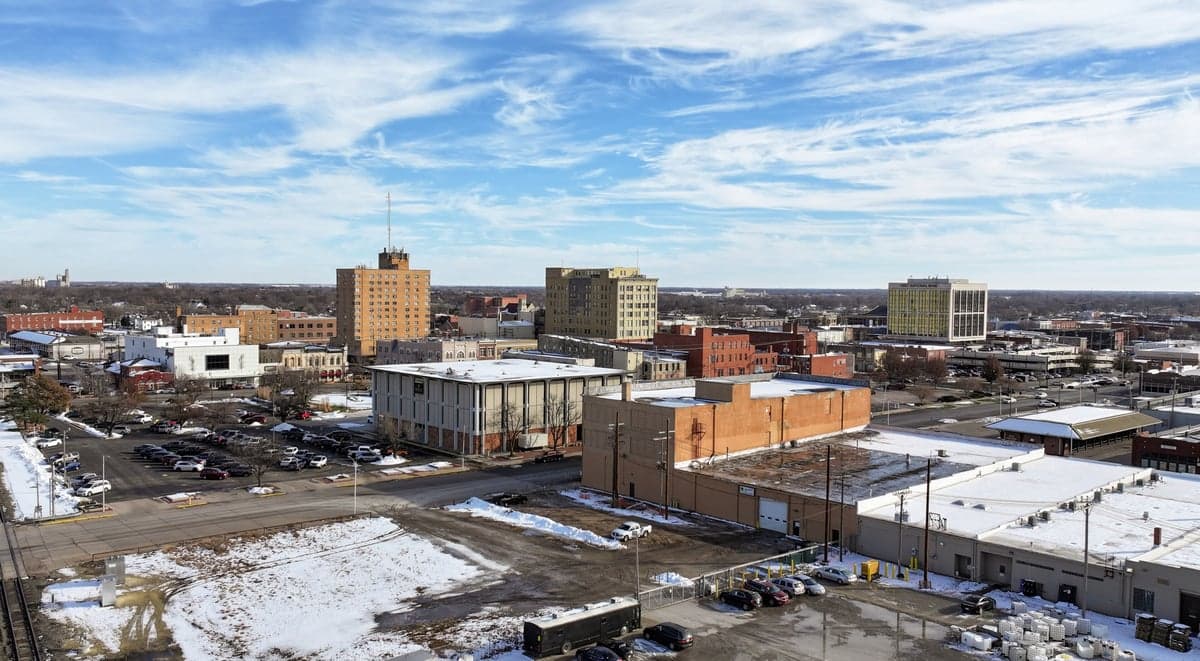
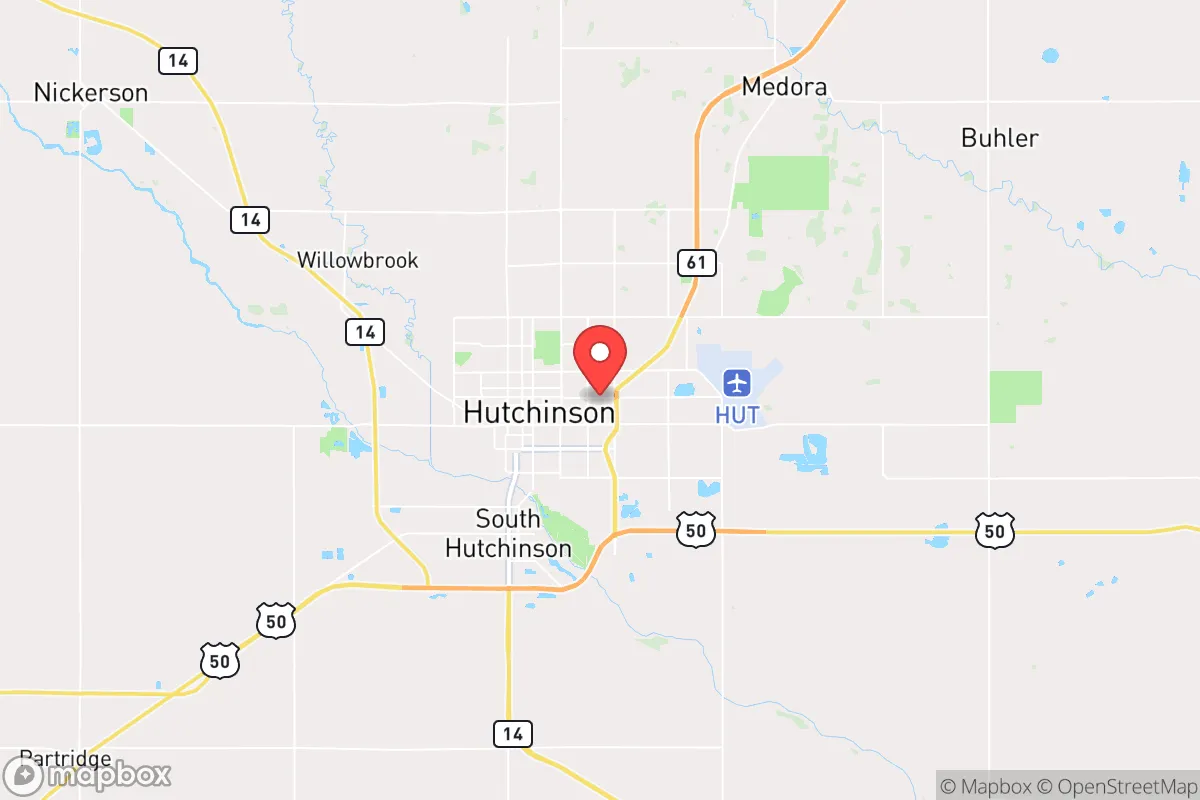
Photo: Wikipedia
Demographics of Hutchinson, KS
Affluence Level in Hutchinson, KS
A middle-class area roughly in line with national averages across income, home values, education, and employment.
People of Hutchinson, KS
The people of Hutchinson, Kansas, today form a predominantly white, working- and middle-class community of roughly 40,000, marked by a strong sense of local identity rooted in agriculture, manufacturing, and faith-based institutions. With a foreign-born population of just 1.3%, the city remains one of the least ethnically diverse in Kansas, though a growing Hispanic minority (13.1%) is gradually reshaping its cultural and economic landscape. Hutchinson’s character is distinctly Midwestern—practical, family-oriented, and politically conservative—with a population density of about 1,200 people per square mile that gives it a small-city feel without the sprawl of larger metros. The city’s residents are notably less college-educated than the national average (20.0%), reflecting a workforce historically tied to blue-collar industries rather than white-collar professional sectors.
How the city was settled and grew
Hutchinson was founded in 1871 as a railroad town on the Santa Fe Trail, drawing its first wave of settlers from the Midwest and Upper South—primarily farmers, merchants, and railroad workers of German, Irish, and English descent. The discovery of salt deposits in 1887 triggered a second wave, attracting skilled laborers and entrepreneurs who built the city’s salt-processing industry, which remains a major employer today. These early populations settled in the Original Townsite (the downtown core) and spread into South Hutchinson, a working-class neighborhood that grew around the salt plants and rail yards. A third wave arrived during the 1930s Dust Bowl, when displaced farmers from the Oklahoma and Texas panhandles moved north, settling in Carey Park and East Hutchinson, areas that became known for their modest bungalows and tight-knit communities. By 1950, Hutchinson’s population had reached 33,000, and the city’s ethnic makeup was overwhelmingly white, with small pockets of African American families who had come as railroad workers and settled in the North Monroe neighborhood.
Modern era (post-1965)
After the 1965 Hart-Cellar Act, Hutchinson saw only a trickle of new immigration—far less than larger Kansas cities like Wichita or Garden City. The foreign-born share peaked at around 2% in the 1990s and has since declined to 1.3%, with most newcomers being Hispanic laborers drawn to meatpacking and agricultural work. These families concentrated in West Hutchinson (near the Kansas State Fairgrounds) and along the 30th Avenue corridor, where older single-family homes and apartment complexes offered affordable housing. The city’s Black population, which had grown modestly during the Great Migration, peaked at about 5% in 1970 and has since fallen to 3.2%, as younger generations moved to Wichita or out of state for better job opportunities. East/Southeast Asian residents (0.5%) and Indian-subcontinent residents (0.2%) remain tiny enclaves, mostly professionals employed by Hutchinson Regional Medical Center or the local university. Suburbanization after 1980 pushed middle-class white families into newer developments in Northwest Hutchinson (around the Yoder Road area) and Hillside Estates, leaving older neighborhoods like South Hutchinson and East Hutchinson with aging housing stock and a higher share of renters.
The future
Hutchinson’s population is projected to remain flat or decline slightly over the next decade, as out-migration of young adults (ages 20–34) to larger cities offsets any modest growth from Hispanic in-migration. The city is not homogenizing into a single culture; rather, it is slowly tribalizing into three distinct enclaves: a predominantly white, older, and more affluent northwest quadrant; a working-class Hispanic corridor in West Hutchinson; and a declining, majority-white core in South and East Hutchinson where poverty rates are higher. The Hispanic share (13.1%) is likely to rise to 18–20% by 2040, driven by higher birth rates and continued labor demand in food processing and construction, but the foreign-born share will remain low as most growth comes from U.S.-born children of Hispanic families. The Indian and East/Southeast Asian communities are expected to remain very small, as Hutchinson lacks the professional job base or university presence to attract significant numbers. Assimilation patterns suggest that second-generation Hispanic residents are already moving into Northwest Hutchinson and adopting the city’s conservative, church-going norms, blurring ethnic lines over time.
For someone moving to Hutchinson now, the city offers a stable, low-cost, and safe environment where community ties are strong and change comes slowly. The population is becoming slightly more diverse but remains overwhelmingly white and culturally conservative, with a working-class ethos that values self-reliance and neighborliness over cosmopolitan amenities. New arrivals will find a place where knowing your neighbors and attending local events—like the Kansas State Fair or high school football games—still defines daily life, and where the biggest demographic story is not rapid transformation but gradual, organic evolution.

* Values derived from national, state, county, city and local statistics and may differ in a specific area. Last updated: 2026-05-01T16:22:02.000Z
Narrative content on this page is AI-generated and may contain mistakes. Verify any details that matter before acting on them.
ReloMaps may earn a commission from affiliate links at no extra cost to you.

