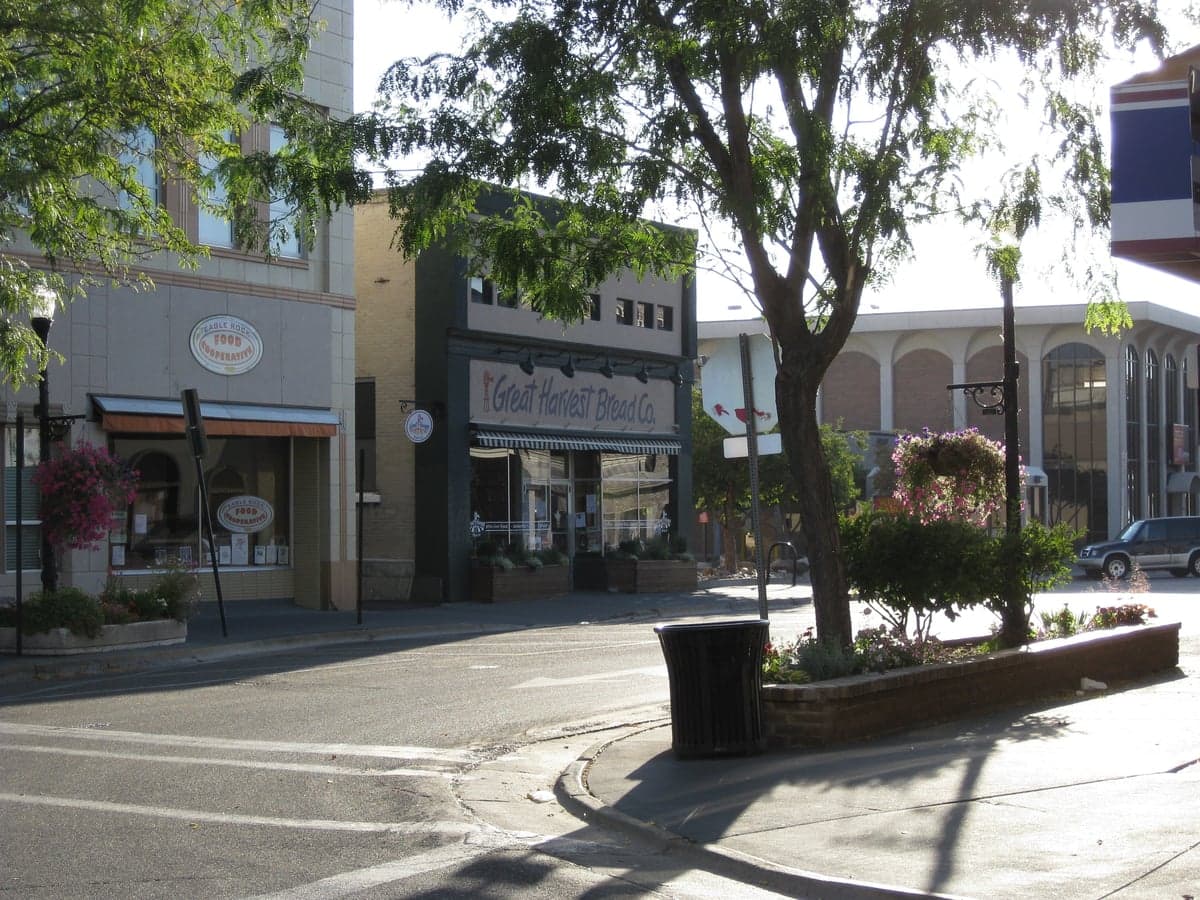
Photo: Wikipedia
Personal Sovereignty in Idaho Falls, ID
Moderate friction. Expect trade-offs in some aspect of personal liberty and independence.
What does Personal Sovereignty tell us?
Personal Sovereignty measures your capacity for self-reliance and independence with minimal government friction. Higher scores mean fewer barriers between you and the way you want to live... but it assumes you have the space you need and good neighbors.
What does this tell us?
Personal Sovereignty measures your capacity for self-reliance and independence with minimal government friction. Higher scores mean fewer barriers between you and the way you want to live... but it assumes you have the space you need and good neighbors.
State Policy
Energy independence: Importer (25% of energy produced in-state)
Personal Liberty
Homesteading

Personal Liberty Analysis
Idaho Falls offers one of the strongest personal sovereignty environments in the Intermountain West, combining low state-level interference with a deeply ingrained culture of self-reliance. For those concerned about federal overreach and the erosion of individual rights, this city provides a legal and practical framework where you can live largely unbothered—provided you respect the same freedom for your neighbors. The combination of permissive gun laws, minimal business regulation, and a political class that views government as a necessary evil rather than a solution makes Idaho Falls a serious contender for anyone prioritizing autonomy over convenience.
Tax burden and regulatory posture: how Idaho Falls keeps government off your back
Idaho’s tax structure is designed to leave money in your pocket, not fund an expanding state apparatus. There is no state income tax on personal income—a flat 5.8% rate applies only to corporate income and certain pass-through entities, meaning your wages, investments, and retirement accounts are untouched by state-level taxation. Property taxes in Bonneville County average around 0.69% of assessed value, which is roughly half the national average. For a $400,000 home, that’s about $2,760 annually—a fraction of what you’d pay in blue states like California or New York. Sales tax is a flat 6% statewide, with no local add-ons in Idaho Falls, and groceries are exempt. The regulatory environment mirrors this fiscal restraint: Idaho Falls has no city-level business license requirement for most home-based operations, and zoning codes are generally permissive for small-scale manufacturing, repair work, or cottage food production. The state’s “right-to-farm” laws protect agricultural activities from nuisance lawsuits, which matters if you plan to keep chickens, bees, or a small garden in a residential zone. The overall posture is clear: the government assumes you can manage your own affairs until you prove otherwise.
Self-defense and gun law specifics: what you can carry and where
Idaho is a constitutional carry state, meaning no permit is required to carry a concealed firearm for anyone legally allowed to possess one. This applies to both residents and non-residents who are at least 18 years old. Idaho Falls has no additional city-level restrictions beyond state law, so you can carry openly or concealed in most public spaces, including parks, sidewalks, and commercial buildings unless posted. The state preempts local gun ordinances, so city councils cannot ban carry in city buildings or impose waiting periods. Stand-your-ground laws are fully in effect—there is no duty to retreat before using deadly force if you are lawfully present and reasonably believe force is necessary to prevent death or great bodily harm. Magazine capacity is unrestricted, and there is no state registry for firearms or ammunition. For those with a survivalist mindset, Idaho also allows the use of suppressors and short-barreled rifles without a state-level permit, though federal NFA rules still apply. The practical takeaway: you can defend your home, vehicle, and person with the same tools and rules that apply in rural Texas or Arizona, and the local sheriff’s office is generally supportive of armed citizens.
Self-reliance and homesteading viability: lot sizes, zoning, and off-grid feasibility
Idaho Falls proper is a city of about 67,000, but its zoning code allows for genuine self-reliance within city limits if you choose the right neighborhood. Standard residential lots in subdivisions like Eagle Crest or the older central neighborhoods range from 0.15 to 0.25 acres, which is enough for a substantial vegetable garden, a small chicken coop, and a few fruit trees. For larger ambitions, the county’s agricultural zoning (A-1) requires a minimum of 5 acres, and parcels in the unincorporated areas around Ammon, Iona, and Ucon often come with irrigation water rights from the Snake River system. Off-grid living is legally feasible but requires navigating county building codes: Bonneville County does not require connection to municipal water or sewer if you can demonstrate a private well and septic system that meets health department standards. Solar panels are permitted without special permits, and net metering is available through Idaho Power, though the utility caps residential solar at 25 kW. Rainwater collection is unrestricted, and you can drill a well for domestic use without a state water right permit as long as you use less than 13,000 gallons per day. The biggest practical hurdle is winter: heating a home off-grid in Idaho Falls requires serious planning, as January lows average 14°F, and wood-burning stoves are common but must meet EPA emissions standards. Overall, the area is one of the most permissive in the lower 48 for a semi-autonomous lifestyle, especially if you’re willing to live 10-15 minutes outside city limits.
Personal liberties: parental rights, medical autonomy, speech, and property
Idaho has become a national leader in protecting parental rights. The state’s “Parents’ Bill of Rights” (Idaho Code § 33-138) explicitly affirms that parents have the fundamental right to direct their children’s education, healthcare, and moral upbringing. This means you can opt your child out of any curriculum or activity you find objectionable without needing a lawyer, and schools must obtain parental consent before administering any mental health or medical survey. Medical autonomy is similarly strong: Idaho has no state mask or vaccine mandates for adults, and the legislature has passed laws prohibiting discrimination against unvaccinated individuals in employment and public accommodations. The Idaho Freedom Act (2023) also restricts the state’s ability to enforce federal public health orders that conflict with state law. On speech, Idaho Falls is a conservative city where political expression—whether on bumper stickers, yard signs, or social media—faces no meaningful restriction. Property rights are protected by the state’s “private property rights” act, which requires governments to prove a compelling interest before restricting land use, and eminent domain is tightly limited to public utilities and transportation projects. The city’s planning department is known for being pragmatic rather than ideological; variances for fences, sheds, or home businesses are routinely approved if they don’t create a nuisance. The net effect is that you can raise your family, run a business, and speak your mind without fear of government retaliation—a combination that’s increasingly rare in the United States.
Compared to other relocation destinations for sovereignty-minded individuals, Idaho Falls sits in a sweet spot. It lacks the extreme libertarian legal framework of New Hampshire or the total absence of zoning found in rural Alaska, but it offers a practical, middle-ground environment where the state is not your adversary. The cost of living is reasonable, the legal climate is predictable, and the culture rewards self-sufficiency rather than dependency. For a single person or a family looking to build a life that answers to no one but themselves, Idaho Falls is one of the few places in the country where that vision is still achievable without constant legal battles or social friction.

* Values derived from national, state, county, city and local statistics and may differ in a specific area. Last updated: 2026-04-19T08:08:27.000Z
Narrative content on this page is AI-generated and may contain mistakes. Verify any details that matter before acting on them.
ReloMaps may earn a commission from affiliate links at no extra cost to you.

