Photo: Wikipedia
Demographics of Idaho Falls, ID
Affluence Level in Idaho Falls, ID
A middle-class area roughly in line with national averages across income, home values, education, and employment.
People of Idaho Falls, ID
The people of Idaho Falls today form a predominantly white, family-oriented community of 66,672 residents, with a notably low foreign-born share of 2.4% that reflects the city's historic insularity. The population is 77.6% white and 16.5% Hispanic, with tiny East/Southeast Asian (0.6%), Black (0.4%), and Indian subcontinent (0.1%) communities. This is a city where 31.0% of adults hold a college degree, and the dominant cultural identity remains rooted in Latter-day Saint pioneer heritage and agricultural self-reliance.
How the city was settled and grew
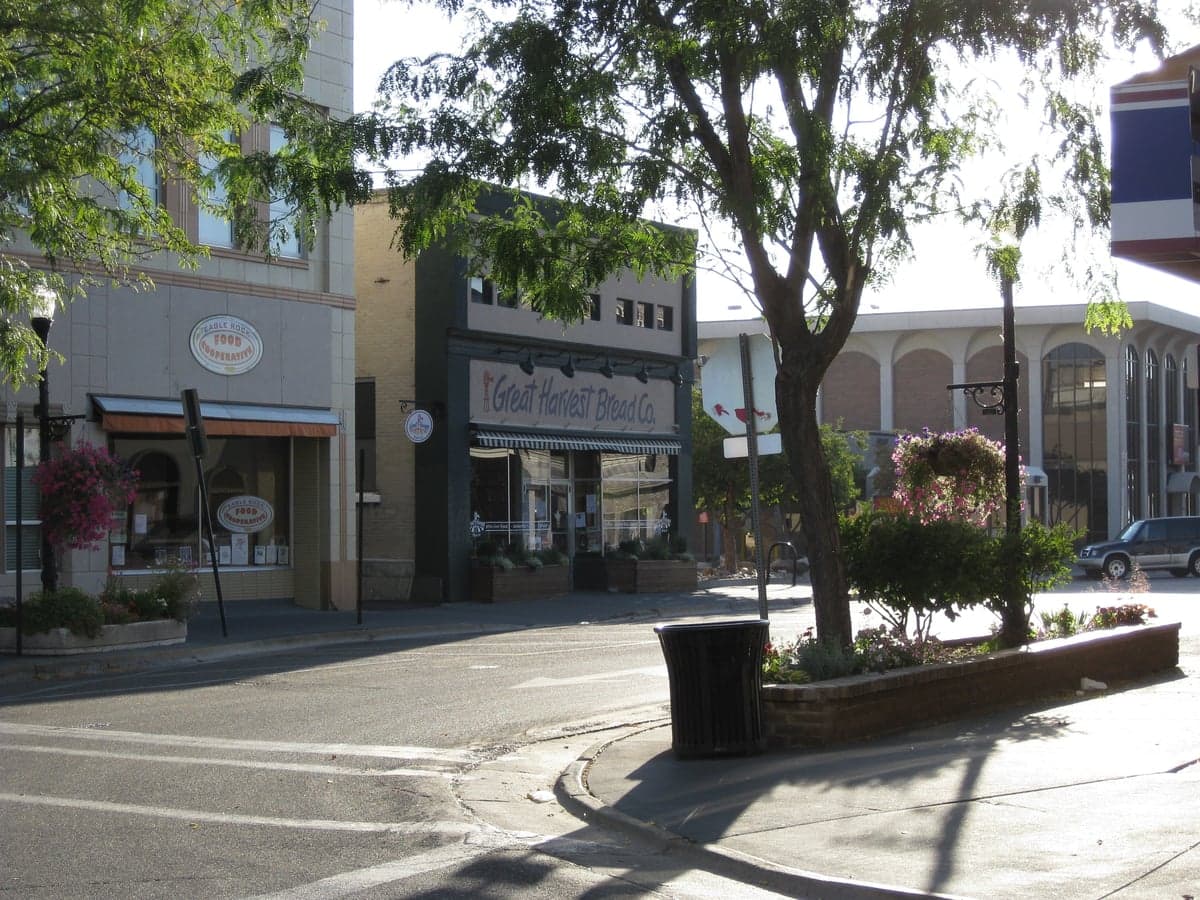
Idaho Falls was founded in 1864 as a Mormon agricultural colony called Eagle Rock, named for a nearby landmark on the Snake River. The original settlers were predominantly Latter-day Saint families from Utah, drawn by church-organized irrigation projects and the promise of fertile farmland. The city's first permanent neighborhood, Historic Downtown (originally the Eagle Rock settlement), was built by these pioneers along the river's east bank. A second wave arrived after the Oregon Short Line Railroad reached the area in 1879, bringing non-Mormon merchants, railroad workers, and homesteaders who established the West Side neighborhood near the depot. By 1900, the population had grown to roughly 4,000, with a distinct division: the east side remained heavily LDS and agrarian, while the west side became more diverse with Protestant and Catholic families. The 1940s brought a third wave when the U.S. Navy built the Naval Ordnance Plant (now the Idaho National Laboratory site), drawing engineers and technicians from across the country. These newcomers settled in the Ammon area (now a separate city but historically an Idaho Falls suburb) and the South Boulevard corridor, creating a professional class distinct from the farming base.
Modern era (post-1965)
After the 1965 Immigration and Nationality Act, Idaho Falls saw minimal direct immigration compared to national trends. The foreign-born share remained below 3% through 2020, with most newcomers being domestic migrants from other Western states. The Hispanic population grew from under 5% in 1990 to 16.5% by 2024, driven largely by agricultural labor migration to the surrounding potato and sugar beet farms. These families concentrated in the Northgate area (north of the river near the fairgrounds) and along the Yellowstone Highway corridor, where older housing stock and rental properties offered affordable entry points. The white population, while still dominant, has aged slightly as younger professionals move to Boise or Salt Lake City for broader job markets. The East/Southeast Asian community (0.6%) is almost entirely tied to the Idaho National Laboratory, with families from Japan, Korea, and the Philippines settling in the University District near the Idaho Falls campus of Brigham Young University-Idaho and the College of Eastern Idaho. The Indian subcontinent community (0.1%) is negligible, consisting of a handful of medical professionals at the local hospital. The Black population (0.4%) has remained static since the 1970s, concentrated in the West Side near the old railroad corridor.
The future
Idaho Falls is likely to remain a predominantly white, LDS-influenced city for the next decade, but with steady Hispanic growth that may reach 20-22% by 2035. The foreign-born share will rise slowly as the Hispanic population matures and second-generation families remain in the area. The city is not tribalizing into distinct ethnic enclaves—Hispanic families are dispersing across the Northgate and Yellowstone Highway areas, while white families continue to dominate the newer subdivisions in the Eagle Ridge and Lincoln neighborhoods on the city's south and west edges. The East/Southeast Asian and Indian communities are too small to form visible enclaves and will likely remain tied to the lab and hospital. The biggest demographic shift may be domestic: as remote work expands, Idaho Falls is attracting conservative-leaning migrants from California and the Pacific Northwest, drawn by lower housing costs and the area's political culture. This inflow is reinforcing the city's white, college-educated, and Republican character rather than diversifying it.
For a conservative-leaning mover, Idaho Falls is becoming a more stable, family-oriented version of itself—whiter and more politically homogeneous than the national average, with a growing Hispanic workforce that is integrating into the broader community rather than forming separate enclaves. The city's low crime, strong schools, and LDS-influenced social fabric remain intact, while the tiny immigrant communities pose no threat to cultural continuity. The next 20 years will likely see slow, organic growth driven by domestic migration and Hispanic natural increase, not the rapid diversification reshaping larger Western cities.

* Values derived from national, state, county, city and local statistics and may differ in a specific area. Last updated: 2026-04-19T08:08:27.000Z
Narrative content on this page is AI-generated and may contain mistakes. Verify any details that matter before acting on them.
ReloMaps may earn a commission from affiliate links at no extra cost to you.

