Photo: Wikipedia
Demographics of Montgomery County
Affluence Level in Montgomery County
A middle-class area roughly in line with national averages across income, home values, education, and employment.
People of Montgomery County
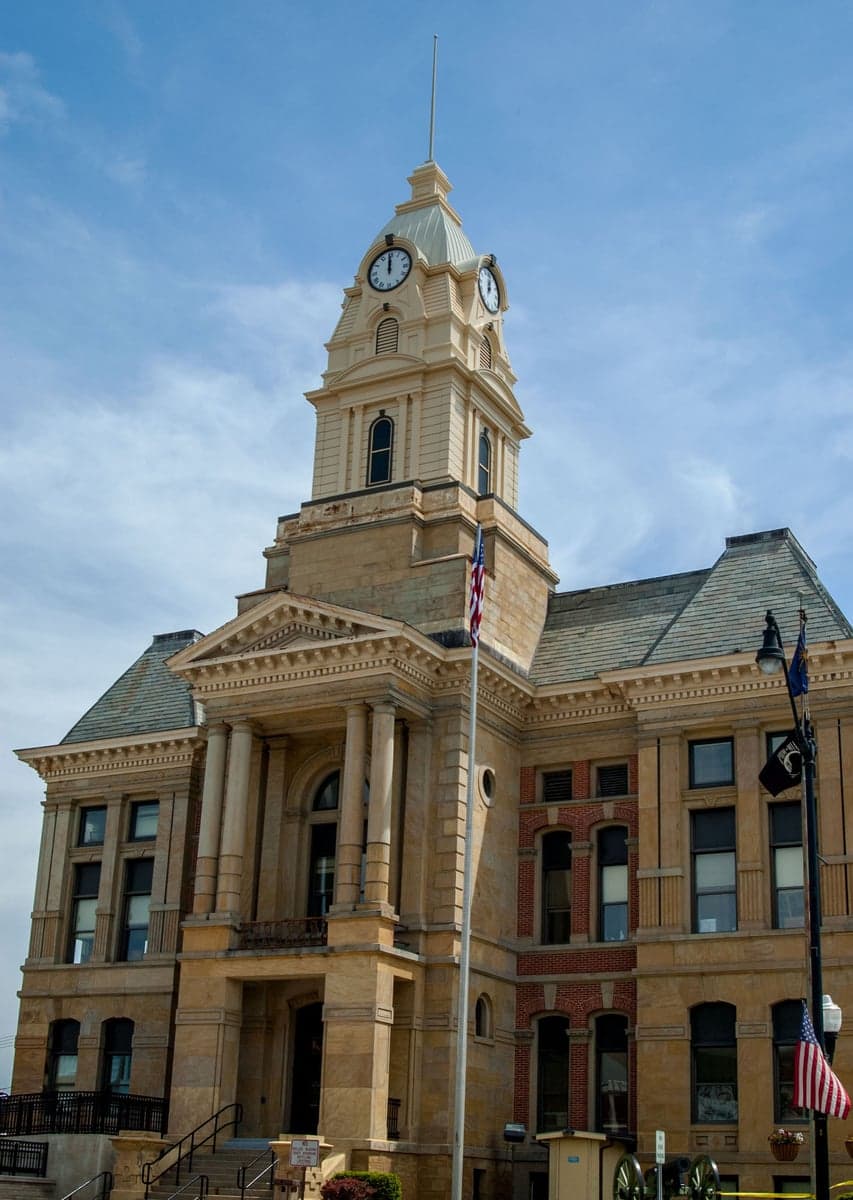
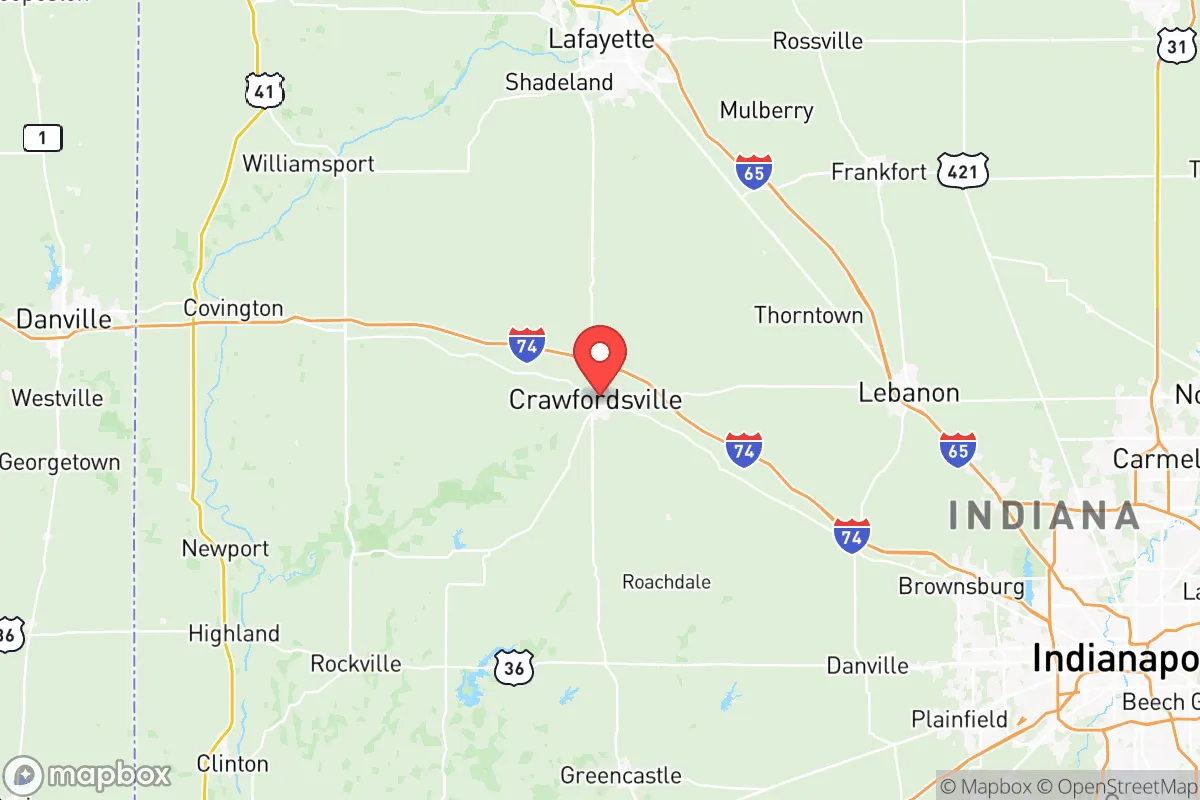
Montgomery County, Indiana, today is a predominantly white, rural community of 38,155 residents, defined by its agricultural roots and small-town character centered on the county seat of Crawfordsville. With a population that is 89.1% white and a foreign-born share of just 2.0%, the county remains one of the least ethnically diverse in the state, though a growing Hispanic community of 6.1% is beginning to reshape its cultural landscape. The county’s identity is distinctly Midwestern and conservative, shaped by generations of family farms, manufacturing, and a deep sense of local tradition. For those moving here, Montgomery County offers a quiet, affordable lifestyle where community ties run deep and change comes slowly.
Settlement & growth (pre-1960)
Long before European settlers arrived, the area now known as Montgomery County was part of the ancestral homeland of the Miami and Wea peoples, who used the Wabash River and its tributaries for travel and trade. The first permanent American settlers began arriving in the 1820s, following the 1818 Treaty of St. Mary’s that ceded Miami lands to the United States. These early pioneers were overwhelmingly of Scots-Irish and English stock, migrating from Kentucky, Ohio, and the upland South in search of cheap, fertile land. They established the first settlements at Crawfordsville (founded 1823) and Linden (platted 1831), drawn by the rich prairie soil and the promise of self-sufficient farming.
The 1830s and 1840s brought a second wave of settlers: German immigrants, who arrived via the Ohio River and pushed into the county’s interior. Unlike the Scots-Irish, who tended toward isolated farmsteads, the Germans clustered in tight-knit rural communities, founding the villages of Waveland and New Market. They brought with them a tradition of mixed farming—corn, wheat, and livestock—and established the county’s first creameries and cheese factories. By 1850, Germans made up roughly 15% of Montgomery County’s population, a share that held steady through the end of the century.
The arrival of the railroad in the 1850s transformed the county’s economy and demographics. The Indianapolis, Cincinnati and Lafayette Railroad linked Crawfordsville to regional markets, spurring the growth of Darlington and Ladoga as shipping points for grain and livestock. The post-Civil War decades saw a modest influx of Irish laborers, who built the rail lines and settled in Crawfordsville’s working-class neighborhoods near the depot. By 1900, the county’s population had peaked at roughly 29,000, with Crawfordsville serving as a commercial and manufacturing hub—home to the Wabash College (founded 1832) and several foundries and textile mills.
The early 20th century brought little new immigration to Montgomery County. The county’s population remained overwhelmingly native-born white, with small pockets of African American residents—never exceeding 2%—who worked as domestic servants and railroad laborers in Crawfordsville. The Great Depression and World War II accelerated a rural-to-urban shift, as young people left farms for factory jobs in Indianapolis and Lafayette. By 1960, the county’s population had fallen to 27,000, and its character was firmly set: a white, Protestant, agricultural community with a conservative political bent and a deep attachment to local institutions like the county fair and the 4-H club.
Modern era (post-1965)
The 1965 Hart-Cellar Act, which opened U.S. immigration to non-European countries, had almost no immediate effect on Montgomery County. The county’s foreign-born population in 2026 stands at just 2.0%, and the vast majority of those are European or Canadian retirees, not new immigrant groups. Instead, the county’s modern demographic story is one of domestic migration and suburban spillover from the Indianapolis metropolitan area, which lies roughly 45 miles to the southeast.
Since the 1990s, Montgomery County has experienced a slow but steady population increase, driven by families and retirees seeking lower housing costs and a slower pace of life. The towns of Waynetown and Wingate have seen new subdivisions built on former farmland, attracting commuters who work in Lafayette’s manufacturing plants or Indianapolis’s logistics centers. This influx has been almost entirely white, reinforcing the county’s existing racial composition. The county’s Black population remains negligible at 0.5%, and East/Southeast Asian communities (0.2%) and Indian-subcontinent residents (0.2%) are present only in tiny numbers, mostly as faculty at Wabash College or as medical professionals at the county’s hospitals.
The most notable demographic shift since 2000 has been the growth of the Hispanic population, which rose from 2.8% in 2000 to 6.1% today. This growth is almost entirely driven by Mexican and Central American immigrants who work in the county’s agricultural sector—particularly in the hog and poultry operations around New Richmond and Alamo—as well as in construction and food processing. These families have formed small but visible enclaves in Crawfordsville’s south side, where a handful of Mexican grocery stores and taquerias now operate. The Hispanic population is younger and has higher birth rates than the white population, making it the primary driver of the county’s modest growth.
Suburbanization has been limited compared to counties closer to Indianapolis. Montgomery County lacks a major interstate highway (I-74 runs through its southern tip, but the county’s core is served by U.S. 231 and State Road 32), which has kept development at a rural pace. The county’s college-educated share is just 19.5%, well below the state average, reflecting an economy still anchored in agriculture, manufacturing, and low-skill service jobs. The county’s political culture remains deeply conservative: in 2024, Montgomery County voted 72% for Donald Trump, one of the highest margins in Indiana.
The future
Montgomery County is likely to become slightly more diverse over the next two decades, but the change will be gradual and concentrated in specific pockets. The Hispanic population is projected to grow to 10-12% by 2040, driven by continued immigration and higher birth rates, with the most visible growth in Crawfordsville and the agricultural communities of Mace and Browns Valley. This growth will be partly offset by the aging and out-migration of the white population, as young adults continue to leave for college and urban jobs in Indianapolis, Lafayette, and beyond.
The county’s Asian and Indian populations are unlikely to grow significantly, given the lack of high-skilled employment opportunities and the county’s distance from major research universities or tech hubs. Wabash College will continue to attract a small number of international students and faculty, but most will leave after graduation or retirement. The Black population will remain tiny, as there are no historical or economic pull factors to attract African American residents.
The county’s cultural identity will remain predominantly white, rural, and conservative, but the growing Hispanic presence will slowly reshape local life. Spanish-language services will become more common in schools and healthcare, and the county’s annual festivals—like the Crawfordsville Strawberry Festival—may begin to incorporate Latino food and music. The county’s political leanings are unlikely to shift meaningfully, as Hispanic voters in rural Indiana tend to lean conservative on economic and social issues.
For someone moving in now, Montgomery County offers a stable, affordable, and safe environment with strong community institutions and low crime. The trade-off is limited diversity, a narrow range of job opportunities, and a cultural life that revolves around church, family, and the outdoors. The county is not becoming a multicultural melting pot, but it is becoming a slightly more varied version of its historical self—a place where the old and new rural economies coexist, and where change, when it comes, arrives at a Midwestern pace.

* Values derived from national, state, county, city and local statistics and may differ in a specific area. Last updated: 2026-08-14T16:38:23.000Z
Narrative content on this page is AI-generated and may contain mistakes. Verify any details that matter before acting on them.
ReloMaps may earn a commission from affiliate links at no extra cost to you.

