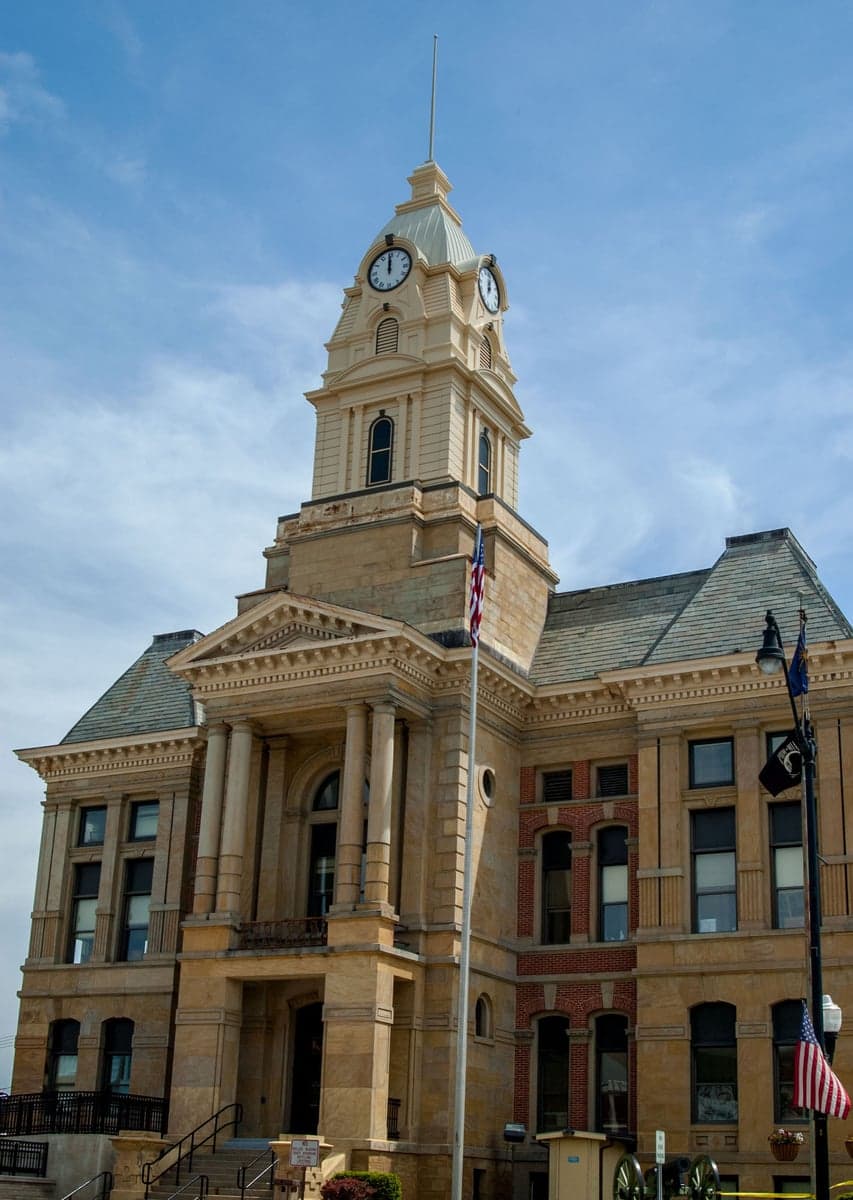
Photo: Wikipedia
Political ClimatePolitical Climate in Montgomery County
Showing district-level results — no local-only data available.
Local Political AnalysisPolitical Analysis of Montgomery County
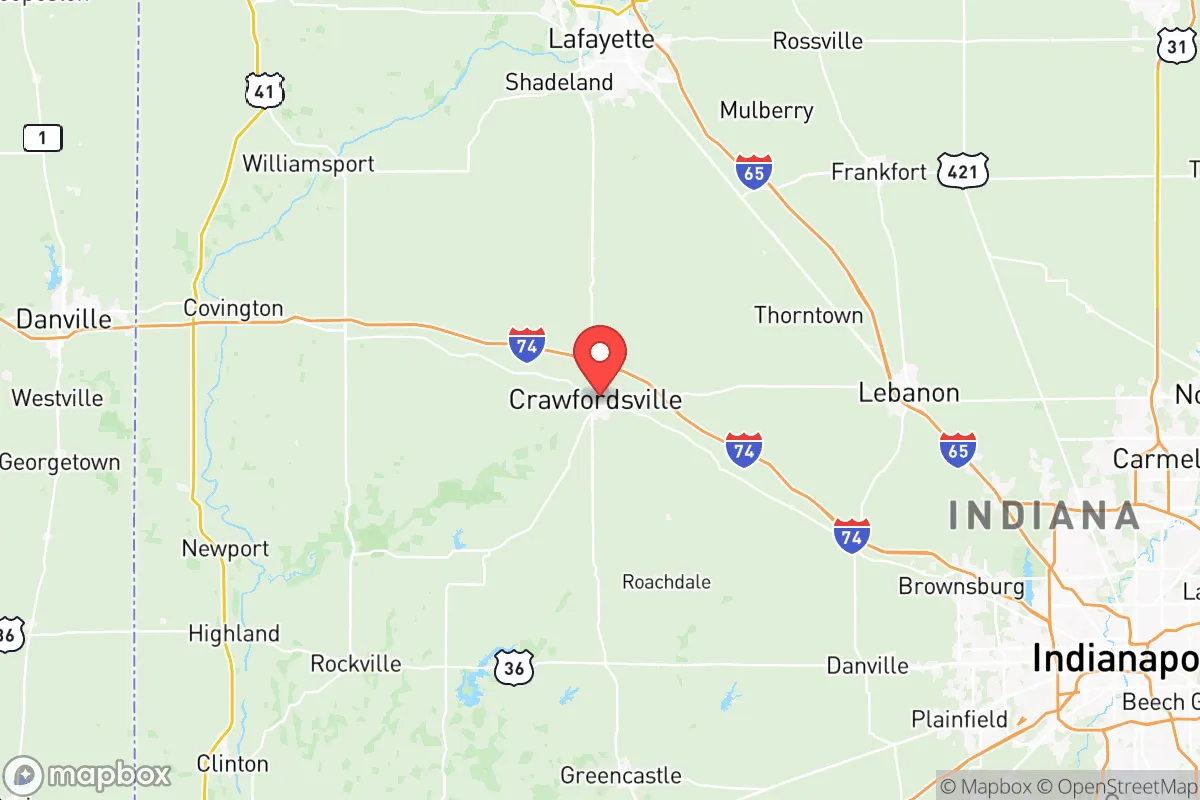
Montgomery County, Indiana, is a reliably Republican stronghold with a Cook PVI of R+15, making it significantly more conservative than the state of Indiana as a whole, which sits at R+9. This isn't a recent shift; the county has been a GOP bastion for decades, with the rural and small-town character of places like Crawfordsville, the county seat, and the surrounding farm communities consistently delivering comfortable margins for Republican candidates. However, the political landscape isn't a monolith—you'll find subtle but real variation between the more moderate, college-influenced precincts around Wabash College in Crawfordsville and the deeply red rural townships like Union and Franklin.
How it compares
The six-point gap between Montgomery County's R+15 and Indiana's R+9 is substantial. In practice, this means a Republican candidate for statewide office can expect to win Montgomery County by roughly 15 points, while the same candidate might only win the state by 9. This difference is driven by the county's lack of large, reliably Democratic urban centers like Indianapolis or Lake County. Within the county, the most conservative precincts are in the rural townships—places like Brown, Scott, and Walnut—where GOP margins often exceed 75%. The swing precincts, if you can call them that, are in the more densely populated parts of Crawfordsville, particularly around the Wabash College campus and the near-west side, where a mix of faculty, students, and younger professionals can push the Republican margin down to the 55-60% range. Linden and New Market are smaller towns that lean red but can be slightly more competitive in local races, reflecting a more independent streak. The county's trajectory has been stable—it hasn't trended blue in any meaningful way, but it also hasn't moved further right as fast as some rural Indiana counties. The presence of Wabash College and a modest manufacturing base (like RR Donnelley and Nucor) provides a small counterweight to the otherwise deep-red rural vote.
What this means for residents
For conservative residents, Montgomery County is a comfortable environment where their political views are the clear majority. Local elections are often decided in the Republican primary, and the county commission, council, and school board are dominated by GOP members. This means conservative policy priorities—like low taxes, limited regulation, and traditional values—are the default. For liberal or moderate residents, the reality is more nuanced. They are a clear minority, but not an invisible one. The Wabash College community and a small but active Democratic precinct organization in Crawfordsville provide a social and political outlet. You won't find many openly progressive candidates winning countywide office, but you will find a respectful, if sometimes tense, coexistence. The practical impact is that liberal residents often focus their energy on local issues like school funding or downtown revitalization, where bipartisan consensus is more achievable, rather than on national partisan battles. The county's politics are generally civil, with a "live and let live" attitude prevailing in day-to-day life, even if the voting booth tells a different story.
A key cultural distinction is the county's strong sense of local identity, which sometimes transcends party lines. There's a shared pride in the historic downtown Crawfordsville, the annual Strawberry Festival, and the county's covered bridges. This localism means that a candidate's reputation for being a good neighbor or a competent administrator can matter as much as their party label in local races. The influence of Wabash College also brings a slightly more cosmopolitan, intellectually curious tone to the county's public discourse, even if it doesn't shift the overall vote much. For a conservative, this is a place where your values are reflected in local governance. For a liberal, it's a place where you can be an active, respected member of the community, even if you're on the losing side of most elections. The long-term outlook is for continued Republican dominance, but with the possibility of a slow, modest drift toward the center as the county's small urban core continues to attract new residents and the college maintains its influence.

State Political ClimatePolitical Climate in Indiana
State Political AnalysisPolitical Environment in the State
Indiana is a solidly Republican state with a Cook PVI of R+9, meaning it votes about nine points more Republican than the nation as a whole. Over the last 10-20 years, the state has shifted rightward, driven by the exodus of moderate Democrats from rural areas and the consolidation of GOP control in the suburbs. While Democrats can still win in Indianapolis and a few Lake County strongholds, the statewide trajectory is unmistakably conservative, with Republicans holding supermajorities in both chambers of the legislature and every statewide office.
Urban vs. rural divide
The political map of Indiana is a classic story of urban islands in a red sea. Indianapolis (Marion County) is the Democratic anchor, consistently voting blue by double digits, but it’s surrounded by a ring of deeply Republican suburbs like Carmel, Fishers, and Noblesville in Hamilton County — one of the most GOP-friendly large counties in the nation. Lake County (Gary, Hammond) in the northwest corner is the other Democratic stronghold, powered by union households and a large Black population. Meanwhile, Fort Wayne (Allen County) has trended redder as its manufacturing base has shrunk, and Evansville (Vanderburgh County) is reliably conservative. The rural counties — think Greene County, Switzerland County, and Jay County — routinely vote 70-80% Republican. The divide isn’t just about population density; it’s cultural. Urban voters prioritize transit, public schools, and social services, while rural voters focus on agriculture, gun rights, and local control.
Policy environment
Indiana’s policy environment is defined by low taxes and limited regulation. The state has a flat income tax of 3.05% (scheduled to drop to 2.9% by 2027), and property taxes are capped at 1% of assessed value for owner-occupied homes. There is no estate tax. The regulatory posture is business-friendly, with a right-to-work law on the books since 2012 and a low corporate income tax rate of 4.9%. Education policy leans toward school choice: Indiana has one of the nation’s largest voucher programs, and charter schools are widespread. Healthcare is a mixed bag — the state expanded Medicaid under the Healthy Indiana Plan, but it did so with a conservative work requirement waiver (later blocked in court). Election laws are moderately restrictive: voter ID is required, early voting is available but limited, and same-day registration is not allowed. The state also has a “stand your ground” self-defense law and permits constitutional carry (permitless carry) for handguns since 2022.
Recent policy direction
The last five years have seen Indiana move decisively to the right on several fronts. On gun and self-defense law, the 2022 permitless carry law (House Enrolled Act 1296) eliminated the requirement for a license to carry a handgun, though a background check is still needed for purchase. On parental and education rights, the state passed a “Parents’ Bill of Rights” (Senate Enrolled Act 380) in 2023, requiring schools to notify parents of curriculum changes and allowing them to opt their children out of certain materials. Medical and bodily autonomy saw a near-total abortion ban in 2022 (Senate Enrolled Act 1), with exceptions only for rape, incest, and lethal fetal anomalies up to 10 weeks, and to save the mother’s life. Property rights are strong: Indiana is a “Dillon’s Rule” state, meaning local governments have only the powers explicitly granted by the state, which limits local zoning and rent control experiments. Taxation has been trending downward: the 2023 budget accelerated the income tax cut and eliminated the business personal property tax for many small businesses. Voting and ballot access tightened slightly with a 2021 law requiring absentee ballots to be returned by Election Day (no postmark grace period), though no major voter ID changes were made. On privacy and surveillance, the state has not passed a comprehensive data privacy law, but it did ban TikTok on state devices in 2023. The overall direction is toward more individual liberty on guns and education, less on abortion, and a lighter tax burden.
Civil unrest & political movements
Indiana has seen its share of political flashpoints, but they tend to be localized. The 2020 Black Lives Matter protests in Indianapolis were large and occasionally violent, with property damage downtown and a heavy police response. In response, the Republican legislature passed a “back the blue” bill (House Enrolled Act 1006) in 2021, increasing penalties for rioting and blocking efforts to defund the police. On the right, the Indiana Freedom Coalition and local “Moms for Liberty” chapters have been active in school board races, particularly in Hamilton County and Johnson County, pushing for book bans and curriculum transparency. Immigration politics are less heated than in border states, but there is a small but vocal movement against sanctuary cities — though no Indiana city has declared itself one. Election integrity controversies flared after 2020, with some GOP county officials calling for audits, but no major fraud was found. The most visible flashpoint for a new resident might be the annual Indiana Right to Life rally at the Statehouse, which draws thousands, countered by smaller reproductive rights protests. Overall, political activism is present but not overwhelming; most Hoosiers are polite about their differences.
Projection
Over the next 5-10 years, Indiana is likely to stay solidly Republican, but the margins may narrow slightly in suburban areas. In-migration is modest — the state gains population mostly from natural increase and international immigration, not domestic relocation — so the demographic shift is slow. The biggest wildcard is the Indianapolis suburbs: Hamilton County is growing fast and becoming more diverse, which could nudge it from R+20 to R+15 over a decade. Rural counties will continue to hemorrhage population and double down on GOP voting. The state’s tax-cutting trajectory will likely continue, with the flat income tax possibly dropping to 2.5% by 2030. Abortion politics will remain a flashpoint, but the legislature is unlikely to further restrict the current ban. Expect more school choice expansion and possibly a school voucher for all students. A new resident moving in now should expect a state that is reliably conservative, with low taxes and a business-friendly climate, but with a growing urban-rural cultural divide that occasionally erupts in school board and legislative fights.
Bottom line for a new resident: If you’re conservative, you’ll find a state that largely aligns with your values — low taxes, strong gun rights, school choice, and a government that stays out of your business. If you’re liberal, you’ll find a state where your vote matters most in Indianapolis or Lake County, and where you’ll need to be comfortable with a legislature that often moves in the opposite direction of your preferences. Either way, Indiana is a place where politics is present but not all-consuming; most people are more concerned with the price of corn, the condition of the roads, and whether the Colts are any good. It’s a solid, predictable red state that rewards stability over drama.
* Values derived from national, state, county, city and local statistics and may differ in a specific area. Last updated: 2026-08-14T16:38:23.000Z
Narrative content on this page is AI-generated and may contain mistakes. Verify any details that matter before acting on them.
ReloMaps may earn a commission from affiliate links at no extra cost to you.

