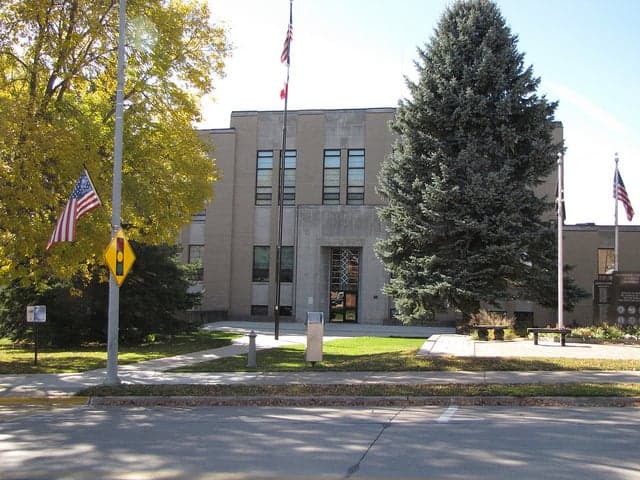
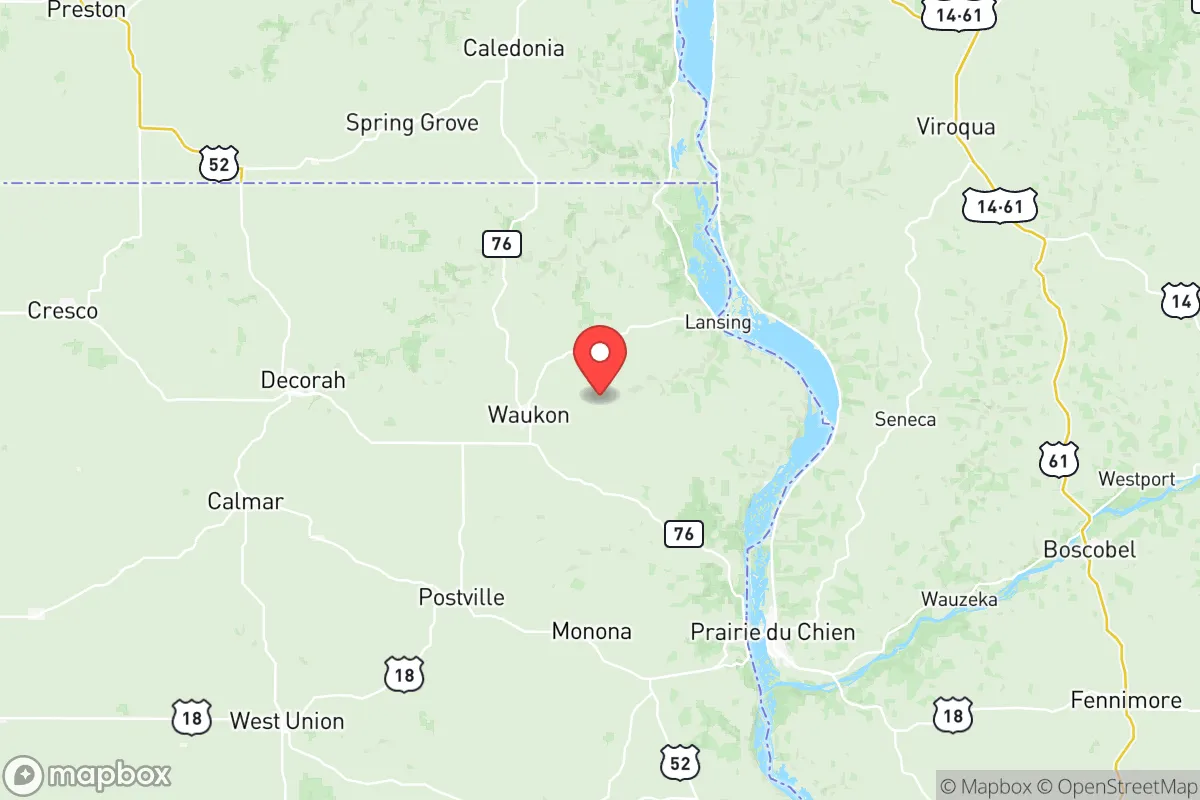
Photo: Wikipedia
Demographics of Allamakee County
Affluence Level in Allamakee County
A middle-class area roughly in line with national averages across income, home values, education, and employment.
People of Allamakee County
The people of Allamakee County, Iowa, today number roughly 14,000, forming a predominantly white, rural population with a notable Hispanic minority of 8.7% and a small but growing foreign-born presence at 3.9%. The county’s character is shaped by its deep agricultural roots, a strong German and Scandinavian heritage, and a population density of just 18 people per square mile—among the lowest in Iowa. Distinctive identity markers include a robust Lutheran church tradition, a reliance on dairy farming and corn production, and a cultural pride tied to the Mississippi River bluffs and the Driftless Area’s rugged landscape. This is a place where generational continuity runs deep, but where outmigration of young adults and an aging demographic are reshaping the community’s future.
Settlement & growth (pre-1960)
Before Euro-American settlement, the area now known as Allamakee County was home to the Sauk and Meskwaki (Fox) peoples, who used the Mississippi River valley for seasonal hunting and fishing. Occasional Dakota Sioux war parties also passed through. The first permanent non-Native presence came with the 1832 Black Hawk Purchase, which opened the region to American settlers. The county was officially organized in 1849, named after a Native American leader, and the earliest Euro-American arrivals were primarily of Yankee stock from New England and New York, drawn by cheap land and the promise of lead mining in the nearby Upper Mississippi Lead District. These settlers founded the county seat of Waukon in 1849, along with early river towns like Lansing (1851) and New Albin (1852), which served as steamboat landings for grain and timber.
The major demographic wave came between 1850 and 1880, when German immigrants arrived in large numbers, fleeing political unrest and economic hardship in the German states. They settled heavily in the fertile valleys around Postville, Harpers Ferry, and Waterville, establishing dairy farms and small hamlets. Simultaneously, Norwegian immigrants began arriving in the 1850s, drawn by the region’s resemblance to their homeland’s fjords and forests. They concentrated in the northern part of the county, founding Norwegian Ridge near Dorchester and the community of Hanover. By 1900, over 40% of Allamakee County residents claimed German ancestry, and another 15% were Norwegian, with smaller numbers of Irish and English settlers. The economy revolved around subsistence farming, dairy cooperatives, and logging, with the Milwaukee Road railroad connecting Waukon to the national market by 1877.
The period from 1900 to 1960 saw little new immigration. The county’s population peaked at 22,514 in 1900, then began a slow decline as agricultural mechanization reduced the need for farm labor. The Great Depression hit hard, but the county’s dairy-based economy provided more stability than cash-crop regions. No significant Dust Bowl migration occurred, as the county was already settled. The post-World War II era brought a modest influx of returning veterans and a few families from the Upper Midwest, but the population continued its gradual slide, dropping to 16,000 by 1960. The county remained overwhelmingly white, with fewer than 50 non-white residents recorded in the 1950 census.
Modern era (post-1965)
The 1965 Hart-Cellar Act had minimal direct impact on Allamakee County, as the region lacked the industrial jobs or urban centers that attracted new immigrant groups to larger cities. However, a significant demographic shift began in the 1990s, when Hispanic immigrants, primarily of Mexican origin, arrived to work in the county’s meatpacking and food-processing plants. The largest concentration developed in Postville, where the Agriprocessors kosher meatpacking plant (later Agri Star) became a major employer. By 2000, Postville’s population was over 30% Hispanic, with many families settling in the town’s older housing stock and establishing Spanish-language churches and small businesses. A smaller Hispanic community also formed in Waukon, drawn by work at the local turkey processing plant and construction jobs.
Domestic migration during this period was largely outward. Young adults left for college and urban jobs in Des Moines, Minneapolis, and La Crosse, Wisconsin, accelerating the county’s aging trend. The 2020 census recorded a median age of 47.3, well above the national average of 38.8. The county’s white population share fell from 98.2% in 1990 to 87.4% in 2024, driven entirely by Hispanic growth and a small increase in Black residents (1.8%), many of whom are also employed in meat processing. The East/Southeast Asian population remains tiny at 0.5%, and the Indian subcontinent population is effectively zero. Suburbanization has been minimal; the county has no suburbs, only a handful of unincorporated hamlets and the four incorporated towns: Waukon (population 3,700), Lansing (1,000), Postville (1,500), and New Albin (500).
The foreign-born share of 3.9% is slightly below the Iowa state average of 5.6% but represents a dramatic increase from near-zero in 1980. These residents are overwhelmingly Hispanic, with a small number of East African refugees (primarily Somali and Ethiopian) who arrived in the 2010s to work at the Postville plant. The county’s racial and ethnic landscape remains starkly divided: the Hispanic population is concentrated in Postville and, to a lesser extent, Waukon, while the rest of the county remains nearly all white. Intermarriage between groups is rare, and Spanish is increasingly heard in Postville’s grocery stores and schools, where over 40% of students are now Hispanic.
The future
Allamakee County’s population is projected to continue its slow decline, falling to roughly 13,000 by 2040, according to state demographers. The county’s white population is aging rapidly, with a death rate exceeding the birth rate, while the Hispanic population is younger and has higher fertility. This will likely push the Hispanic share to 12-15% by 2040, with most growth concentrated in Postville and Waukon. The East/Southeast Asian and Black populations will likely remain small, as the county lacks the economic diversity to attract significant new immigration beyond meatpacking.
The county’s cultural identity is evolving from a homogeneous German-Scandinavian farming community into a more bilingual, binational region, particularly in Postville, where Spanish-language signage and a Mexican grocery store now coexist with Lutheran churches and 4-H clubs. Resistance to this change is present, but the economic necessity of immigrant labor in the processing plants has created a pragmatic acceptance among many long-time residents. The county’s political leanings remain conservative—Allamakee voted +28 points for Donald Trump in 2020—but local elections increasingly turn on school funding and housing availability rather than cultural issues.
For someone moving in now, Allamakee County offers a quiet, affordable rural life with strong community ties, but also a shrinking job base outside of agriculture and processing, limited diversity, and an aging infrastructure. The county is becoming more Hispanic and more bilingual, but it remains one of the whitest and most culturally traditional counties in Iowa. The next decade will likely see continued population loss in the countryside, with slight growth in the towns, as the county’s identity shifts from a purely agrarian past to a more complex, working-class present shaped by the meatpacking industry and the families it employs.

* Values derived from national, state, county, city and local statistics and may differ in a specific area. Last updated: 2026-10-19T10:04:50.000Z
Narrative content on this page is AI-generated and may contain mistakes. Verify any details that matter before acting on them.
ReloMaps may earn a commission from affiliate links at no extra cost to you.

