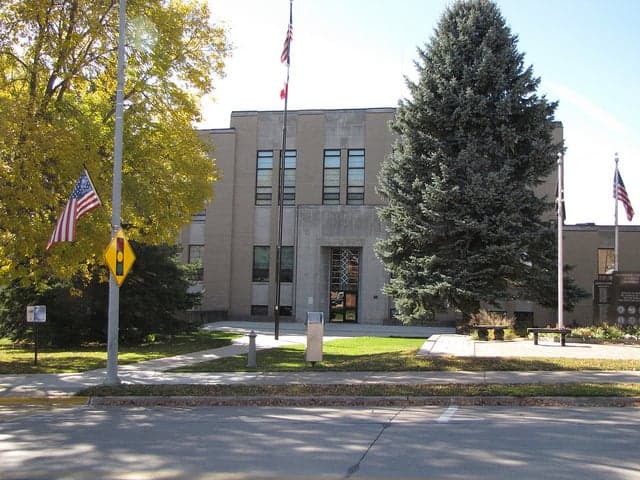
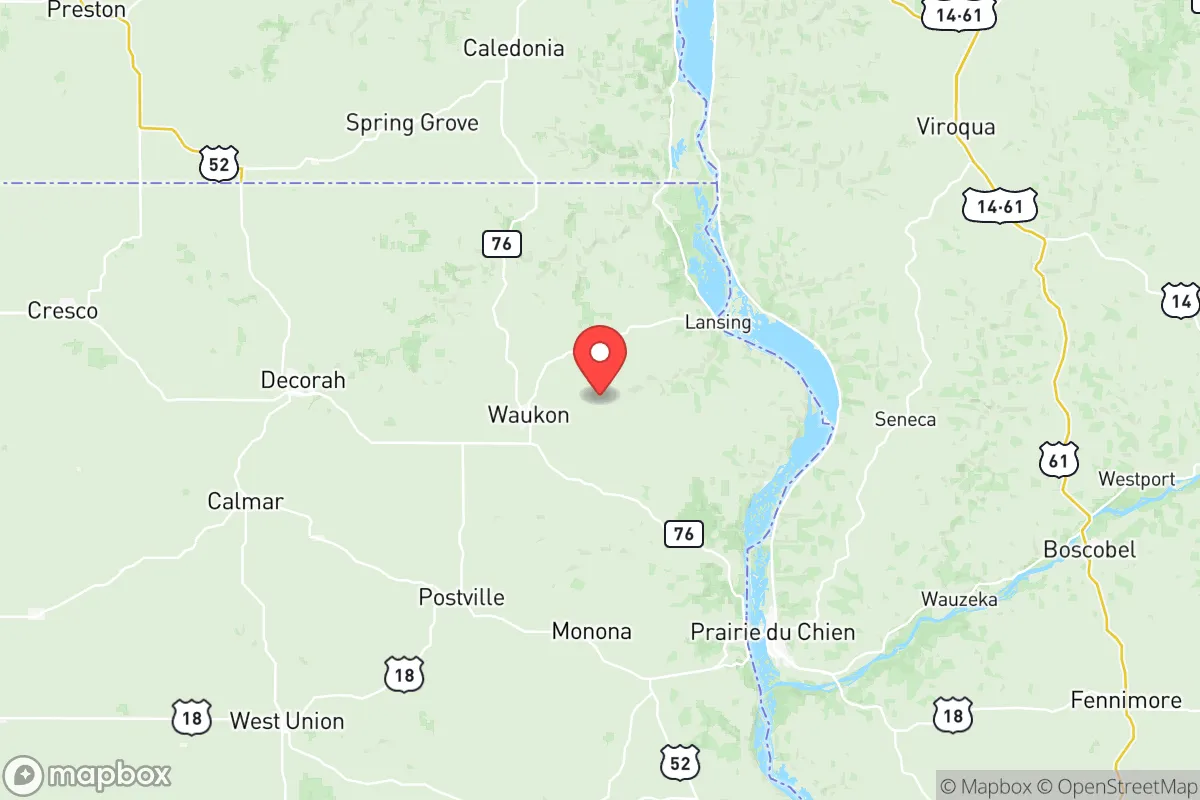
Photo: Wikipedia
Political ClimatePolitical Climate in Allamakee County
Showing district-level results — no local-only data available.
Local Political AnalysisPolitical Analysis of Allamakee County
Allamakee County, Iowa, leans Republican with a Cook PVI of R+4, making it slightly less conservative than the state of Iowa as a whole, which sits at R+6. This means the county is reliably red in statewide and national elections, but it’s not a deep-red stronghold—there’s enough Democratic and independent presence to keep races competitive, especially at the local level. Over the past decade, the county has shifted rightward, mirroring rural Iowa trends, but the drift has been slower here than in neighboring counties like Winneshiek or Clayton, thanks to a mix of small-town manufacturing, a growing Latino population in Postville, and a stubbornly independent streak among voters in the bluff country.
How it compares
Compared to Iowa’s R+6 statewide lean, Allamakee’s R+4 is a meaningful difference. In 2020, Donald Trump won the county by about 18 points, while he won Iowa by 8.5 points—so the county is actually more Republican than the PVI suggests in presidential years. But look at state legislative races, and the picture gets more nuanced. The county is split between two Iowa House districts: the western half, including Waukon and Lansing, leans red, while the eastern half, including Postville and Harpers Ferry, is more purple. Postville, with its large Hispanic and immigrant community, consistently votes more Democratic than the rest of the county, often swinging precincts by 10-15 points toward the blue side. In contrast, the rural precincts around New Albin and Waterville are reliably Republican, often delivering 70% or more for GOP candidates. The county’s overall R+4 masks this internal variation—it’s not a monolith, and local elections for county supervisor or sheriff can be genuinely competitive, with candidates often winning by single-digit margins.
What this means for residents
For conservative residents, Allamakee County feels like a comfortable place to live politically. Republican candidates usually win, and the county’s GOP platform—focused on agriculture, gun rights, and limited regulation—resonates with most voters. You’ll see Trump signs in yards from Waukon to Lansing, and the local Republican party is active. For liberal residents, the picture is more mixed. You’re not in a deep-blue enclave, but you’re also not isolated—Postville and parts of Harpers Ferry offer pockets of progressive thought, and the county’s Democratic party maintains a presence, especially around issues like labor rights and public education. The practical effect is that most residents, regardless of party, find common ground on local issues like maintaining the county’s roads, supporting the school districts in Waukon and Postville, and preserving access to the Mississippi River for recreation and tourism. The political divide is real, but it’s not as sharp as in urban areas—neighbors tend to get along, and local politics often boils down to personality and competence rather than party label.
Culturally, Allamakee County stands out for its strong sense of local identity. The county is home to the Effigy Mounds National Monument and a deep-rooted Norwegian and German heritage, which influences everything from festivals to local policy on land use. One notable distinction is the county’s approach to immigration: Postville’s meatpacking plant has drawn a diverse workforce for decades, and the community has navigated the tensions that come with that more pragmatically than some other rural Iowa towns. You won’t see the same level of anti-immigrant rhetoric here as in parts of western Iowa, partly because the local economy depends on that labor. Looking ahead, the county’s political trajectory will likely hinge on demographic shifts—if Postville’s population continues to grow, it could nudge the county slightly leftward, but the rural precincts are aging and staying red, so the net effect is probably a slow, modest rightward drift, keeping Allamakee a shade more moderate than the state as a whole.

State Political ClimatePolitical Climate in Iowa
State Political AnalysisPolitical Environment in the State
Iowa has shifted from a classic purple swing state to a solidly Republican R+6 lean over the past decade, driven by a realignment of its rural and small-town voters and a steady drift rightward among its white working-class base. The state voted for Barack Obama in 2008 and 2012, then flipped hard for Donald Trump in 2016 and 2020, and backed him again in 2024 by a comfortable margin. The dominant coalition today is a mix of evangelical conservatives, rural farmers, and suburban retirees, while the Democratic stronghold is shrinking to a handful of urban counties and college towns. For a relocator, this means a state where conservative policies are the norm, but where the old progressive tradition still has pockets of real influence.
Urban vs. rural divide
The political map of Iowa is a textbook study in the urban-rural split. The Democratic base is concentrated in three main areas: the Des Moines metro (Polk and Dallas counties), Iowa City (Johnson County), and the Quad Cities (Scott County). Polk County, home to Des Moines, voted for Biden by 18 points in 2020, but that margin is shrinking as the suburbs of Ankeny and Waukee trend right. Johnson County, anchored by the University of Iowa, is the bluest county in the state, voting for Biden by 38 points. Meanwhile, the rural counties of northwest and north-central Iowa—places like Sioux County (home to conservative Dordt University), Lyon County, and Osceola County—routinely vote 75-80% Republican. The real story is the collapse of Democratic support in small industrial towns like Ottumwa and Fort Dodge, which were union strongholds a generation ago and now vote reliably red. The 2020 election saw 31 of Iowa's 99 counties flip to Trump from Obama, mostly in the rural south and west.
Policy environment
Iowa's policy environment is defined by a low-tax, limited-government posture that has become more pronounced since Republicans took full control of state government in 2017. The state has a flat income tax of 3.8% (phased down from a top rate of 8.98% a decade ago), and the corporate tax rate is being cut to a flat 5.5% by 2026. There is no estate tax. Property taxes are moderate, with a median effective rate of about 1.5% of home value. Education policy is a flashpoint: Iowa passed a universal school voucher program in 2023, allowing any family to use public funds for private or homeschool expenses, a move that has reshaped the political landscape in suburban districts. Healthcare is more conservative than neighboring Minnesota or Illinois—Iowa did not expand Medicaid under the Affordable Care Act in the traditional way, instead using a managed-care waiver system. Election laws tightened after 2020: the state now requires voter ID, reduced early voting from 40 days to 20 days, and closed polls at 8 p.m. sharp. Abortion is restricted to the first six weeks of pregnancy under a 2023 law that was briefly blocked by the courts but is now in effect.
Recent policy direction
The last three years have seen a cascade of legislation that signals where Iowa is headed. On gun rights, Iowa became a permitless carry state in 2021, allowing any legal adult to carry a concealed firearm without a permit or training. On parental rights, the state passed a law in 2023 banning instruction on sexual orientation and gender identity in grades K-6, and requiring schools to notify parents of any changes to a student's health or well-being. On speech and privacy, Iowa enacted a law in 2024 that restricts public library content deemed "age-inappropriate" and allows parents to challenge materials. On medical autonomy, the six-week abortion ban is the most restrictive in the Midwest outside of Missouri, with no exceptions for rape or incest (only for medical emergency). On property rights, the state has a strong eminent domain protection law passed in 2006 after the Kelo decision, and recent legislation has limited local governments' ability to regulate short-term rentals like Airbnb. On voting, the 2021 election integrity law shortened the absentee ballot request window and banned private funding of election offices. The overall direction is toward a more libertarian-leaning conservative model on guns and taxes, combined with a socially conservative agenda on education and family policy.
Civil unrest & political movements
Iowa has not seen the kind of large-scale civil unrest seen in coastal states, but there have been notable flashpoints. The 2020 Black Lives Matter protests in Des Moines and Iowa City were relatively small and peaceful compared to national events, but they did lead to a push for police reform that ultimately stalled in the legislature. The most visible political movement in recent years has been the rise of the "Parents' Rights" movement, which organized heavily around school board elections in suburbs like Ankeny, Waukee, and Cedar Rapids, successfully flipping several boards to conservative majorities. On the left, the Iowa City area has a small but vocal activist community focused on immigrant rights, particularly around the state's refusal to accept refugees from certain countries. Immigration politics are less heated than in border states, but there have been controversies over local "sanctuary city" resolutions in Iowa City and Des Moines, both of which were symbolic and non-binding. Election integrity remains a live issue: the 2020 and 2022 elections saw no major fraud cases, but conservative groups continue to push for further restrictions. There is no serious secession or nullification movement in Iowa.
Projection
Over the next five to ten years, Iowa is likely to become more Republican, but with a twist. The rural counties will continue to bleed population, while the Des Moines metro and Iowa City grow. This demographic shift will make the state's politics more suburban and less purely rural. The suburbs of Ankeny and Waukee are trending right, but not as fast as the rural areas are trending left—meaning the overall partisan balance may stabilize at R+6 to R+8. The biggest wildcard is in-migration: Iowa is attracting remote workers from Chicago and the coasts, many of whom are moderate or liberal, and they are settling in the Des Moines area. If that trend accelerates, it could create a more competitive environment in the 2030s. However, the state's conservative policy infrastructure—the flat tax, the voucher program, the abortion ban—is now deeply embedded and would take a Democratic trifecta to reverse, which seems unlikely in the near term. A relocator moving in now should expect a state that is reliably red on most issues, with a growing cultural divide between the urban islands and the rural sea.
For a new resident, the bottom line is straightforward: if you lean conservative, you will find a state that has enacted most of your policy priorities and is likely to continue doing so. If you lean liberal, you will find a state where your vote matters most in local elections in Des Moines or Iowa City, but where state-level policy will often run against your preferences. The practical takeaway is that Iowa offers a stable, low-tax environment with a strong sense of local community, but the political climate is increasingly polarized along geographic lines. You will notice the difference driving from Ankeny to Ames, or from Sioux City to Iowa City—and that divide is only going to deepen.
* Values derived from national, state, county, city and local statistics and may differ in a specific area. Last updated: 2026-10-19T10:04:50.000Z
Narrative content on this page is AI-generated and may contain mistakes. Verify any details that matter before acting on them.
ReloMaps may earn a commission from affiliate links at no extra cost to you.

