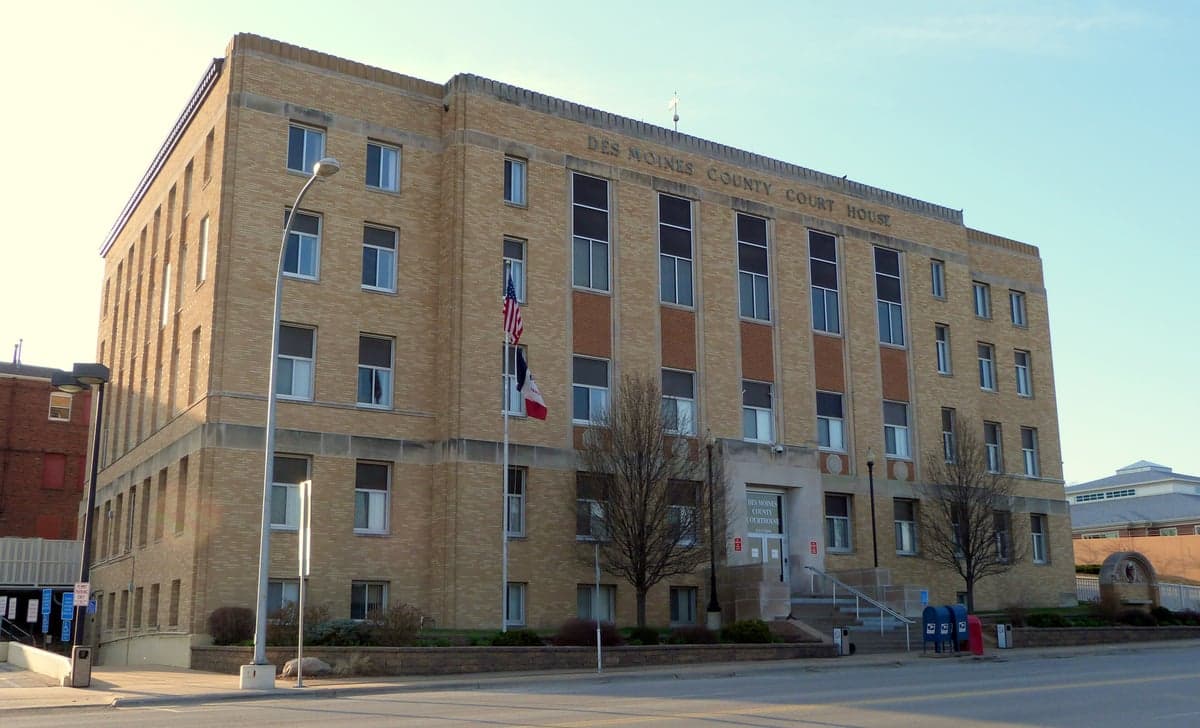
Photo: Wikipedia
Personal Sovereignty in Des Moines County
Viable for self-reliance. Generally workable, though some barriers may limit total independence.
What does Personal Sovereignty tell us?
Personal Sovereignty measures your capacity for self-reliance and independence with minimal government friction. Higher scores mean fewer barriers between you and the way you want to live... but it assumes you have the space you need and good neighbors.
What does this tell us?
Personal Sovereignty measures your capacity for self-reliance and independence with minimal government friction. Higher scores mean fewer barriers between you and the way you want to live... but it assumes you have the space you need and good neighbors.
State Policy
Energy independence: Importer (50% of energy produced in-state)
Personal Liberty
Homesteading

Personal Liberty Analysis
For conservative-leaning individuals and families prioritizing personal sovereignty, Des Moines County in southeast Iowa offers a notably permissive environment compared to the restrictive corridors of the East and West Coasts, though it operates within the broader framework of a state that has seen increasing regulatory encroachment in recent years. The county’s rural character, anchored by the Mississippi River and its largest city, Burlington, provides a buffer against the most aggressive forms of government overreach, but residents must remain vigilant about state-level trends. The autonomy picture here is mixed: strong on Second Amendment protections and property rights, but facing headwinds on taxation and medical freedom that require strategic navigation.
Tax burden and regulatory posture in Des Moines County
Iowa’s overall tax burden is moderate compared to high-tax states like New York or California, but Des Moines County residents face specific pressures that erode personal sovereignty. The state’s income tax, while recently cut to a flat 3.9% rate as of 2026, still represents a direct claim on earnings that preppers and self-reliant individuals resent. Property taxes in the county average around 1.5% of assessed value, which is higher than neighboring rural counties like Lee or Henry, largely due to the presence of Burlington’s municipal services and school district. For those seeking maximum autonomy, the unincorporated areas around West Burlington and Middletown offer lower mill levies and fewer zoning restrictions than inside Burlington city limits. The county’s regulatory posture on business and land use is generally light-touch, with no county-wide building codes in rural zones, though the Iowa Department of Natural Resources (DNR) imposes strict oversight on well water and septic systems—a point of friction for off-grid homesteaders. The state’s recent push to eliminate property taxes on machinery and equipment for small manufacturers is a positive sign, but the overall trend toward centralized environmental regulation remains a concern for those who value local control.
Self-defense and gun law specifics in southeast Iowa
Des Moines County is a stronghold for Second Amendment rights, with Iowa’s permitless carry law (effective since 2021) allowing any law-abiding adult to carry a concealed firearm without a license. This is a critical advantage for personal sovereignty, and local sheriffs in Burlington and Danville have publicly affirmed their support for the law. The county has no additional firearm restrictions beyond state statutes, meaning no waiting periods, no magazine capacity limits, and no red flag laws—though a 2024 state law did create a voluntary extreme risk protection order mechanism that some preppers view as a slippery slope. Gun ranges and training facilities are accessible, with the Burlington Gun Club offering rifle and pistol ranges, and the Big Hollow Recreation Area providing a public shooting range in nearby Des Moines County. For those concerned about government overreach, the county’s culture of self-defense is reinforced by a strong network of private property owners who post “no trespassing” signs and enforce their rights. The only practical limitation is the lack of a local gun show; residents often travel to Mount Pleasant (Henry County) or Fort Madison for private sales, which remain legal without background checks under state law.
Self-reliance and homesteading viability in Des Moines County
The county’s agricultural land and relatively low population density make it a viable location for homesteading and off-grid living, though not without bureaucratic hurdles. Lot sizes in unincorporated areas can be as small as 1 acre for residential use, but for serious self-reliance—gardening, livestock, and water independence—parcels of 5 to 20 acres are common and affordable, with prices ranging from $3,000 to $6,000 per acre. Areas around Mediapolis and Yarmouth offer the best combination of cheap land and minimal zoning, while the Mississippi River bottoms near Burlington’s outskirts have richer soil but higher flood risk. Off-grid feasibility is mixed: Iowa law requires all dwellings to have approved water and wastewater systems, meaning a drilled well and septic tank are mandatory, and the DNR’s inspection process can be invasive. Solar panels and rainwater collection are legal but must comply with state electrical codes, and composting toilets are not recognized as a primary sanitation method. For those willing to work within the system, the county’s agricultural extension office offers resources on permaculture and livestock management, but the regulatory overhead is a reminder that true off-grid autonomy is constrained by state-level health and safety mandates. The county’s right-to-farm ordinance protects agricultural operations from nuisance lawsuits, a boon for those raising chickens, goats, or bees on small acreages.
Personal liberties: parental rights, medical autonomy, speech, and property
Des Moines County’s cultural conservatism supports strong parental rights, with local school boards in Burlington, West Burlington, and Danville Community School District generally deferring to parents on curriculum and health decisions. Iowa’s 2023 law banning instruction on sexual orientation and gender identity in grades K-6 is widely supported here, and the county’s public libraries have resisted controversial materials, though the state’s book removal process remains a point of contention. Medical autonomy is weaker: Iowa’s vaccine mandate for schoolchildren (with limited exemptions) and the state’s prescription drug monitoring program are seen as intrusions, and the county’s healthcare system is dominated by Southeast Iowa Regional Medical Center in Burlington, which follows federal protocols. Free speech is robust, with no local ordinances restricting political expression, and property rights are protected by Iowa’s eminent domain laws, which require just compensation and public hearings. The county’s zoning board has a reputation for approving variances for home-based businesses and workshops, supporting economic self-reliance. However, the state’s recent expansion of sales tax to some digital services and the ongoing debate over property tax caps remind residents that fiscal sovereignty is always under pressure from Des Moines.
Overall, Des Moines County offers a solid foundation for personal sovereignty relative to the heavily regulated urban centers of the coasts, but it is not a libertarian paradise. The county’s gun-friendly culture, low land costs, and conservative local governance provide a buffer against the worst federal overreach, but state-level mandates on water, sanitation, and education require compliance. For the strategic relocator, the best path is to settle in unincorporated areas near Middletown or Mediapolis, where zoning is minimal and neighbors share a self-reliant ethos, while maintaining a close watch on Iowa’s legislative trends. Compared to states like Montana or Idaho, Des Moines County lacks the same degree of off-grid freedom, but it outperforms most of the Midwest in Second Amendment protections and property rights. For those willing to engage in local politics and build community networks, this corner of southeast Iowa remains a viable redoubt against the erosion of personal autonomy.

* Values derived from national, state, county, city and local statistics and may differ in a specific area. Last updated: 2026-05-28T01:27:25.000Z
Narrative content on this page is AI-generated and may contain mistakes. Verify any details that matter before acting on them.
ReloMaps may earn a commission from affiliate links at no extra cost to you.

