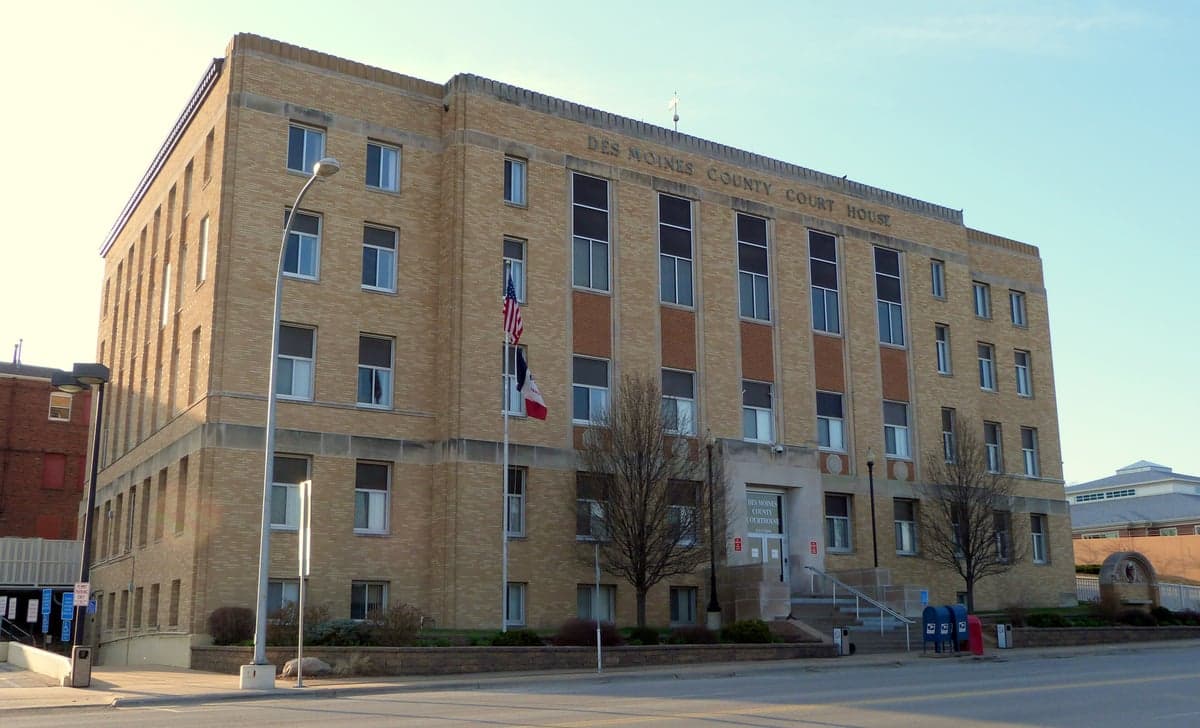
Photo: Wikipedia
Political ClimatePolitical Climate in Des Moines County
Showing district-level results — no local-only data available.
Local Political AnalysisPolitical Analysis of Des Moines County
Des Moines County, anchored by Burlington, has long been a bellwether for Iowa’s shifting political winds, but it’s now trending redder than its reputation suggests. The county’s Cook Partisan Voting Index (PVI) is R+4, meaning it votes about four points more Republican than the national average—a notable shift from the purple-leaning swing county it was just a decade ago. That puts it slightly to the right of the state as a whole, which sits at R+6, but the real story is how the county’s internal dynamics are changing. If you’ve been around here long enough, you remember when Burlington itself could flip blue in a wave election; now, the rural precincts and smaller towns are pulling the county decisively right, and the progressive drift in the city is starting to feel like an outlier.
How it compares
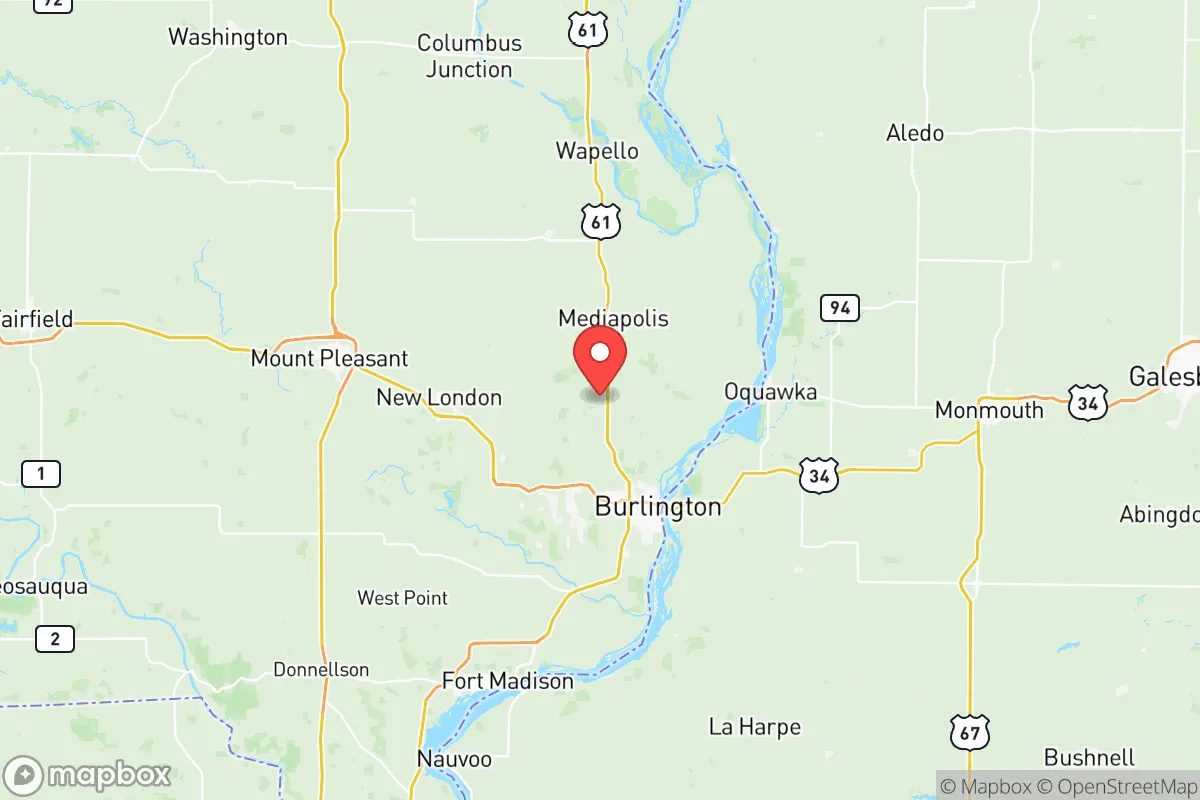
Compared to Iowa’s R+6 statewide lean, Des Moines County is a touch more moderate, but that gap is closing fast. The county’s R+4 rating reflects a mix of old-school conservative strongholds and a few stubbornly blue pockets. Take Burlington, the county seat and largest city: it’s the only real blue dot, with precincts near downtown and the riverfront leaning Democratic by 10-15 points in recent cycles. But drive ten minutes west to West Burlington, and you’ll find a solidly red suburb that votes R+8 or better. Head north to Mediapolis or Danville, and those small towns are R+12 or more—places where folks still wave the Gadsden flag and talk about property rights at the feed store. The swing precincts are in the unincorporated areas around Middletown and Yarmouth, where independent voters decide races by a few hundred votes. What’s changed is that those swing areas are breaking red more consistently now, while Burlington’s blue vote is shrinking as younger progressives move out for jobs in the Quad Cities or Des Moines.
What this means for residents
For those of us who’ve lived here through the 2000s and 2010s, the political shift means a growing tension between local control and state-level mandates. The county’s conservative majority has pushed back hard on things like mask mandates and vaccine passports—remember the 2021 school board fights in Burlington?—but the city council has tried to go the other way on zoning and environmental rules. That’s created a patchwork where your rights can depend on which side of the railroad tracks you live on. The real concern is that as the county gets redder, the progressive minority in Burlington is getting louder, pushing for things like rent control and “equity” initiatives that feel like government overreach to most of us. Meanwhile, the state legislature in Des Moines keeps passing preemption laws that override local ordinances, which cuts both ways—it protects gun rights and property rights, but it also means we can’t opt out of state-level tax hikes or energy mandates.
Culturally, Des Moines County still feels like the Iowa of the 1990s in the small towns: church suppers, hunting seasons, and a general distrust of government telling you how to live your life. But Burlington’s downtown has seen a wave of new coffee shops and art galleries that bring a more progressive vibe, and the annual Steamboat Days festival now has a noticeable political split in who shows up. Long-term, I see the county settling into a stable R+5 or R+6 as the rural vote solidifies and Burlington’s influence wanes. The key for residents is to stay engaged at the county level—school boards, supervisors, and zoning boards—because that’s where the real fights over your freedoms are happening, not in Washington. If you value low taxes and minimal government interference, you’ll find plenty of neighbors who agree, but you’ll also need to keep an eye on the city council meetings in Burlington, where the progressive agenda is still trying to get a foothold.

State Political ClimatePolitical Climate in Iowa
State Political AnalysisPolitical Environment in the State
Iowa has been reliably Republican for over a decade, carrying the GOP in every presidential election since 2016 and holding a Cook PVI of R+6, but the state’s politics are far from monolithic. The dominant coalition is a mix of rural conservatives, evangelical Christians, and suburban moderates who have increasingly aligned with the GOP on cultural and economic issues. Over the last 20 years, Iowa has shifted from a classic swing state—voting for Obama in 2008 and 2012—to a solid red stronghold, driven by a combination of rural realignment, suburban drift rightward, and a steady influx of conservative-leaning migrants from the coasts. The Democratic stronghold in the state has shrunk to a handful of urban counties, while the rest of the map has turned a deep shade of red.
Urban vs. rural divide
The political map of Iowa is a textbook case of the urban-rural split. The Democratic base is concentrated in the state’s three major metro areas: Des Moines (Polk County), Iowa City (Johnson County), and Ames (Story County). Polk County, home to the state capital, voted for Biden by 13 points in 2020, while Johnson County, anchored by the University of Iowa, went for Biden by a staggering 35 points. Story County, home to Iowa State University, gave Biden a 17-point margin. These three counties alone account for roughly 30% of the state’s population, but they are islands of blue in a sea of red. The rest of the state—from the sprawling cornfields of Sioux County in the northwest to the manufacturing towns of Dubuque and Davenport in the east—votes overwhelmingly Republican. Sioux County, for example, gave Trump 82% of the vote in 2020, making it one of the most conservative counties in the nation. The rural-urban divide is stark: drive 30 minutes outside Des Moines, and you’ll find yourself in counties like Dallas or Warren, which flipped from blue to red in the 2010s and now vote Republican by double digits. The suburbs of Ankeny and Waukee, once swing areas, have also shifted right, reflecting a broader trend of suburban conservatives consolidating behind the GOP.
Policy environment
Iowa’s policy environment is a conservative’s dream, with a low-tax, low-regulation posture that has been aggressively pursued by the Republican-controlled legislature and Governor Kim Reynolds. The state has a flat income tax of 3.9% (phased down from a progressive top rate of 8.98% in 2018), and corporate taxes are among the lowest in the Midwest. There is no estate tax, and property taxes are capped at 2% annual growth. On education, Iowa passed a universal school voucher program in 2023, allowing any family to use public funds for private or homeschool expenses—a major win for parental rights. Healthcare policy is mixed: the state expanded Medicaid under the Affordable Care Act in 2014, but the legislature has since imposed work requirements for able-bodied adults, a move that has been tied up in court. Election laws have been tightened significantly: in 2021, Iowa passed a law reducing early voting days from 29 to 20, closing polls at 8 p.m. instead of 9 p.m., and requiring absentee ballot applications to be returned by mail rather than dropped off. Voter ID is also required. These changes were sold as election integrity measures, but critics argue they suppress turnout in Democratic-leaning urban areas. On the regulatory front, Iowa is a right-to-work state, has no state-level minimum wage above the federal $7.25, and has preempted local governments from enacting their own labor or environmental rules—keeping the business climate friendly and predictable.
Trajectory & freedom
Iowa is becoming more free in the conservative sense, with a clear trajectory toward expanding personal liberty in areas like gun rights, parental rights, and economic freedom. In 2021, the state passed constitutional carry, allowing any law-abiding adult to carry a concealed firearm without a permit—a major expansion of Second Amendment rights. In 2023, the legislature passed a law banning gender-affirming care for minors, a move framed as protecting children from irreversible medical decisions. The same year, a law was enacted requiring schools to notify parents if a student requests a name or pronoun change, and banning instruction on sexual orientation and gender identity through sixth grade. These laws are part of a broader push to assert parental authority over schools and medical providers. On the economic front, the flat tax and regulatory rollbacks have made Iowa a magnet for businesses fleeing high-tax states like California and Illinois. However, there are concerns about government overreach: the state’s ban on local plastic bag bans and its preemption of local minimum wage hikes can be seen as limiting local control. Still, for a conservative relocating from a blue state, Iowa’s trajectory is unmistakably toward greater personal and economic freedom.
Civil unrest & political movements
Iowa has seen relatively little civil unrest compared to coastal states, but there have been flashpoints. In 2020, Black Lives Matter protests erupted in Des Moines and Iowa City, with some turning violent—windows were smashed and a statue was toppled at the state capitol. The response from state and local law enforcement was generally restrained, but the protests highlighted the cultural divide between urban and rural Iowa. On the right, the state has been a hotbed for the “Parents’ Rights” movement, with groups like Moms for Liberty gaining traction in suburban school board races, particularly in Ankeny and West Des Moines. Immigration politics are less heated than in border states, but there have been controversies over sanctuary city policies: in 2019, Iowa City declared itself a “welcoming city,” limiting cooperation with federal immigration enforcement, which drew backlash from state Republicans who passed a law in 2020 banning such policies statewide. Election integrity remains a live issue: after the 2020 election, Trump’s narrow loss in Iowa (by 8 points) led to calls for audits, but no widespread fraud was found. The state’s new election laws have been challenged in court but remain in effect. A new resident would notice that political activism is visible but not overwhelming—yard signs, church bulletin inserts, and local talk radio are the main battlegrounds, not street protests.
Projection
Over the next 5-10 years, Iowa is likely to become even more Republican, driven by demographic shifts and in-migration patterns. The state’s population is aging and slowly growing, with most growth occurring in the conservative-leaning suburbs of Des Moines—places like Ankeny, Waukee, and Johnston—while rural counties continue to lose population. The influx of migrants from blue states, particularly Illinois and California, tends to be conservative-leaning, as they are often fleeing high taxes and progressive policies. The Democratic base in the urban cores is shrinking as young professionals move to the suburbs or out of state. The state’s political trajectory is toward even lower taxes, more school choice, and further restrictions on progressive social policies. A new resident moving in now should expect to find a state that is solidly red, with a government that is actively rolling back the clock on progressive reforms. The only wild card is the potential for a suburban backlash if the GOP overreaches on cultural issues, but for now, the trend is clear: Iowa is becoming a conservative stronghold, not a swing state.
Bottom line for a new resident: If you’re moving to Iowa from a blue state, you’ll find a government that respects your gun rights, your parental authority, and your wallet. The tax burden is low, the schools are increasingly choice-friendly, and the political culture is one of quiet conservatism rather than noisy activism. Just be prepared for the urban-rural divide: if you settle in Des Moines or Iowa City, you’ll be in a blue bubble, but the state as a whole will feel like a safe haven for conservative values. The trajectory is toward more freedom, not less, and that’s a rare thing in America today.
* Values derived from national, state, county, city and local statistics and may differ in a specific area. Last updated: 2026-05-28T01:27:25.000Z
Narrative content on this page is AI-generated and may contain mistakes. Verify any details that matter before acting on them.
ReloMaps may earn a commission from affiliate links at no extra cost to you.

