Photo: Wikipedia
Demographics of Irmo, SC
Affluence Level in Irmo, SC
A middle-class area roughly in line with national averages across income, home values, education, and employment.
People of Irmo, SC
The people of Irmo, South Carolina today number 11,799, forming a community that is predominantly White (61.3%) with a substantial Black population (29.3%) and small but distinct East/Southeast Asian (2.2%) and Hispanic (2.8%) communities. The city is notably less diverse than the broader Columbia metropolitan area in its foreign-born share—just 1.5% of residents were born outside the United States, compared to roughly 6% for the metro as a whole. With 37.3% of adults holding a bachelor’s degree or higher, Irmo’s population is more educated than the state average (29%), reflecting its character as a middle-to-upper-middle-class suburb anchored by families working in Columbia’s professional and government sectors. Residents often describe Irmo as a quiet, family-oriented bedroom community with a strong sense of local identity, distinct from the faster-paced growth of nearby Lexington or the urban density of Columbia proper.
How the city was settled and grew
Irmo’s human history is almost entirely a 20th-century story. The area was sparsely settled through the 1800s, with a handful of farming families working cotton and timber land along the Dutch Fork region. The town’s founding is tied directly to the railroad: in 1890, the Columbia, Newberry and Laurens Railroad laid tracks through the area, and a depot was established at a crossroads known as “Irmo” (a name derived from the postmaster’s wife, Irma, with a letter rearranged). The first wave of permanent residents were railroad workers, merchants, and small-scale farmers who built homes along the rail corridor near what is now Main Street and the historic Irmo Depot district. Through the 1920s and 1930s, the population remained tiny—fewer than 200 people—and was almost entirely White, with a small number of Black families living in rural pockets outside the town limits. The Lake Murray Dam construction (1927–1930) brought a temporary influx of laborers, but most left after completion. Irmo remained a quiet whistle-stop until the post-World War II era, when the first suburban subdivisions began appearing along Broad River Road and what is now Harbison Boulevard, drawing White families from Columbia seeking larger lots and lower taxes.
Modern era (post-1965)
The passage of the Immigration and Nationality Act of 1965 had minimal direct impact on Irmo, as the city’s foreign-born population remains very low. Instead, the major demographic force after 1965 was domestic in-migration from the Rust Belt and from within South Carolina itself. The completion of Interstate 26 in the 1970s and the expansion of Harbison State Forest and nearby corporate parks turned Irmo into a prime commuter suburb for Columbia’s growing white-collar workforce. The Woodfield and Lake Pointe neighborhoods were developed in the 1970s and 1980s, attracting middle-class families—overwhelmingly White—employed by the state government, Blue Cross Blue Shield of South Carolina, and the University of South Carolina. By the 1990s, Black families began moving into Irmo in larger numbers, particularly into established subdivisions like Piney Grove and newer developments along St. Andrews Road. This shift was part of a broader pattern of Black middle-class suburbanization from Columbia’s urban core. The East/Southeast Asian community (2.2%) is small but visible, concentrated among professionals in engineering and healthcare who settled in Harbison and newer sections of Lake Pointe during the 2000s. The Indian-subcontinent population (0.3%) is negligible, and the Hispanic community (2.8%) is dispersed, with no single ethnic enclave. The city’s Black population share has risen steadily from roughly 15% in 1990 to 29.3% today, while the White share has declined from over 80% in 1990 to 61.3%.
The future
Irmo’s population is likely to continue growing slowly, with the city’s buildable land largely constrained by Lake Murray to the west and the town of Lexington to the south. The demographic trend points toward gradual diversification, driven primarily by continued Black middle-class in-migration from Columbia and, to a lesser extent, by East/Southeast Asian professionals attracted to the school system and proximity to the Harbison employment corridor. The foreign-born share is unlikely to rise sharply given the city’s housing costs (median home value around $280,000) and lack of entry-level rental stock. The Hispanic and Indian-subcontinent populations are expected to remain small and assimilated rather than forming distinct enclaves. The city is not tribalizing into separate ethnic neighborhoods; rather, the older subdivisions like Woodfield and Lake Pointe are becoming more mixed, while newer developments along Lake Murray Boulevard attract a predominantly White, affluent demographic. The next decade will likely see Irmo become slightly more diverse but remain a predominantly White and Black middle-class suburb with a very small immigrant presence.
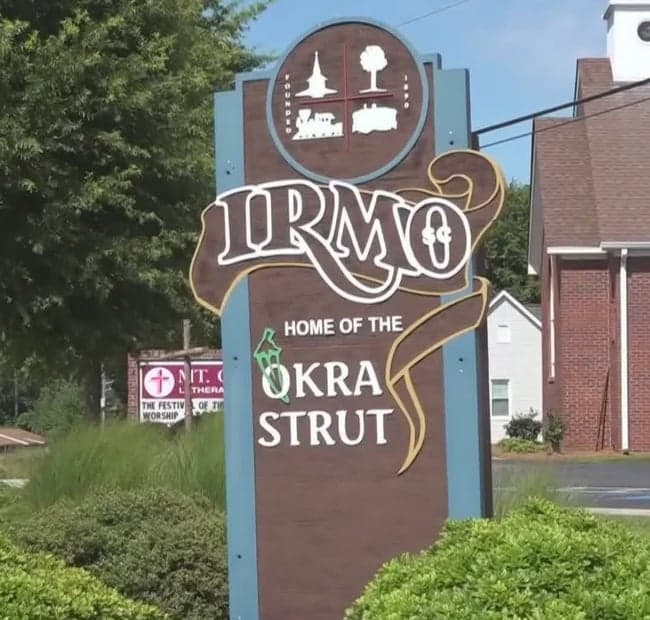
For someone moving in now, Irmo offers a stable, family-oriented environment with good schools and low crime, but with limited ethnic diversity and a population that is overwhelmingly native-born. The city is becoming more racially integrated in its older neighborhoods while maintaining its character as a quiet, commuter-oriented suburb. New residents should expect a community where neighborly familiarity and local events—like the Irmo Okra Strut festival—still define daily life, and where demographic change is gradual rather than disruptive.

* Values derived from national, state, county, city and local statistics and may differ in a specific area. Last updated: 2026-04-29T22:54:06.000Z
Narrative content on this page is AI-generated and may contain mistakes. Verify any details that matter before acting on them.
ReloMaps may earn a commission from affiliate links at no extra cost to you.

