Photo: Wikipedia
Demographics of Jacksboro, TX
Affluence Level in Jacksboro, TX
A below-average socioeconomic profile. Incomes, home values, and educational attainment trail the U.S., with higher poverty and unemployment.
People of Jacksboro, TX
The people of Jacksboro, Texas, today number 4,151, forming a predominantly White (61.8%) and Hispanic (29.5%) community with a small Black population (7.1%) and a foreign-born share of 6.5%. The city retains a distinctly rural, conservative character, with only 11.5% of adults holding a college degree, reflecting its historical roots in agriculture and energy. Jacksboro’s identity is shaped by its location as the seat of Jack County, a role that has anchored its population around the courthouse square and surrounding neighborhoods like the historic downtown district and the newer subdivisions along U.S. Highway 281.
How the city was settled and grew
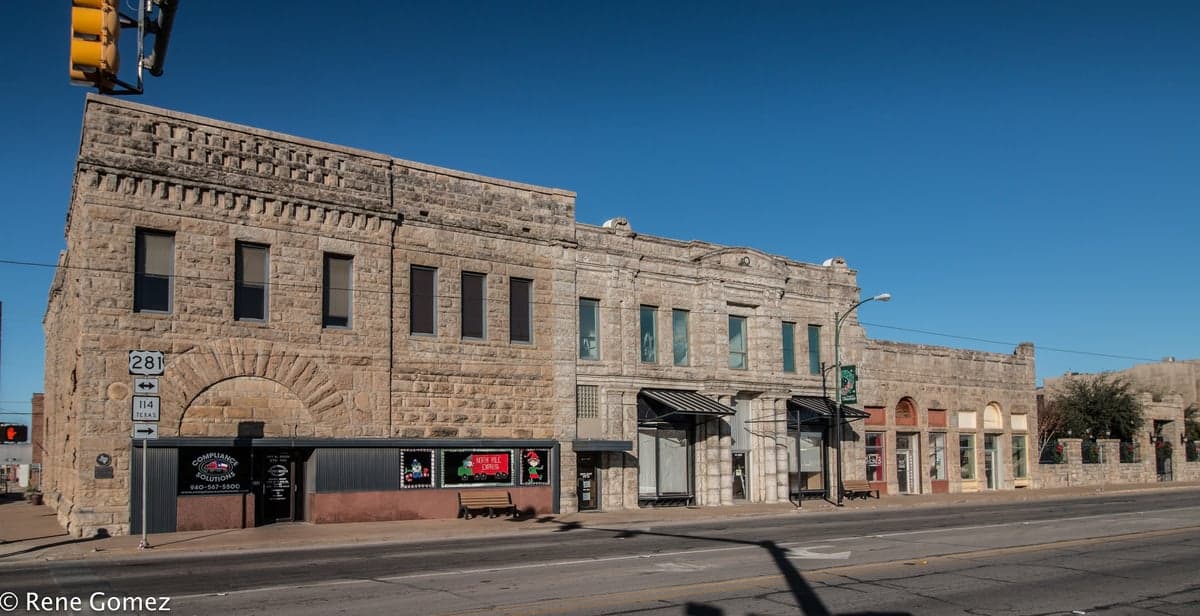
Jacksboro was founded in 1856 as the county seat of Jack County, named after brothers William and Thomas Jack, early Texas settlers. The original population was drawn by land grants offered to Anglo-American settlers under the Texas Republic and later state policies, with the first wave arriving in the 1850s and 1860s. These settlers were primarily farmers and ranchers from the U.S. South, establishing homesteads in what is now the Old Town Jacksboro neighborhood around the courthouse square, where many original limestone buildings still stand. The arrival of the Fort Worth and Denver Railway in 1882 spurred a second wave, bringing merchants, railroad workers, and a small number of Black families who settled in the Southside district, historically the city’s African American enclave. By the early 20th century, the discovery of oil in the nearby Jack County fields in the 1910s and 1920s drew a transient population of roughnecks and drillers, many of whom lived in temporary camps that later evolved into the Oil Field Addition neighborhood on the city’s western edge. The population remained overwhelmingly Anglo through the mid-20th century, with Hispanic families beginning to arrive in small numbers during the 1940s and 1950s, primarily as agricultural laborers who settled in the Barrio Viejo area along the railroad tracks.
Modern era (post-1965)
After the 1965 Hart-Cellar Act, Jacksboro saw a modest increase in Hispanic immigration, driven by demand for labor in ranching, oilfield services, and the local poultry processing industry. The Hispanic population grew from roughly 5% in 1970 to 29.5% today, with most families settling in the Barrio Nuevo neighborhood east of the downtown core, a newer area of modest single-family homes built in the 1980s and 1990s. The Black population, which peaked at around 12% in the 1950s, has declined to 7.1% as younger generations moved to larger cities like Fort Worth and Dallas for employment and education. Domestic in-migration since 2000 has been modest, with new residents drawn by low housing costs and a rural lifestyle; these newcomers have largely built homes in the Lakeview Estates subdivision, a master-planned community on the city’s north side developed in the 2000s. The Asian and Indian populations remain at 0.0%, reflecting the city’s limited economic diversification and lack of professional-sector jobs that attract these groups. The foreign-born share of 6.5% is almost entirely Hispanic, with many families having roots in Mexico and Central America, and they are increasingly assimilating into the broader community through intermarriage and English-language adoption.
The future
Jacksboro’s population is projected to remain stable or grow slowly, with the Hispanic share likely continuing to rise toward 35-40% over the next decade, driven by higher birth rates and continued immigration for agricultural and energy-sector work. The White population is aging and declining in absolute numbers, as younger Anglos leave for college and urban careers, a trend visible in the emptying of older neighborhoods like Old Town and Southside. The city is not tribalizing into distinct enclaves; instead, residential patterns are becoming more integrated, with Hispanic families now living in all neighborhoods, including previously Anglo-dominated Lakeview Estates. The Black population is expected to plateau or decline further, as the community lacks the economic base to retain younger generations. The next 10-20 years will likely see Jacksboro become a more Hispanic-majority city, with a continued rural, conservative political culture, but with a growing bilingual and bicultural character.
For someone moving in now, Jacksboro is a stable, slow-growing rural community where the population is becoming more Hispanic but remains overwhelmingly conservative and family-oriented. The city offers low-cost housing and a tight-knit social fabric, but limited economic opportunity and educational attainment will continue to push younger residents outward. New arrivals will find a place where the old Anglo ranching heritage and the newer Hispanic working-class culture are gradually blending into a single, locally rooted identity.

* Values derived from national, state, county, city and local statistics and may differ in a specific area. Last updated: 2026-05-23T03:37:43.000Z
Narrative content on this page is AI-generated and may contain mistakes. Verify any details that matter before acting on them.
ReloMaps may earn a commission from affiliate links at no extra cost to you.

