Demographics of Jackson, MS
Affluence Level in Jackson, MS
A low-income area with significant economic hardship. Household wealth and educational attainment are well below national averages.
People of Jackson, MS
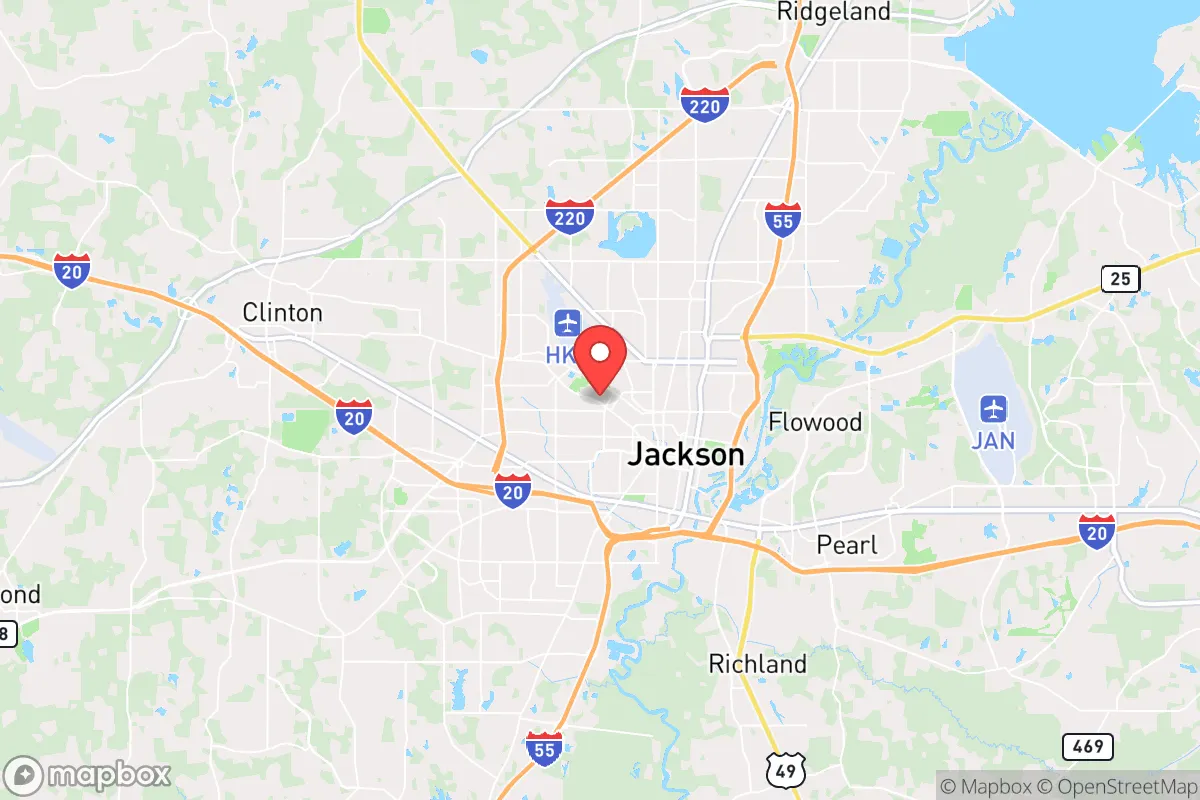
Jackson, Mississippi, is a predominantly Black city of 149,827 residents, with a population that is 81.5% Black, 14.1% White, 2.2% Hispanic, and less than 1% combined East/Southeast Asian and Indian. The city is characterized by its deep-rooted African American cultural and political identity, a legacy of both the Great Migration and post-1960s White flight, and a relatively low foreign-born share of just 1.1%. Today, Jackson is a majority-Black, majority-Democratic urban core surrounded by predominantly White, Republican suburbs, creating a stark demographic and political divide within the metro area.
How the city was settled and grew
Founded in 1822 as the state capital on the Pearl River, Jackson’s early growth was driven by its role as a government and transportation hub. The original White settlers were primarily Anglo-American planters and merchants, who built the city’s early neighborhoods like Fondren and Belhaven as affluent enclaves. After the Civil War, Jackson’s Black population grew slowly, concentrated in areas like Farish Street, which became the historic center of Black commerce and culture during the Jim Crow era. The first major demographic shift came with the Great Migration (1910–1970), when tens of thousands of Black Mississippians moved from rural Delta plantations to Jackson for industrial and service jobs. By 1960, Jackson was roughly 40% Black, with Black families settling in established neighborhoods like Georgetown and West Jackson due to restrictive housing covenants that confined them to certain wards.
Modern era (post-1965)
The post-1965 period reshaped Jackson’s population dramatically. The 1968 Fair Housing Act and the end of legal segregation triggered rapid White flight to suburbs like Madison, Ridgeland, and Flowood. Between 1970 and 2020, Jackson’s White population fell from roughly 60% to 14.1%, while the Black share rose from 40% to over 80%. This exodus hollowed out the city’s tax base and left many once-integrated neighborhoods, such as Eastover and Woodland Hills, predominantly Black and middle-class. The city’s foreign-born population remains tiny (1.1%), with small clusters of Hispanic residents in South Jackson and a handful of East/Southeast Asian families in North Jackson. Unlike many Southern cities, Jackson did not attract significant post-1965 immigration from Asia or Latin America; its demographic story is overwhelmingly one of domestic Black in-migration and White out-migration. The Indian subcontinent population is negligible at 0.1%, and East/Southeast Asian communities are similarly minimal at 0.2%.
The future
Jackson’s population is projected to continue declining slowly, from a peak of roughly 200,000 in 1980 to under 150,000 today. The city is not homogenizing into a single enclave but rather tribalizing along class lines within the Black majority. Affluent Black professionals are gravitating toward neighborhoods like Belhaven and Fondren, which have seen reinvestment and gentrification, while lower-income Black residents are increasingly concentrated in West Jackson and South Jackson. The Hispanic share (2.2%) is growing slowly but remains far below national averages, and the foreign-born population is unlikely to rise significantly due to restrictive state immigration policies and limited economic opportunities. The White population has stabilized at around 14%, mostly in historic enclaves like Belhaven and near the medical center. Over the next 10–20 years, Jackson will likely remain a majority-Black, economically stratified city with a shrinking overall population, a small but stable White minority, and negligible immigrant growth.
For someone moving in now, Jackson offers a deeply rooted African American cultural heritage and lower housing costs than the surrounding suburbs, but also faces challenges of population decline, a weak job market, and strained city services. The city is becoming more class-divided within its Black majority rather than more diverse, and newcomers should expect a community that is politically and culturally cohesive but economically polarized.

* Values derived from national, state, county, city and local statistics and may differ in a specific area. Last updated: 2026-04-24T06:30:35.000Z
Narrative content on this page is AI-generated and may contain mistakes. Verify any details that matter before acting on them.
ReloMaps may earn a commission from affiliate links at no extra cost to you.

