 Popular
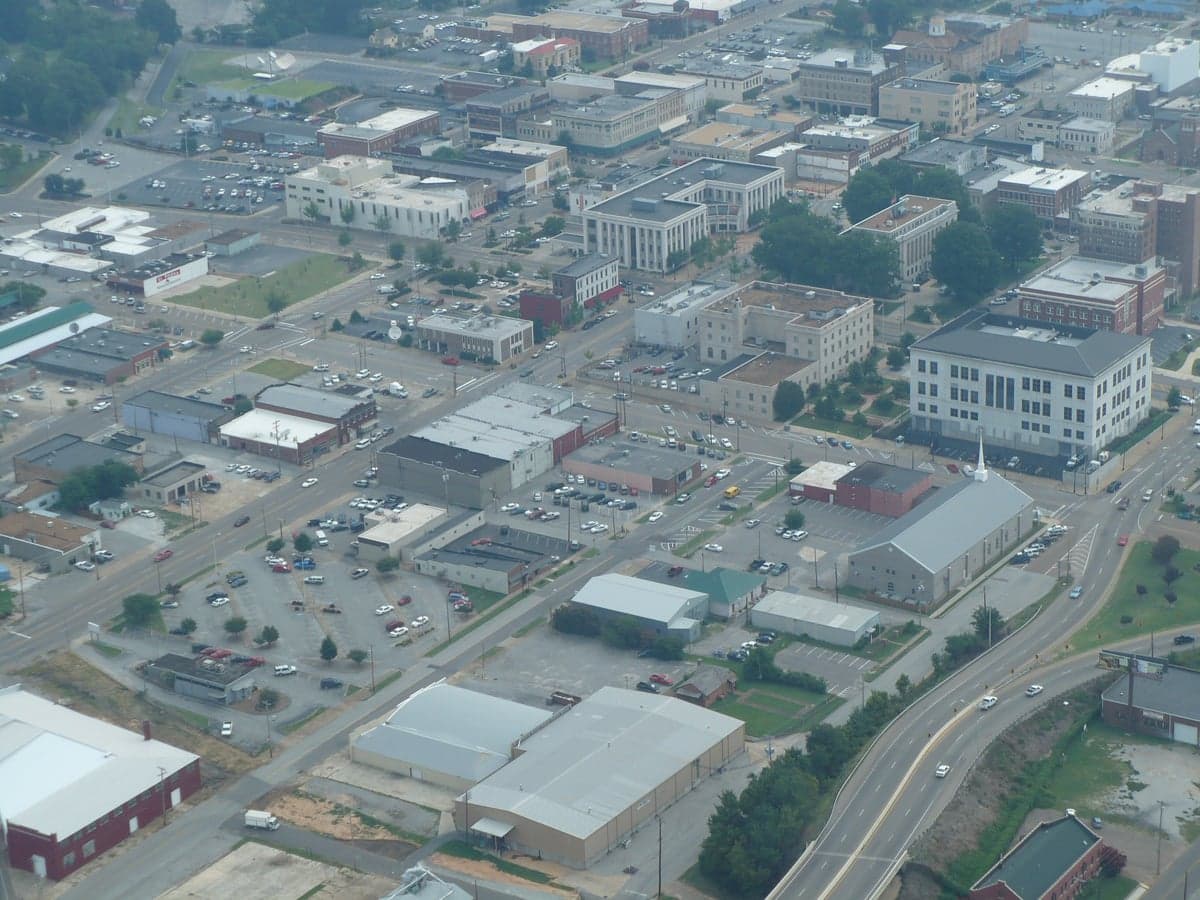
Photo: Wikipedia
Demographics of Jackson, TN
Affluence Level in Jackson, TN
A below-average socioeconomic profile. Incomes, home values, and educational attainment trail the U.S., with higher poverty and unemployment.
People of Jackson, TN
The people of Jackson, Tennessee today form a nearly evenly split Black and White city of 68,098, a demographic rarity in the South that reflects its distinct industrial and migration history. With a foreign-born population of just 2.0% and a college attainment rate of 26.6%, Jackson is a predominantly native-born, working-to-middle-class community where racial identity, rather than immigration, has been the defining demographic story. The city’s character is shaped by a legacy of railroad and factory employment, a strong religious and family-oriented culture, and a population that is slowly diversifying through Hispanic and East/Southeast Asian growth while remaining overwhelmingly American-born.
How the city was settled and grew
Jackson was founded in 1821 as the seat of newly formed Madison County, named after President Andrew Jackson, and its early population was drawn by the promise of fertile cotton land and the strategic location on the Forked Deer River. The original settlers were primarily White yeoman farmers and slaveholding planters from Virginia, North Carolina, and Kentucky, who established the city as a regional cotton and trading hub. The arrival of the railroad in the 1850s—first the Memphis and Ohio, then the Nashville and Chattanooga—transformed Jackson into a rail junction, attracting Irish and German laborers who settled in the Lambuth and North Jackson neighborhoods near the rail yards. After the Civil War, freedmen moved into the city from surrounding plantations, forming the foundation of the Black community in areas like East Jackson and the Washington Street corridor, where churches, schools, and small businesses anchored a self-sufficient African American district. The early 20th century brought a second wave of Black migration from rural West Tennessee during the Great Migration, drawn by factory jobs at companies like the Jackson Iron Works and the Bemis cotton bag plant, which concentrated Black families in the Bemis and South Jackson neighborhoods. By 1950, Jackson’s population was roughly 70% White and 30% Black, a ratio that would shift dramatically over the next 70 years.
Modern era (post-1965)
The post-1965 period saw Jackson’s White population begin a steady decline as suburbanization and school desegregation prompted many White families to move to outlying areas like North Jackson and the Highland Park district, while Black families moved into previously White neighborhoods such as Lambuth and East Jackson. The 1970s and 1980s brought a significant influx of Black residents from rural Madison County and neighboring counties, drawn by expanding employment at the Jackson-Madison County General Hospital and industrial plants like the Procter & Gamble paper mill and the Caterpillar parts facility. This wave solidified Jackson’s Black population at roughly 40-45% by 1990, while White flight to unincorporated areas and the bedroom community of Medon accelerated. The Hispanic population, though small at 4.7% today, began growing in the 1990s as Mexican and Central American workers arrived for construction, poultry processing, and agricultural labor, settling primarily in South Jackson and the Airport Road area. East/Southeast Asian communities, at 1.1%, are a more recent addition, with Vietnamese and Filipino families arriving after 2000 for medical and manufacturing jobs, clustering near the Jackson-Madison County General Hospital campus. The Indian-subcontinent population remains tiny at 0.3%, largely professionals in healthcare and education. The net effect is a city that has become nearly evenly split between Black and White residents, with a small but growing Hispanic presence and minimal foreign-born influence—a pattern that distinguishes Jackson from more immigrant-heavy Southern cities like Nashville or Memphis.
The future
Jackson’s population is projected to remain stable or decline slightly over the next 10-20 years, as the city’s low birth rate and out-migration of young adults to larger metros offset any new in-migration. The White population is likely to continue a slow decline, while the Black population may plateau or grow modestly through natural increase and continued in-migration from rural West Tennessee. The Hispanic share is expected to rise gradually, potentially reaching 6-8% by 2040, as families already in the South Jackson enclave grow and attract new arrivals from Mexico and Central America. East/Southeast Asian and Indian communities will likely remain small, sustained by specific employer recruitment rather than chain migration. The city is not homogenizing into a single identity; rather, it is tribalizing into distinct neighborhoods—predominantly Black areas in East Jackson and Bemis, White-majority areas in North Jackson and Highland Park, and a small Hispanic corridor in South Jackson. This pattern reflects a city where race and geography remain tightly linked, and where the absence of significant immigration means demographic change will be slow and incremental.
For someone moving to Jackson now, the city offers a deeply rooted, family-oriented community with a strong sense of place, but one where racial divisions are still visible in neighborhood composition and social networks. The low foreign-born share means English is the near-universal language, and the city’s culture remains grounded in church, school, and local sports. Jackson is not becoming a diverse melting pot; it is a stable, biracial Southern city with a small Hispanic fringe, where newcomers will find a community that values tradition and neighborliness over rapid change.

* Values derived from national, state, county, city and local statistics and may differ in a specific area. Last updated: 2026-05-02T22:10:32.000Z
Narrative content on this page is AI-generated and may contain mistakes. Verify any details that matter before acting on them.
ReloMaps may earn a commission from affiliate links at no extra cost to you.

