Photo: Wikipedia
Demographics of Jamestown, ND
Affluence Level in Jamestown, ND
A middle-class area roughly in line with national averages across income, home values, education, and employment.
People of Jamestown, ND
Jamestown, North Dakota, is home to 15,774 residents who form a predominantly white (89.6%), native-born community with a strong Scandinavian and German heritage. The city’s identity is rooted in its role as a regional trade, healthcare, and education hub for the surrounding agricultural plains, with a population density that feels small-town but not isolated. Distinctive markers include a high proportion of families and retirees, a low foreign-born share (1.9%), and a modest college attainment rate (22.1%), reflecting a workforce oriented toward practical trades, farming, and local services. The people here value stability, self-reliance, and community ties, with a conservative-leaning ethos that shapes local politics and daily life.
How the city was settled and grew
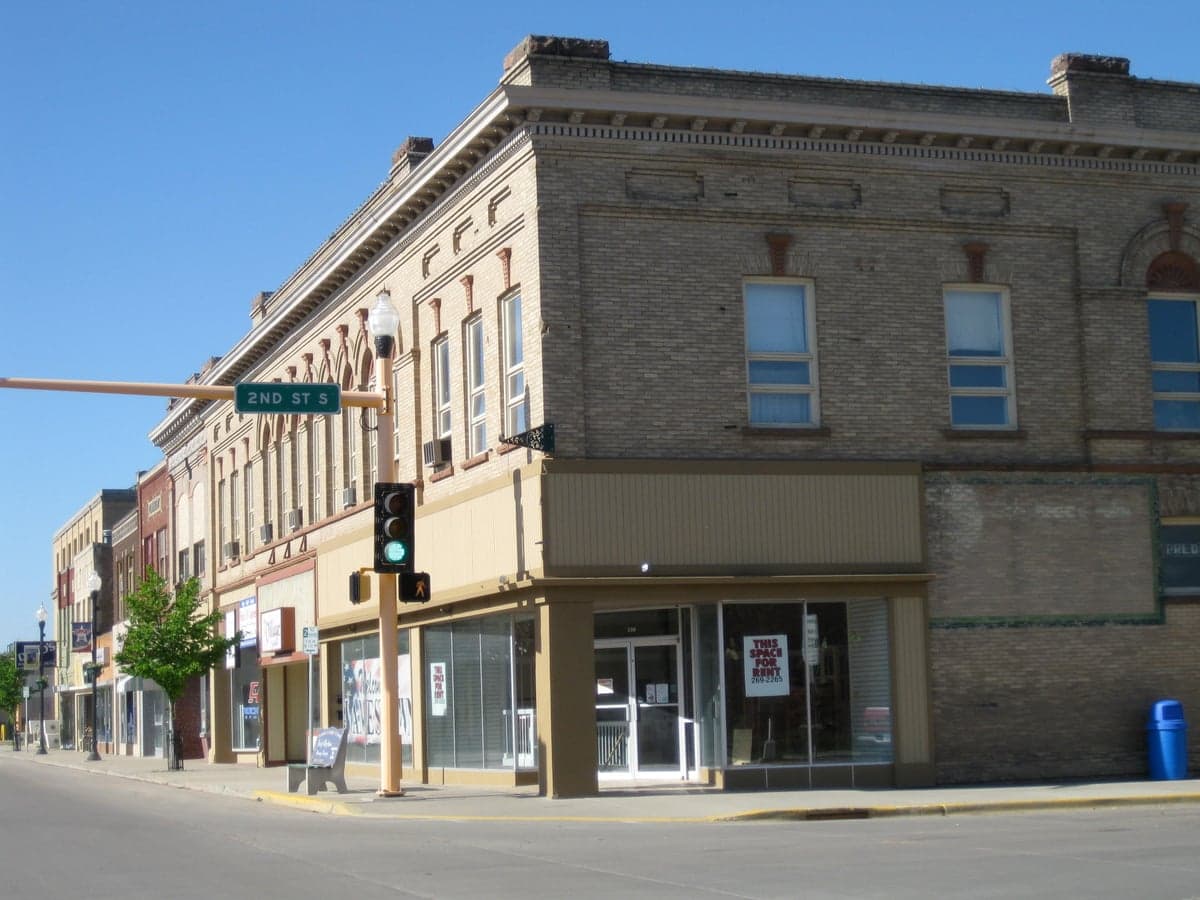
Jamestown was founded in 1872 as a Northern Pacific Railroad division point, drawing its first wave of settlers from Scandinavia, Germany, and Canada. The railroad and the promise of free land under the Homestead Act attracted farmers and laborers who built the city’s earliest neighborhoods. The original settlement clustered around the railroad depot in what is now the Downtown Historic District, where Scandinavian immigrants established churches, mercantile stores, and grain elevators. By the 1880s, a second wave of German-Russian immigrants—fleeing religious persecution and seeking farmland—settled in the North Side neighborhood, building modest frame houses and founding St. John’s Lutheran Church. The city’s growth accelerated after 1900 with the expansion of the creamery and milling industries, drawing additional Scandinavian and German families to the South Hill area, which became a middle-class enclave of teachers, shopkeepers, and railroad workers. By 1950, Jamestown’s population had reached roughly 10,000, with a nearly all-white, native-born character shaped by these northern European roots.
Modern era (post-1965)
After the 1965 Hart-Cellar Act, Jamestown saw minimal immigration compared to larger cities, reflecting its remote location and limited industrial diversification. The foreign-born share remains low at 1.9%, with the largest non-white groups being Hispanic (3.7%) and Black (2.8%). Hispanic residents, primarily of Mexican descent, began arriving in the 1990s for work in meatpacking and agriculture, settling in the West Side neighborhood near the industrial park and along Highway 281. The Black population, largely composed of families connected to the nearby military base (now closed) and a small number of professionals at the University of Jamestown, concentrated in the East Side rental corridor near 10th Street SE. East/Southeast Asian residents (0.6%)—mostly Vietnamese and Filipino—arrived in the 2000s as healthcare workers at Jamestown Regional Medical Center, living scattered across the University District near the college. The Indian-subcontinent population (0.1%) is negligible, consisting of a handful of medical professionals. Domestic in-migration since 2000 has been modest, with retirees from rural North Dakota moving into the Hillcrest subdivision and younger families drawn by affordable housing in the Southwest Addition.
The future
Jamestown’s population is slowly aging and slightly shrinking, with a median age of 40.7 and a birth rate below replacement. The city is not homogenizing into a single identity but rather tribalizing into distinct enclaves: the white, native-born majority remains concentrated in the South Hill and Downtown Historic District, while Hispanic families are consolidating in the West Side and Black residents in the East Side. The immigrant communities are plateauing rather than growing, as the meatpacking plant has not expanded and the military base closure in the 1990s ended that pipeline. Over the next 10–20 years, Jamestown will likely become slightly more Hispanic (projected 5–6% by 2040) and slightly less white, but the overall demographic profile will remain overwhelmingly northern European and native-born. The college-educated share (22.1%) may rise slowly as the University of Jamestown attracts out-of-state students, but most graduates leave for larger cities. The city is becoming a stable, low-growth community where newcomers are absorbed into existing neighborhoods rather than creating new ones.
For someone moving in now, Jamestown offers a predictable, safe, and culturally homogeneous environment where community ties run deep and change is gradual. The population is not diversifying rapidly, and the city’s character remains rooted in its Scandinavian and German agricultural heritage. New residents—especially those seeking a conservative, family-oriented lifestyle—will find a place where neighbors know each other, crime is low, and the pace of life is deliberate. The trade-off is limited ethnic diversity and a slow demographic turnover that may feel insular to outsiders.

* Values derived from national, state, county, city and local statistics and may differ in a specific area. Last updated: 2026-04-19T04:56:46.000Z
Narrative content on this page is AI-generated and may contain mistakes. Verify any details that matter before acting on them.
ReloMaps may earn a commission from affiliate links at no extra cost to you.

