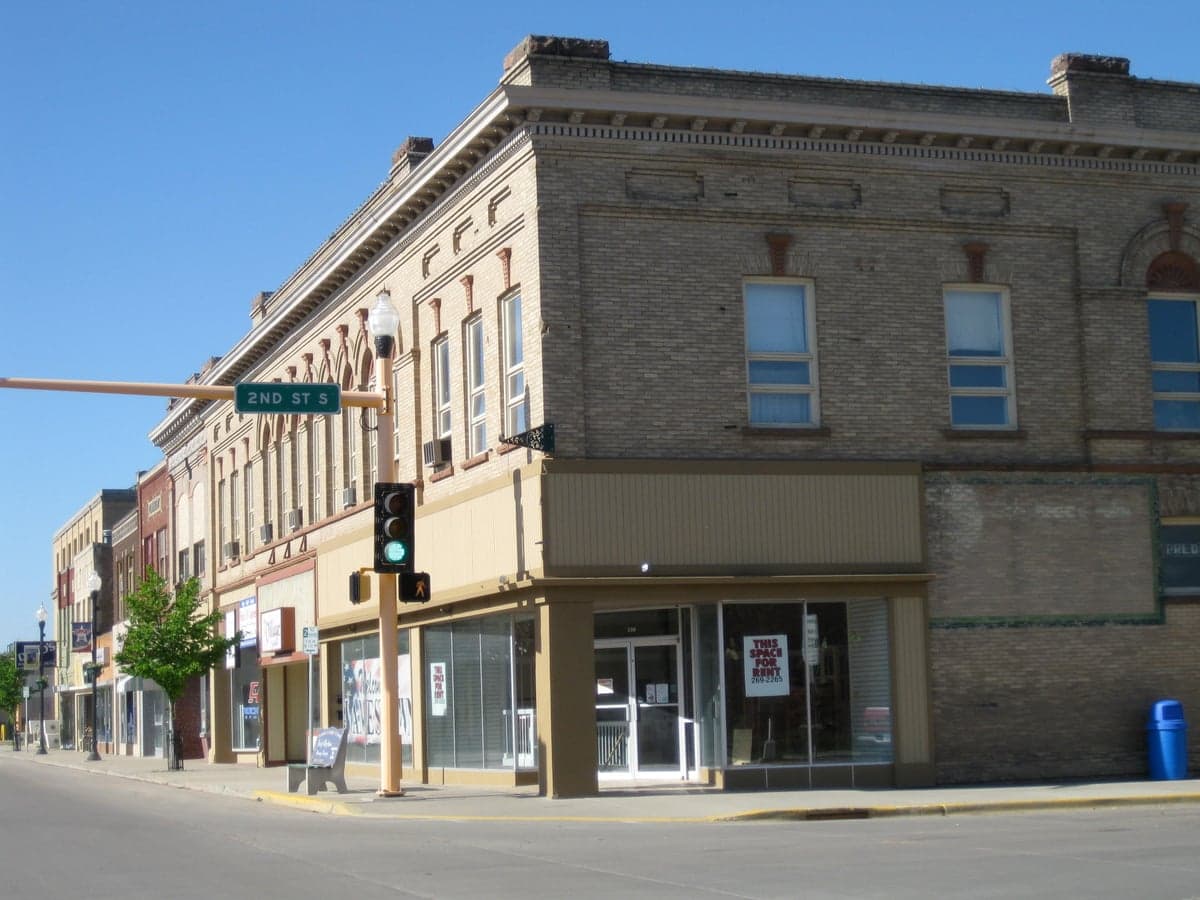
Photo: Wikipedia
Personal Sovereignty in Jamestown, ND
Strong independent fundamentals that actively favor personal liberty and low regulation.
What does Personal Sovereignty tell us?
Personal Sovereignty measures your capacity for self-reliance and independence with minimal government friction. Higher scores mean fewer barriers between you and the way you want to live... but it assumes you have the space you need and good neighbors.
What does this tell us?
Personal Sovereignty measures your capacity for self-reliance and independence with minimal government friction. Higher scores mean fewer barriers between you and the way you want to live... but it assumes you have the space you need and good neighbors.
State Policy
Energy independence: Net exporter (500% of energy produced in-state)
Personal Liberty
Homesteading

Personal Liberty Analysis
Jamestown, North Dakota, offers a level of personal sovereignty that is increasingly rare in the modern United States, largely because the state government in Bismarck has historically treated local autonomy and individual rights as default positions rather than privileges to be granted. For a single individual or parent operating from a survivalist or prepper mindset, this translates into a legal environment where the burden of proof falls on the government to justify interference in your life, not on you to justify your choices. The combination of a low population density, a state constitution that explicitly protects the right to keep and bear arms, and a tax structure that does not penalize productive behavior makes this region one of the more viable places in the Upper Midwest to live according to your own rules, provided you are willing to accept the trade-offs that come with a small-town, agricultural economy.
Tax burden and regulatory posture: How North Dakota compares to neighboring states
From a financial sovereignty standpoint, Jamestown sits in a state that has no personal income tax, which immediately puts more money in your pocket to allocate toward supplies, land, or savings rather than sending it to a distant capital. The state sales tax is 5%, with local options adding roughly 1.5% to 2% in Jamestown, bringing the total to around 6.5% to 7% — competitive with South Dakota and well below Minnesota or Montana for most purchases. Property taxes in Stutsman County are moderate, averaging about 1.2% of assessed value, but the state offers a homestead tax credit for owner-occupied residences that can reduce the burden for primary homes. More importantly, North Dakota’s regulatory posture toward small-scale agriculture and home-based businesses is notably permissive. You can operate a cottage food operation, sell eggs from backyard chickens, or run a small repair shop from your garage without the layers of licensing that would choke the same activity in a coastal state. The state’s Department of Environmental Quality does not aggressively pursue individual property owners for minor land-use changes, and the county-level zoning in the rural areas around Jamestown is minimal — often limited to basic setback requirements and septic system standards. For someone who wants to minimize interaction with government bureaucracy, this is a significant advantage.
Self-defense and gun law specifics: What the Second Sanctuary status means for you
North Dakota is a constitutional carry state, meaning that as of 2026, no permit is required to carry a concealed firearm for anyone legally allowed to possess one. Jamestown itself is located in Stutsman County, which has formally declared itself a Second Amendment Sanctuary — a resolution that signals local law enforcement and prosecutors will not cooperate with federal firearms restrictions they deem unconstitutional. This is not merely symbolic; it creates a practical buffer against overreach. The state preempts all local gun ordinances, so the city council in Jamestown cannot pass its own restrictions on magazine capacity, barrel length, or storage requirements. Stand-your-ground laws are fully in effect, with no duty to retreat in any place you are lawfully present. For a prepper, this means you can maintain a defensive firearm in your vehicle, on your person, or in your home without worrying about arbitrary "safe storage" mandates or "sensitive places" restrictions that are common in other states. The only notable limitation is that carrying on K-12 school property requires a license, but that license is issued on a shall-issue basis with no subjective "good cause" requirement. If self-defense is a core component of your personal sovereignty, Jamestown offers one of the most legally unencumbered environments in the northern plains.
Self-reliance and homesteading viability: Lot sizes, zoning, and off-grid feasibility
For those looking to reduce dependence on centralized systems, Jamestown and its surrounding rural areas present genuine opportunities. Within the city limits, standard residential lots range from one-quarter acre to half an acre, which is enough for a substantial garden, a small chicken coop, and a rainwater catchment system — though you will need to check with the city building department if you plan to install a composting toilet or disconnect from municipal water. The real potential lies just outside town, where unzoned agricultural parcels of 5 to 40 acres are available for prices that would be laughable in Colorado or Texas — often under $2,000 per acre. There are no county-level restrictions on building a pole barn, keeping livestock, or installing solar panels. Off-grid living is legally feasible: North Dakota has no state law requiring connection to the electrical grid, and while the county health department requires a permitted septic system for any dwelling with plumbing, you can legally live in a dry cabin or a tiny house on wheels without a permit if you do not have running water. The state’s net metering policy is favorable for solar, and there are no HOA-style overlays in the unincorporated areas that would restrict your ability to store supplies, park a trailer, or build a root cellar. The trade-off is that winters are harsh — average January highs are around 20°F — so self-reliance requires serious investment in heating fuel, insulation, and winterized infrastructure. But the legal framework does not stand in your way.
Personal liberties: Parental rights, medical autonomy, speech, and property protections
North Dakota has a strong track record on parental rights, with state law explicitly affirming that parents have the fundamental right to direct the upbringing, education, and healthcare of their children. This means no mandatory vaccine requirements for school attendance (only opt-out forms are needed), and no state-level interference with homeschooling or private schooling. The state does not have a "red flag" law, so there is no mechanism for law enforcement to seize firearms based on a complaint without a criminal conviction or mental health adjudication. Medical autonomy is similarly respected: there is no state mandate for COVID-19 or other experimental vaccines, and the state legislature has passed laws prohibiting discrimination against unvaccinated individuals in employment and public accommodations. On property rights, North Dakota is a "Dillon's Rule" state in theory, but in practice the legislature has consistently limited the ability of cities and counties to impose restrictive land-use regulations. The state’s "takings" law requires compensation for any regulation that reduces property value by more than 50%, which acts as a powerful check on zoning overreach. Free speech is protected by the state constitution, and there are no hate speech laws or social media content moderation mandates that would give the government leverage over your expression. For a parent concerned about what your child is taught in school or what medical decisions you can make, Jamestown offers a legal environment where the default answer is "yes, unless there is a compelling and narrowly tailored reason for no."
In the broader context of the United States in 2026, Jamestown represents a pocket of relative sovereignty that is worth serious consideration for anyone who values the ability to live without constant government oversight. It is not a libertarian utopia — you still have to register your vehicle, pay property taxes, and follow building codes for permanent structures — but the gap between what the state demands and what you are free to do is wider here than in most of the country. Compared to Fargo, which is more urbanized and has a slightly more active city council, Jamestown’s smaller scale means fewer layers of regulation and a community culture that generally assumes you can manage your own affairs. For a single individual or a family with a prepper mindset, the combination of constitutional carry, low taxes, permissive land use, and strong parental rights makes this one of the more defensible places to establish a base of operations. The winters are the price of admission, but the freedom is the dividend.

* Values derived from national, state, county, city and local statistics and may differ in a specific area. Last updated: 2026-04-19T04:56:46.000Z
Narrative content on this page is AI-generated and may contain mistakes. Verify any details that matter before acting on them.
ReloMaps may earn a commission from affiliate links at no extra cost to you.

