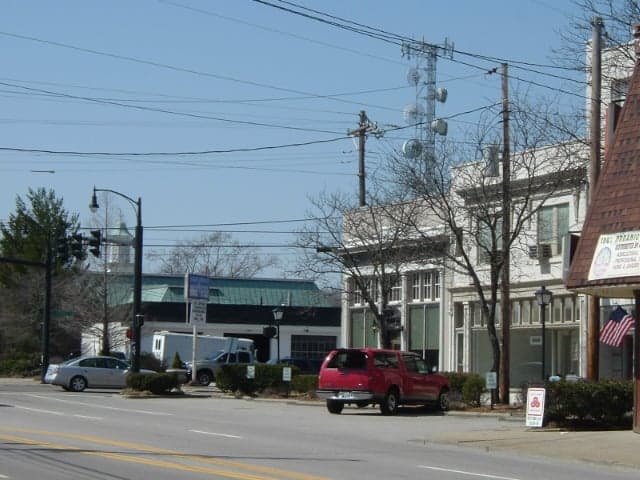
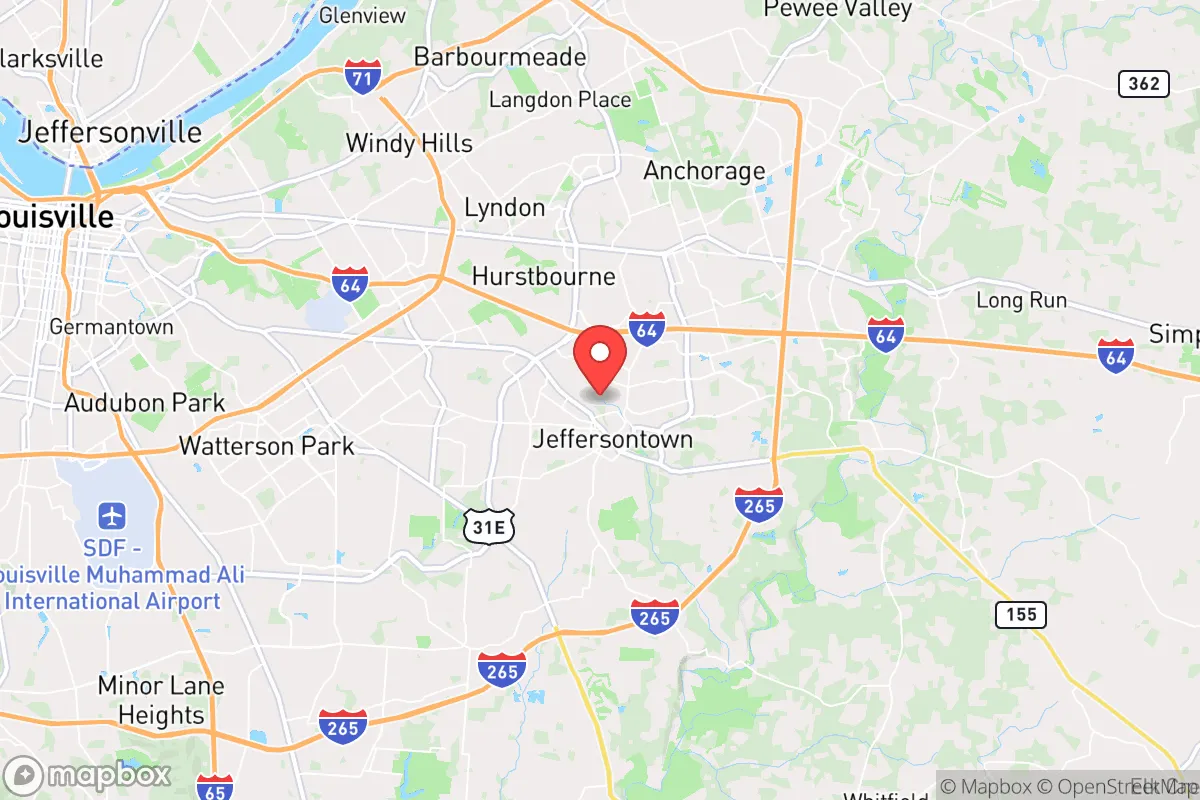
Photo: Wikipedia
Demographics of Jeffersontown, KY
Affluence Level in Jeffersontown, KY
A middle-class area roughly in line with national averages across income, home values, education, and employment.
People of Jeffersontown, KY
Jeffersontown, Kentucky, is a predominantly white, middle-class suburban city of nearly 29,000 residents that blends a historic small-town core with post-1960s suburban expansion. Its population is notably more educated than the state average, with 38.9% holding a bachelor’s degree or higher, and it remains less diverse than Jefferson County as a whole. The city’s identity is shaped by its roots as a farming and railroad hub, its late-20th-century role as a bedroom community for Louisville professionals, and a recent, modest uptick in Hispanic and Black households.
How the city was settled and grew
Jeffersontown was founded in 1794 as a stagecoach stop and farming center along the road from Louisville to Shelbyville. The original settlers were predominantly English, Scots-Irish, and German farmers drawn by land grants and the fertile soils of the Bluegrass region. The arrival of the Louisville and Nashville Railroad in the 1850s spurred a small commercial district around what is now the Jeffersontown Historic District, anchored by the town square and the old railroad depot. Through the early 1900s, the population remained under 1,000, with most residents working in agriculture, milling, or local trades. The city annexed surrounding farmland slowly, and by 1950 the population had only reached 1,500. The first significant non-white residents were a handful of Black families who settled near the railroad corridor in the Glenmary area, working as domestic laborers and farmhands for white landowners.
Modern era (post-1965)
Jeffersontown’s modern growth began in earnest after the 1964 construction of the Gene Snyder Freeway (I-265), which connected the city to Louisville’s suburban ring. Between 1970 and 2000, the population surged from roughly 5,000 to 26,000, driven by white middle-class families fleeing Louisville’s urban core and by the expansion of the Bluegrass Research and Industrial Park, which drew engineers, managers, and skilled tradespeople. The Forest Springs and Lake Forest subdivisions, built in the 1970s and 1980s, became the primary landing points for these new residents—largely white, college-educated families seeking larger lots and lower crime rates. The city’s foreign-born population remained minimal through the 1990s, but the 2000s saw a small influx of Hispanic workers employed in warehousing and food processing along the I-265 corridor, settling in the Westport Road area near the industrial park. The Black population grew from under 3% in 1990 to 12.4% today, concentrated in the Hurstbourne Parkway corridor and the Raintree apartment complexes, reflecting a broader suburbanization of Louisville’s African American middle class. East and Southeast Asian residents (2.1%) and Indian-subcontinent residents (2.2%) are a newer, professional cohort, many employed in healthcare and engineering at nearby Norton Hospital or GE Appliances, and tend to live in the Lake Forest and Springhurst subdivisions.
The future
Jeffersontown’s population is slowly diversifying, but the pace is moderate. The Hispanic share (6.2%) is growing steadily, driven by second-generation families and continued employment in logistics, while the Black population appears to have plateaued after rapid growth in the 2000s. The white share (74.2%) is declining gradually as older residents age in place and younger white families choose newer exurban developments in Shelby or Oldham counties. The Indian and East/Southeast Asian communities are small but growing, attracted by the city’s strong schools and proximity to Louisville’s medical and tech sectors. The city is not tribalizing into distinct ethnic enclaves—most neighborhoods remain predominantly white, with diversity concentrated in specific apartment complexes and the Hurstbourne corridor. Over the next 10–20 years, Jeffersontown will likely become slightly more Hispanic and Asian, but it will remain a majority-white, middle-class suburb. The biggest demographic pressure is aging: the median age is 42, and the city will need to attract younger families to maintain its tax base and school enrollment.
For a conservative-leaning mover today, Jeffersontown offers a stable, low-crime environment with strong public schools and a historic downtown, but it is not a rapidly growing or diversifying hub. It is a mature suburb where the population is slowly graying and modestly diversifying, with most new residents coming from within Jefferson County rather than from out of state or abroad. The city’s character is likely to remain consistent: safe, family-oriented, and politically moderate-conservative, with gradual demographic change rather than sudden transformation.

* Values derived from national, state, county, city and local statistics and may differ in a specific area. Last updated: 2026-04-21T09:09:28.000Z
Narrative content on this page is AI-generated and may contain mistakes. Verify any details that matter before acting on them.
ReloMaps may earn a commission from affiliate links at no extra cost to you.

