Photo: Wikipedia
Demographics of Jewett City, CT
Affluence Level in Jewett City, CT
A below-average socioeconomic profile. Incomes, home values, and educational attainment trail the U.S., with higher poverty and unemployment.
People of Jewett City, CT
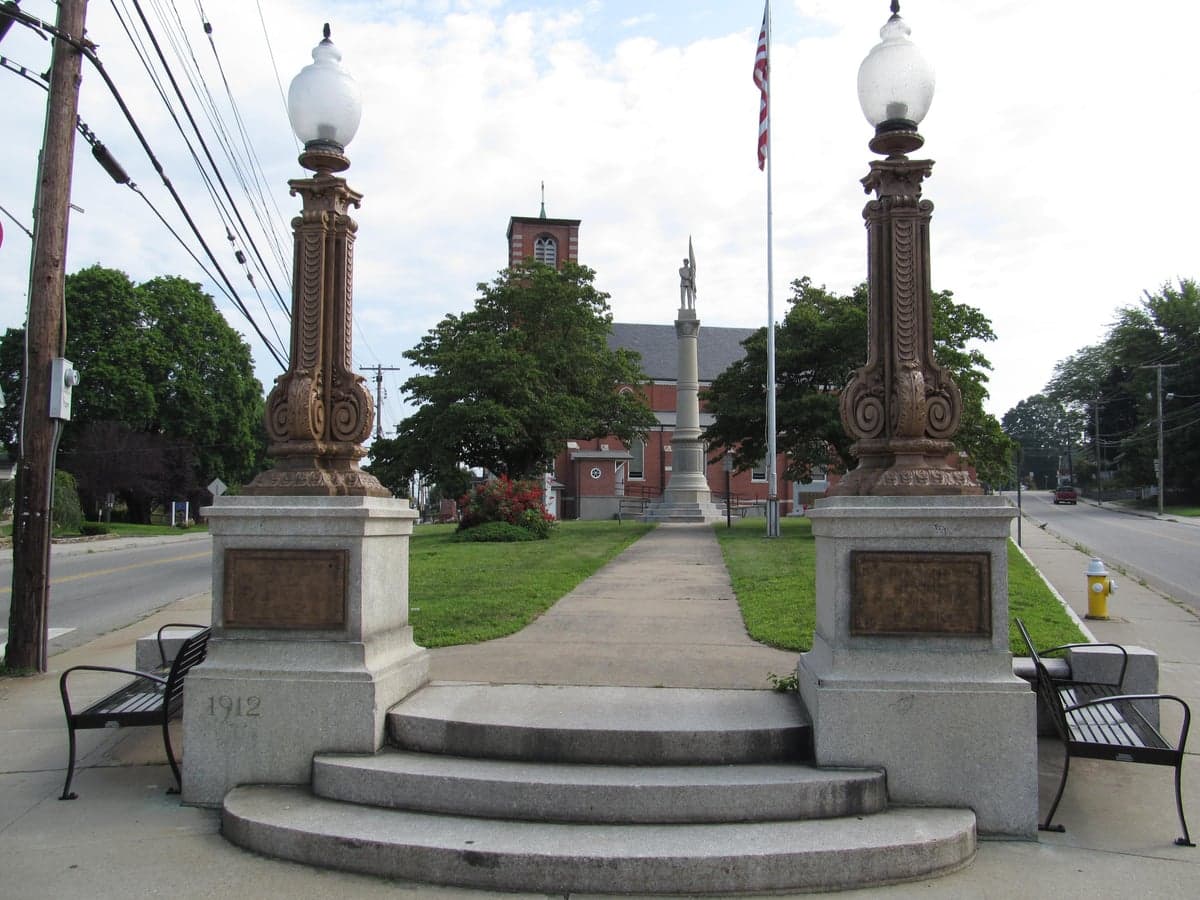
Jewett City, Connecticut, is a small, densely built borough of 3,412 residents that feels more like a tight-knit New England mill village than a typical suburban town. Its population is overwhelmingly white (89.9%) and notably older, with a low college attainment rate of 9.4% and a foreign-born share of just 4.4%, reflecting limited recent immigration. The community retains a working-class character rooted in its industrial past, with a distinctive identity shaped by generations of French-Canadian and Polish families who arrived to work the mills. Today, it is a place where longtime residents dominate, and the demographic profile suggests slow, modest change rather than rapid transformation.
How the city was settled and grew
Jewett City’s population history is inseparable from the textile industry. The borough was originally part of Griswold, Connecticut, and its growth exploded after 1825 when the Jewett City Cotton Manufacturing Company harnessed the Pachaug River for power. The first major wave of settlers were Yankee farmers and mill managers from eastern Connecticut, but the real population boom came with the arrival of French-Canadian immigrants between 1850 and 1900. These families, fleeing Quebec’s agricultural depression, settled in what became known as French Village, a cluster of mill-owned tenements along North Main Street and River Road. By 1900, French was the dominant language in many homes, and the parish of St. Mary’s Church became the cultural anchor.
A second wave of Polish immigrants arrived between 1890 and 1920, drawn by unskilled mill jobs. They concentrated in the area around Poland Hill (roughly along Ashland Street and the eastern slope above the river), building their own church, St. Joseph’s, and a tight-knit neighborhood of triple-decker houses. A smaller contingent of Italian immigrants settled near the Lower Village district along South Main Street, working in the mills and later in local quarries. By 1930, Jewett City was a classic multi-ethnic mill town, with distinct ethnic enclaves separated by religion, language, and street boundaries, but united by the factory whistle. The borough’s population peaked around 4,500 in the 1950s, then began a slow decline as the textile industry contracted.
Modern era (post-1965)
After the 1965 Hart-Cellar Act, Jewett City saw almost none of the new immigration that reshaped larger Connecticut cities. The foreign-born population today is just 4.4%, and the Asian share (East/Southeast Asian) is a mere 1.1%, with no measurable Indian-subcontinent population. The Hispanic share of 5.7% is the only non-white group showing any growth, but it remains small and largely concentrated in rental units along Main Street and near the Griswold Commons shopping area, not in a distinct ethnic neighborhood. The dominant domestic trend has been out-migration of young adults and a gradual aging of the French-Canadian and Polish core families. Many of the old triple-deckers in French Village and Poland Hill have been converted to single-family homes or sit vacant, as the mill-era housing stock no longer matches modern preferences. The borough’s population has stabilized around 3,400 since 2000, with most new residents being white retirees or working-class families priced out of nearby Norwich and Mystic.
The future
Jewett City’s population is heading toward further homogenization and slow decline. The borough lacks the job base, housing diversity, or school reputation (the high school graduation rate is below state average) to attract significant numbers of young families or immigrants. The Hispanic population may grow modestly as some families move in from Norwich, but it is unlikely to reach a critical mass that would create a distinct enclave. The French-Canadian and Polish ethnic identities are fading into a generic white working-class identity, with younger generations moving to larger towns or out of state. Over the next 10–20 years, the population will likely shrink to 3,000–3,200, with an even older median age and a higher share of long-term residents. The borough is not tribalizing into new ethnic enclaves; it is quietly consolidating into a single, older, white demographic block.
For someone moving in now, Jewett City offers affordable housing and a quiet, safe environment, but it is a place where the population is static and aging. The community is not diversifying or growing, and the social fabric remains rooted in the mill-era ethnic neighborhoods that are now more historical memory than living enclaves. New residents should expect a low-key, stable, and predominantly white community where change comes slowly, if at all.

* Values derived from national, state, county, city and local statistics and may differ in a specific area. Last updated: 2026-04-19T07:50:33.000Z
Narrative content on this page is AI-generated and may contain mistakes. Verify any details that matter before acting on them.
ReloMaps may earn a commission from affiliate links at no extra cost to you.

