Photo: Wikipedia
Political ClimatePolitical Climate in Jewett City, CT
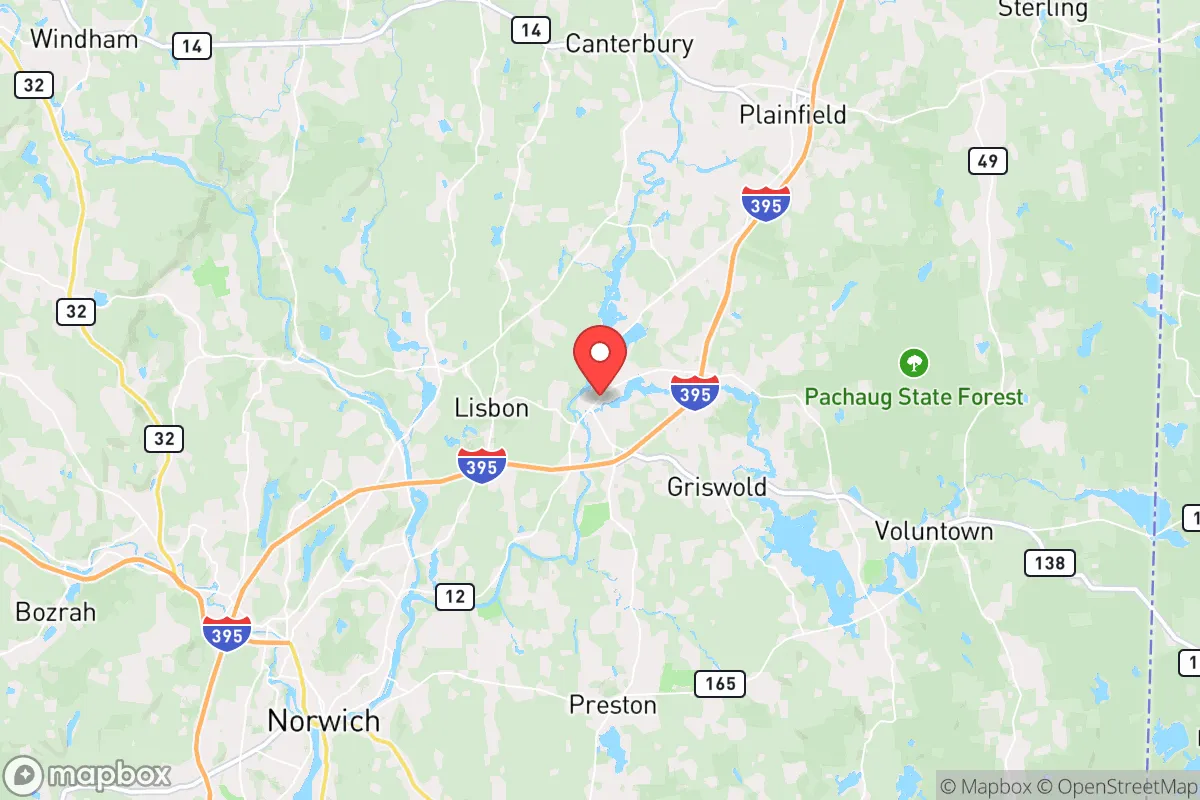
District shown is the primary district for this city’s centroid. Cities may span multiple districts.
Local Political AnalysisPolitical Analysis of Jewett City, CT
Jewett City, the borough at the heart of Griswold, leans left of center with a Cook PVI of D+4, but that number doesn't tell the whole story. This isn't a deep-blue stronghold like New Haven or Hartford; it's a working-class town in New London County that has been shifting uncomfortably toward progressive policies in recent years. If you've been here a while, you remember when local politics were more about keeping taxes low and the streets safe, not about social experiments from the state capitol.
How it compares
Drive ten miles south to Norwich, and you'll find a similar D+4 tilt, but with a more vocal activist scene that pushes for higher spending and stricter regulations. Head west to Lisbon or north to Canterbury, and the political map flips—those towns lean reliably Republican, with voters who are skeptical of Hartford's one-size-fits-all mandates. Jewett City sits right on that dividing line, and you can feel the tension at town hall meetings. The borough itself votes blue, but the surrounding rural parts of Griswold often balance the ticket. What worries me is the direction: the progressive wing has been gaining ground in local school board and planning commission races, pushing for diversity, equity, and inclusion initiatives that sound nice but often come with new rules and higher costs for small businesses and homeowners.
What this means for residents
For the average person living here, the political climate translates directly into your wallet and your freedoms. Property taxes have crept up as the town adopts state-mandated affordable housing quotas and energy efficiency codes that add red tape to even simple home renovations. The Second Amendment is still respected by most locals, but you can feel the pressure from Hartford—magazine bans and storage laws that treat law-abiding gun owners like potential criminals. School choice is limited, and the local curriculum has started to include more progressive social studies materials that some parents find out of step with their values. If you run a small business, you're dealing with paid leave mandates and minimum wage hikes that squeeze margins without improving service. The old Jewett City, where neighbors helped neighbors without a government program, is slowly being replaced by a system that assumes you can't manage your own life.
On the cultural side, the borough still has a strong volunteer fire department and a sense of community at the annual Polish Festival and the farmers market. But the policy shifts are real. The state's push for denser housing development near the Thames River corridor could change the character of the town, bringing more rental units and transient populations rather than stable homeownership. The local Democratic committee has become more vocal about environmental justice and transit-oriented development, which sounds progressive but often means more bureaucracy for anyone trying to build a garage or start a landscaping business. If you value personal responsibility, low taxes, and the freedom to live your life without a government checklist, Jewett City is still a decent place, but you have to stay engaged. The old-timers who remember when the borough was a quiet mill town are watching closely, and they'll tell you: the next few elections will decide whether this stays a place where you can raise a family on your own terms, or becomes another satellite of Hartford's agenda.

State Political ClimatePolitical Climate in Connecticut
State Political AnalysisPolitical Environment in the State
Connecticut has shifted from a classic swing state to a reliably blue stronghold over the past two decades, with Democrats now holding every statewide office and commanding supermajorities in both legislative chambers. The state voted for Hillary Clinton by 14 points in 2016, Joe Biden by 20 points in 2020, and Kamala Harris by roughly 18 points in 2024, reflecting a durable leftward tilt that has accelerated since the early 2000s. For a conservative considering relocation, the political climate here is defined by high taxes, expansive government, and a regulatory environment that often feels designed to squeeze personal freedom out of daily life.
Urban vs. rural divide
The political map of Connecticut is a tale of three regions. The southwestern corner—Fairfield County, anchored by Stamford, Greenwich, and Bridgeport—is the Democratic engine room, fueled by New York City commuters and a dense, diverse population that votes overwhelmingly blue. New Haven and Hartford are deep-blue urban cores, with the latter being one of the poorest cities in the nation and a Democratic stronghold. In contrast, the eastern half of the state—places like Litchfield County, Windham County, and towns such as Killingly and Thompson—vote reliably Republican, though their populations are too small to offset the urban centers. The suburbs of Danbury and Waterbury are more competitive, but even they have trended left in recent cycles. The rural-urban divide is stark: in 2024, Litchfield County went for Trump by about 8 points, while Fairfield County went for Harris by 22 points. The state's political gravity is firmly in the southwest, and that's not changing.
Policy environment
Connecticut's policy environment is a textbook case of progressive governance with a heavy hand. The state has the highest combined state and local tax burden in the nation, with income taxes topping out at 6.99% and property taxes among the steepest in the country—often exceeding 3% of assessed home value in towns like West Hartford and Greenwich. The regulatory posture is aggressive: Connecticut was one of the first states to enact a paid family and medical leave program (PFMLA), funded by a payroll tax on workers, and it has some of the strictest gun laws in the U.S., including a 2023 expansion that banned open carry and raised the purchasing age for long guns to 21. Education policy is dominated by teachers' unions, with per-pupil spending among the highest nationally, yet outcomes in urban districts like Bridgeport and Hartford remain poor. Election laws are permissive: no-excuse absentee voting was expanded in 2023, and early voting was introduced for the first time in 2024. Healthcare is heavily regulated, with a state-run exchange and mandates that drive up premiums. For a conservative, the policy environment feels like a slow squeeze on personal choice and wallet.
Trajectory & freedom
Connecticut is becoming less free by almost any measure, and the trend has accelerated since 2020. On gun rights, the 2023 law (HB 6667) banned the open carry of firearms, raised the purchase age for rifles, and expanded the state's assault weapons ban—a direct contraction of Second Amendment freedoms. On parental rights, the state passed a law in 2021 (SB 1019) that effectively allows schools to hide a child's gender identity from parents, a move that has sparked fierce backlash in conservative towns like Woodbury and Southbury. Medical autonomy took a hit with the 2022 expansion of vaccine mandates for schoolchildren, though COVID-era restrictions have largely faded. Property rights are constrained by some of the nation's strictest zoning laws, which limit development and drive up housing costs. On taxation, there's no sign of relief: the state's progressive income tax structure was made more aggressive in 2023 with a new 6.99% bracket for high earners. The only bright spot for freedom advocates was the 2023 repeal of the state's death penalty, but that's cold comfort when everyday liberties are being chipped away.
Civil unrest & political movements
Connecticut has seen its share of political flashpoints, though they tend to be quieter than in larger states. The Black Lives Matter protests in 2020 were large and disruptive in New Haven and Hartford, with some property damage and clashes with police. More recently, the parental rights movement has gained traction in suburban and rural areas, with organized groups like "CT Parents United" pushing back against school curriculum and gender policies. Immigration politics are a live wire: Connecticut is a sanctuary state, with a 2013 law (HB 6659) that limits local police cooperation with federal immigration enforcement. In 2024, the state legislature considered a bill to further restrict ICE detainers, though it stalled. Election integrity concerns have been raised by conservatives, particularly around the 2020 expansion of absentee voting and the 2024 introduction of early voting, though no major scandals have emerged. The most visible flashpoint for a new resident might be the annual gun rights rallies at the state capitol in Hartford, where thousands of Second Amendment supporters gather to protest new restrictions—a reminder that the fight for freedom is still alive, if uphill.
Projection
Over the next 5-10 years, Connecticut is likely to become more progressive and less free. Demographic trends are working against conservatives: the state's population is aging, with young people leaving for lower-tax states like Florida and Texas, while in-migration from New York City and other blue areas reinforces the Democratic majority. The state's fiscal situation is precarious—pension liabilities are among the highest in the nation—which will likely lead to even higher taxes or service cuts, further driving out the middle class. The legislature is unlikely to shift rightward given the current district maps and the dominance of urban and suburban voters. A new resident moving in now should expect to see continued expansion of government programs, tighter gun laws, and a political culture that prioritizes collective solutions over individual liberty. The only wildcard is a potential economic crisis that forces tax reform, but don't hold your breath.
For a conservative considering Connecticut, the bottom line is this: you'll be paying a premium for a state with beautiful coastline, good schools in certain towns, and proximity to New York City, but you'll also be funding a government that actively works against your values on taxes, guns, education, and personal freedom. If you're set on moving here, look at towns like Litchfield or Killingly where the political climate is more aligned with your views, but understand that state-level policies will still affect your daily life. It's a beautiful state, but it's not a free one—and it's getting less so every year.
* Values derived from national, state, county, city and local statistics and may differ in a specific area. Last updated: 2026-04-19T07:50:33.000Z
Narrative content on this page is AI-generated and may contain mistakes. Verify any details that matter before acting on them.
ReloMaps may earn a commission from affiliate links at no extra cost to you.

