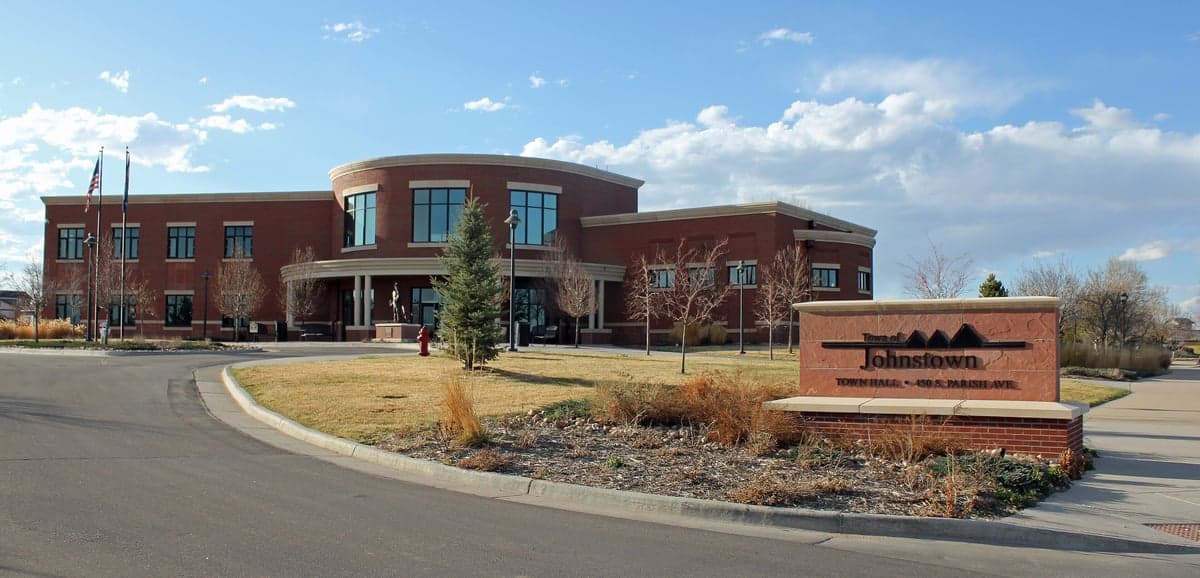
Photo: Wikipedia
Demographics of Johnstown, CO
Affluence Level in Johnstown, CO
An upper-middle-class area. Household wealth, education levels, and homeownership run ahead of national benchmarks.
People of Johnstown, CO
The people of Johnstown, Colorado, today number 18,075, forming a rapidly growing, predominantly white and Hispanic community with a distinctly family-oriented, conservative character. The city’s population is denser than typical rural towns, yet retains a small-town feel, with a notable 37.0% college-educated share and a very low 2.0% foreign-born rate. Its identity is rooted in agricultural heritage, now layered with suburban commuters and young families drawn to new housing developments. This is a place where longtime farming families live alongside newcomers seeking affordable homes and a slower pace, creating a community that values tradition and self-reliance.
How the city was settled and grew
Johnstown’s human history begins with the Union Pacific Railroad’s arrival in the 1860s, which spurred the first permanent settlement. The town was officially platted in 1902 by a group of local farmers and businessmen, including John H. Johnson, who saw the potential for a shipping hub for sugar beets and grain. The original population was almost entirely white, drawn from Midwestern states like Nebraska and Iowa, and from German-Russian immigrant families who had experience with sugar-beet cultivation. These early settlers built the Original Townsite, the historic core centered around the railroad depot and along what is now Main Street. By the 1920s, a small but significant wave of Hispanic laborers arrived, recruited to work the beet fields; they established a modest enclave in the South Side area, near the original rail yards, where some of their descendants still live. The town remained a quiet, agricultural community through the mid-20th century, with a population hovering around 1,000, and its growth was almost entirely organic—driven by births and a slow trickle of farm families from the surrounding plains.
Modern era (post-1965)
The modern transformation of Johnstown began in earnest after the 1965 Immigration and Nationality Act, though its effects were muted here compared to larger Colorado cities. The real driver was domestic in-migration, starting in the 1990s and accelerating after 2000, as the Denver-Boulder metro area’s housing costs pushed families north along the I-25 corridor. This wave was overwhelmingly white and middle-class, drawn by new master-planned subdivisions. The Thompson River Ranch neighborhood, developed from the 2000s onward, became the primary landing pad for these newcomers—mostly young couples and families from other parts of Colorado and the Midwest. Simultaneously, the Hispanic population grew from about 10% in 2000 to 19.8% today, driven by both natural increase and continued migration from Mexico and Central America for construction and service jobs. These newer Hispanic residents concentrated in the West Johnstown area, near the older South Side, and in the more affordable Mountain View mobile home park. The Black population remains very small at 0.5%, and East/Southeast Asian communities at 0.8%, with no distinct ethnic enclaves forming. The Indian-subcontinent population is negligible at 0.1%. The city’s foreign-born share (2.0%) is far below the national average, reflecting that Johnstown’s growth has been almost entirely domestic.
The future
Looking ahead, Johnstown’s population is likely to continue growing, driven by annexation of new land and the build-out of planned communities like Prairie Center and Boulder Creek. These developments are marketed to families and commuters, suggesting the white, college-educated share will remain dominant or even increase. The Hispanic population is expected to grow modestly through natural increase, but the city shows no signs of tribalizing into distinct ethnic enclaves; instead, the pattern is one of assimilation into predominantly white-majority neighborhoods. The foreign-born share is unlikely to rise significantly, as Johnstown lacks the industrial or service-sector magnets that draw large immigrant populations. The biggest demographic shift may be generational: as the original farm families age out, their land is sold to developers, and the city’s character will tilt further toward suburban commuter culture. The Black and Asian shares are projected to remain very small, as Johnstown does not have the job base or social networks to attract these groups in numbers.
For someone moving in now, Johnstown is becoming a classic exurban bedroom community—predominantly white, conservative, and family-focused, with a growing Hispanic minority that is largely integrated. The city offers a safe, low-crime environment with good schools, but little ethnic or cultural diversity. New arrivals will find a place where the past (farming, railroad) is fading, and the future is shaped by subdivisions, chain stores, and a daily commute to Loveland, Fort Collins, or Denver. It is a solid choice for those seeking a stable, homogeneous community with room to grow.

* Values derived from national, state, county, city and local statistics and may differ in a specific area. Last updated: 2026-05-01T03:13:30.000Z
Narrative content on this page is AI-generated and may contain mistakes. Verify any details that matter before acting on them.
ReloMaps may earn a commission from affiliate links at no extra cost to you.

