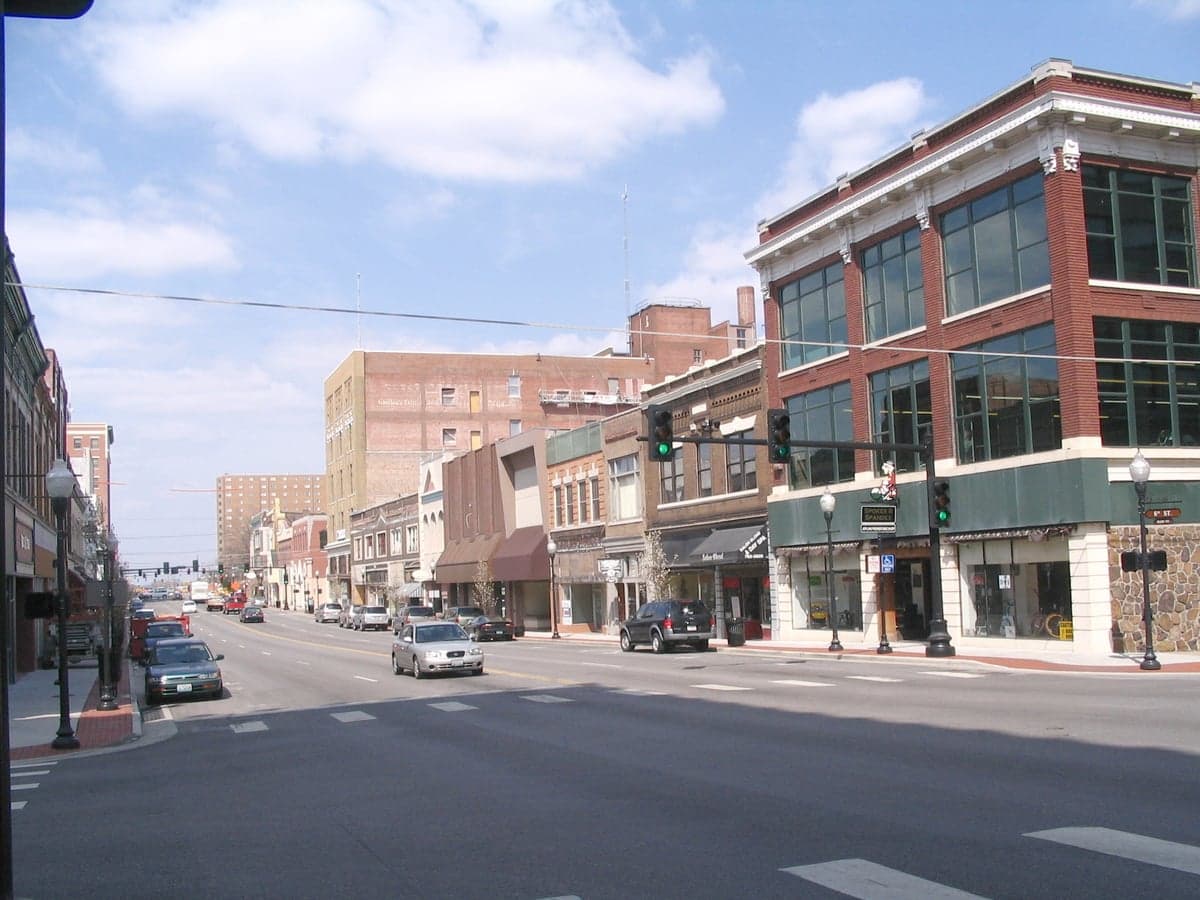
Photo: Wikipedia
Personal Sovereignty in Joplin, MO
Strong independent fundamentals that actively favor personal liberty and low regulation.
What does Personal Sovereignty tell us?
Personal Sovereignty measures your capacity for self-reliance and independence with minimal government friction. Higher scores mean fewer barriers between you and the way you want to live... but it assumes you have the space you need and good neighbors.
What does this tell us?
Personal Sovereignty measures your capacity for self-reliance and independence with minimal government friction. Higher scores mean fewer barriers between you and the way you want to live... but it assumes you have the space you need and good neighbors.
State Policy
Energy independence: Importer (15% of energy produced in-state)
Personal Liberty
Homesteading

Personal Liberty Analysis
For the individual who values personal sovereignty above all else—who sees government overreach as a creeping threat and wants a place where autonomy isn't just tolerated but baked into the landscape—Joplin, Missouri, offers a rare combination of low-tax, low-regulation living with a deeply ingrained culture of self-reliance. Nestled in the southwest corner of the state, this city of roughly 52,000 sits in a region where the Second Amendment is a lived reality, property rights are fiercely defended, and the state government in Jefferson City has, for decades, taken a hands-off approach to local affairs. While no place is a perfect fortress against federal overreach, Joplin’s legal and cultural environment provides a foundation for personal sovereignty that is increasingly hard to find in much of the country. The key question for the strategic relocator is whether this foundation is strong enough to withstand the pressures of a changing world—and the answer, grounded in data and local realities, is that it holds up remarkably well compared to the coasts or even much of the Midwest.
Tax burden and regulatory posture: How Missouri compares to surrounding states
Missouri’s tax structure is a deliberate feature, not a bug, for those prioritizing financial autonomy. The state levies a flat personal income tax rate of 4.95% (as of 2025), with ongoing legislative efforts to reduce it further—a stark contrast to neighboring Kansas, which has a more volatile tax history, or Oklahoma’s slightly higher top rate. For a single individual earning $60,000 annually, this translates to roughly $2,970 in state income tax, leaving significantly more capital for savings, investments, or prepping supplies than in high-tax states like California or New York. Property taxes in Jasper County, where Joplin is the seat, average around 0.85% of assessed value, well below the national average of 1.1%. A $200,000 home carries an annual tax bill of about $1,700—manageable even on a modest budget. Sales tax in Joplin is 8.475% (state + local), which is moderate, but the absence of a state-level estate or inheritance tax means wealth transfers to the next generation aren’t penalized. Regulatory posture is equally favorable: Missouri is a right-to-work state (though that law was repealed by voters in 2018, the practical effect on business climate remains pro-employer), and occupational licensing requirements are among the least burdensome in the nation. For the survivalist-minded, this means starting a side business—say, a small farm, firearms training, or a construction trade—faces minimal bureaucratic hurdles. The state’s “Show-Me” ethos translates into a government that generally assumes you know what you’re doing until proven otherwise, a refreshing contrast to jurisdictions that regulate every aspect of daily life.
Self-defense and gun law specifics: Constitutional carry and castle doctrine in practice
For the prepper or survivalist, Joplin sits in a legal environment that is as close to a firearms-friendly sanctuary as exists in the continental U.S. Missouri is a constitutional carry state—no permit is required to carry a concealed firearm for any law-abiding adult 19 or older (18 for active military). This isn’t a theoretical right; it’s exercised openly and without stigma. The state also has a robust “Stand Your Ground” law, with no duty to retreat in any place where you are lawfully present. Castle doctrine protections extend to your vehicle and place of business, not just your home. For the strategic relocator, this means you can legally defend yourself, your family, and your property without fear of prosecution, provided the threat is reasonable. Magazine capacity restrictions, assault weapon bans, and red flag laws are nonexistent at the state level—Jefferson City has repeatedly rejected such measures. Local law enforcement in Joplin, including the Jasper County Sheriff’s Office, is known for a pro-Second Amendment stance; there are no local ordinances that undermine state preemption. For the prepper, this legal framework allows for stockpiling ammunition, building a defensive arsenal, and training without the shadow of overreach. The only caveat is federal law—NFA items (suppressors, short-barreled rifles) require ATF approval, but Missouri has passed a Second Amendment Preservation Act that attempts to nullify federal gun laws, though its constitutionality is being litigated. In practice, local dealers and ranges operate with a libertarian bent, and the culture is one of mutual respect for the armed citizen.
Self-reliance and homesteading viability: Lot sizes, zoning, and off-grid feasibility
Joplin’s zoning and land-use policies are a major draw for those seeking to reduce dependence on fragile supply chains. Within the city limits, residential lots typically range from 0.15 to 0.5 acres in older neighborhoods, but newer subdivisions and the surrounding unincorporated areas of Jasper and Newton counties offer 1- to 5-acre parcels at prices that would shock someone from the coasts—often under $10,000 per acre. The city’s zoning code is relatively permissive: keeping chickens, goats, or even a small vegetable garden is generally allowed on standard residential lots, though pigs and larger livestock require acreage. For the serious homesteader, the real opportunity lies just outside city limits, where county zoning is minimal or nonexistent. In unincorporated Jasper County, you can build a off-grid home with solar panels, rainwater catchment, and a composting toilet without the permitting nightmares common in blue states. The Missouri Department of Natural Resources does regulate well water and septic systems, but these are straightforward, one-time approvals. The climate—humid continental with hot summers and cold winters—supports a long growing season (April to October), making year-round food production viable with a greenhouse. For the prepper, the ability to drill a well (average depth 200-400 feet, cost $5,000-$10,000) and install a solar array (net metering is available, though utilities like Liberty Utilities have caps) means you can achieve genuine energy and water independence. The biggest challenge is the tornado risk—Joplin was devastated by an EF5 in 2011—which makes a reinforced storm shelter or underground bunker a near-necessity, not a luxury. But that risk is manageable with planning, and the community’s response to that disaster actually demonstrated a high degree of mutual aid and self-organization, a positive sign for survivalist networks.
Personal liberties: Parental rights, medical autonomy, speech, and property protections
Missouri has become a battleground for personal liberties in recent years, and the outcomes have generally favored the sovereign individual. On parental rights, the state passed the “Parental Bill of Rights” in 2022 (SB 681), which explicitly affirms that parents have the fundamental right to direct the education, healthcare, and religious upbringing of their children. This means no school district in Joplin can hide curriculum or medical decisions from parents—a critical factor for those concerned about government overreach in education. Medical autonomy is more nuanced: Missouri has some of the strictest abortion laws in the nation (near-total ban with no exceptions for rape or incest), which aligns with conservative values, but it also has a right-to-try law for terminally ill patients and a relatively free market for alternative medicine. Vaccine mandates are prohibited for state employees and contractors, and while private businesses can impose them, the cultural sentiment in Joplin is strongly against such requirements. On speech, Missouri is a First Amendment haven—there are no state-level hate speech laws, and the public square (including social media) is protected by a 2023 law that prevents platforms from censoring users based on viewpoint, though this is being challenged in court. Property rights are protected by a strong eminent domain statute that requires “public use” (not just economic development) and full compensation, a legacy of the 2005 Kelo decision backlash. For the prepper, this means your land, your supplies, and your home are legally fortified against government seizure for private development. The only significant liberty concern is the state’s medical marijuana program—it’s legal for qualifying patients, but recreational use remains illegal, and federal law still applies. For the survivalist, this is a minor inconvenience; the broader legal environment is one of maximum personal discretion.
In the final analysis, Joplin offers a level of personal sovereignty that is increasingly rare in the United States. Compared to the regulatory thickets of the Pacific Northwest, the tax burdens of the Northeast, or the cultural hostility to firearms in the coastal cities, southwest Missouri stands as a practical refuge for the individualist. The tax burden is low, the gun laws are among the most permissive in the nation, the land is affordable enough to enable genuine self-sufficiency, and the legal framework respects parental and property rights. No place is immune from federal overreach—the ATF, EPA, and IRS still have jurisdiction—but Joplin’s local culture and state-level protections create a buffer that few other regions can match. For the single individual or parent who wants to live on their own terms, with minimal government interference and maximum capacity for self-defense and self-reliance, this city deserves serious consideration. The trade-offs—tornado risk, a relatively isolated location, and a slower pace of life—are acceptable for those who prioritize freedom above convenience. In a country where personal sovereignty is under constant assault, Joplin remains a stronghold worth defending and, for the strategic relocator, worth claiming.

* Values derived from national, state, county, city and local statistics and may differ in a specific area. Last updated: 2026-04-30T04:56:16.000Z
Narrative content on this page is AI-generated and may contain mistakes. Verify any details that matter before acting on them.
ReloMaps may earn a commission from affiliate links at no extra cost to you.

