Strategic Assessment of Joshua, TX
Meaningful friction. Expect exposure to either population pressure, blast zones, or natural disaster risk. Consider buying a retreat property.
What does the Strategic Assessment tell us?
Our Strategic Assessment grades tactical survivability of an area. Major population centers, military targets, fallout zones, natural disasters, and border exposure all drive risk — lower exposure means a more defensible position in a crisis.
This is heavily inspired by Joel Skousen's Strategic Relocation book. Highly recommended you checkout the book ($)What does this tell us?
Our Strategic Assessment grades tactical survivability of an area. Major population centers, military targets, fallout zones, natural disasters, and border exposure all drive risk — lower exposure means a more defensible position in a crisis.
This is heavily inspired by Joel Skousen's Strategic Relocation book. Highly recommended you checkout the book ($)Strategic Pillars

Key Distances
Regional Safe Places
Below is our recommended "safe zones" in Texas and the surrounding area based on our strategic heuristics. For most people, it's unrealistic to live in a “safe zone” full-time due to work, family or other personal reasons. They tend to be more rural. However, many of these areas are perfect for second homes and retreat properties that double as a vacation home or even a short-term rental.

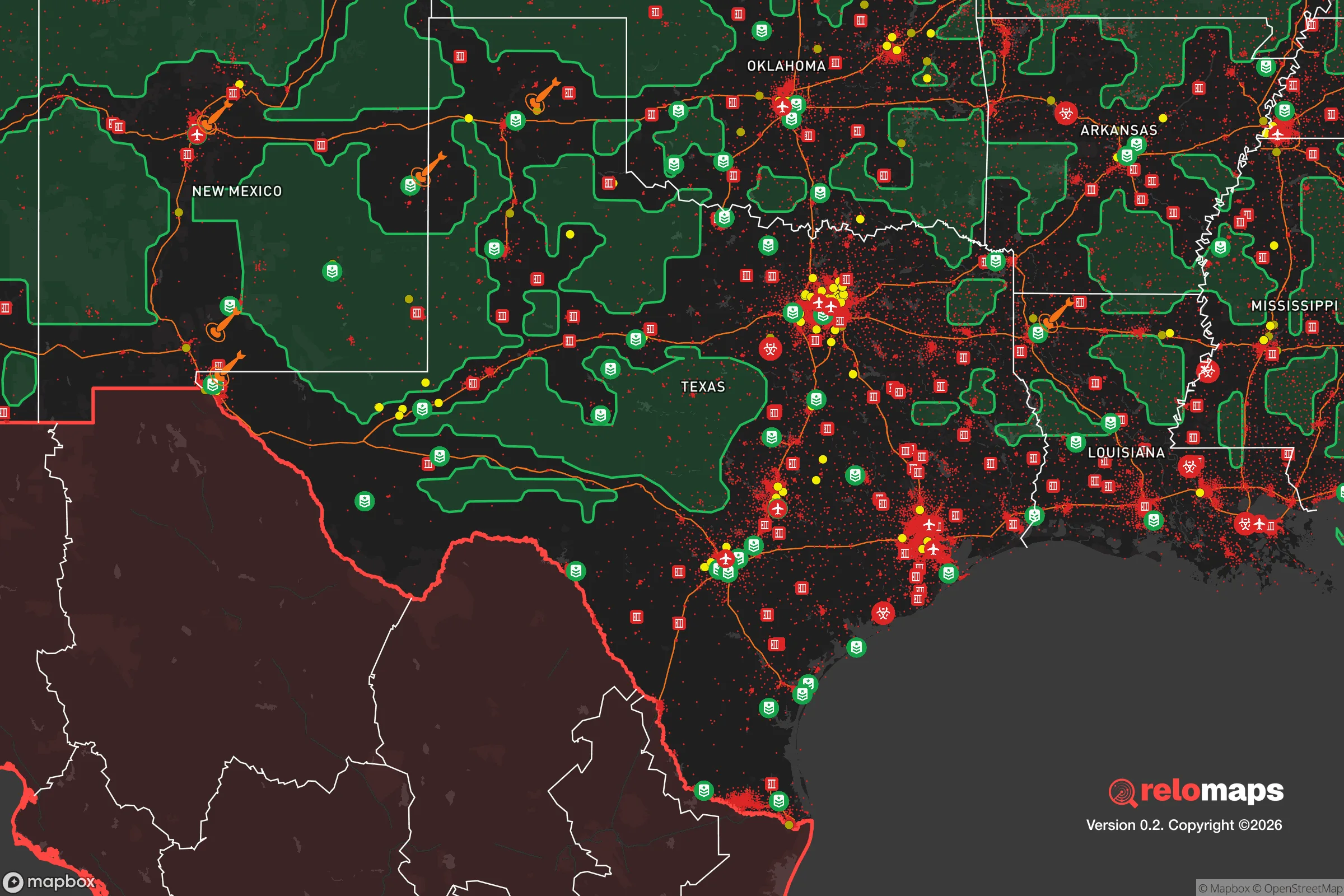


Important Note: For informational purposes only. This does not mean nothing bad ever happens in the green zones. Please use common sense. This is based on public data and modeled with AI. We tried to take a conservative approach but mistakes happen. We update this regularly as new information becomes available.
Solar Generator Recommendations
Backup power matters more here than in safer locations. We've picked three solar generators across budgets and capacity tiers — start with the budget unit if you only need a few essentials, or step up if you want to run a fridge and HVAC for days at a time.

Jackery Portable Power Station Explorer 300
Budget OptionPower on the Go: Weighing only 11 lbs, it's convenient to set up and store with book-sized foldable solar panels

BLUETTI Portable Power Station AC180
Designed for both indoor and outdoor scenarios, AC180 is highly capable as it has a robost capacity and continuous output power.

EF ECOFLOW DELTA Pro Ultra Power Station
Upgraded PickEcoFlow DELTA Pro Ultra is a whole-home energy system designed to grow with your family. Integrated with the Smart Home Panel 2, it scales to meet your evolving energy needs — keeping your home powered, intelligent, and secure through every stage of life.
We earn a commission, at no additional cost to you.
Strategic Assessment Analysis
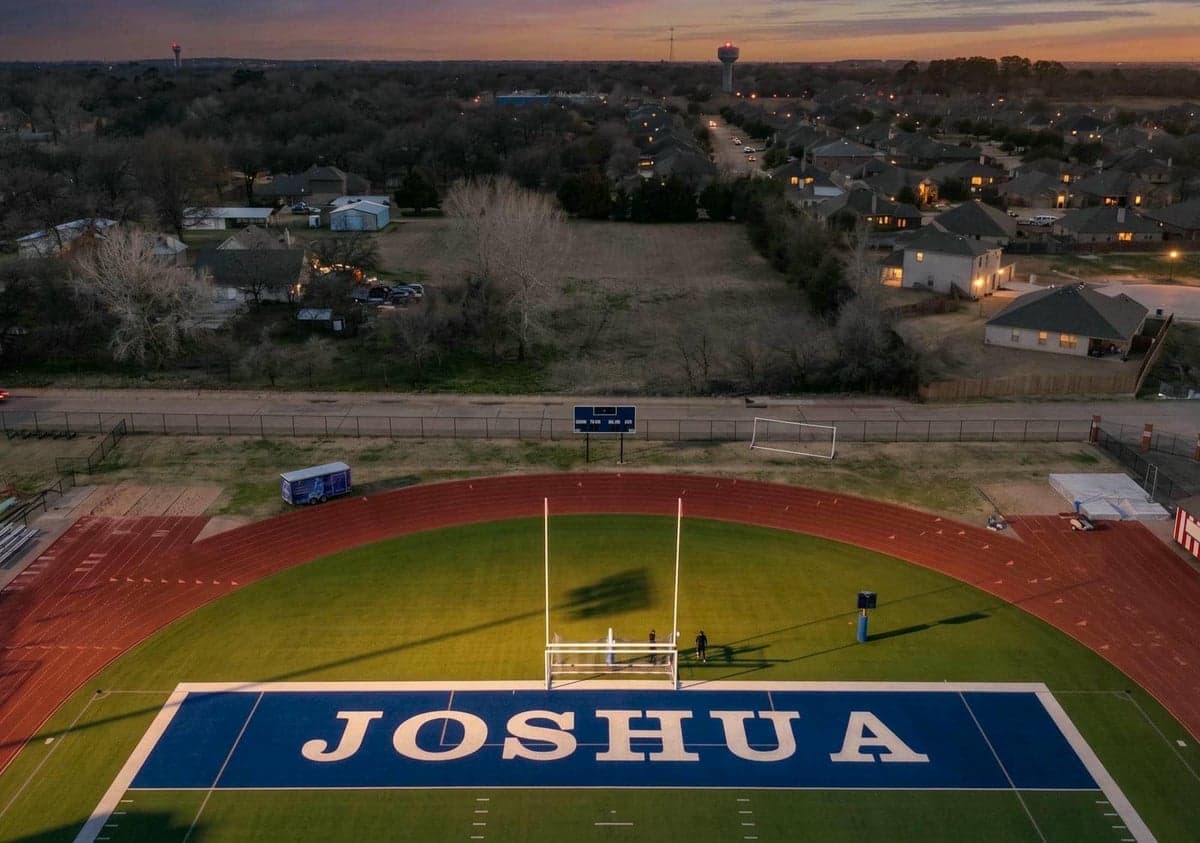
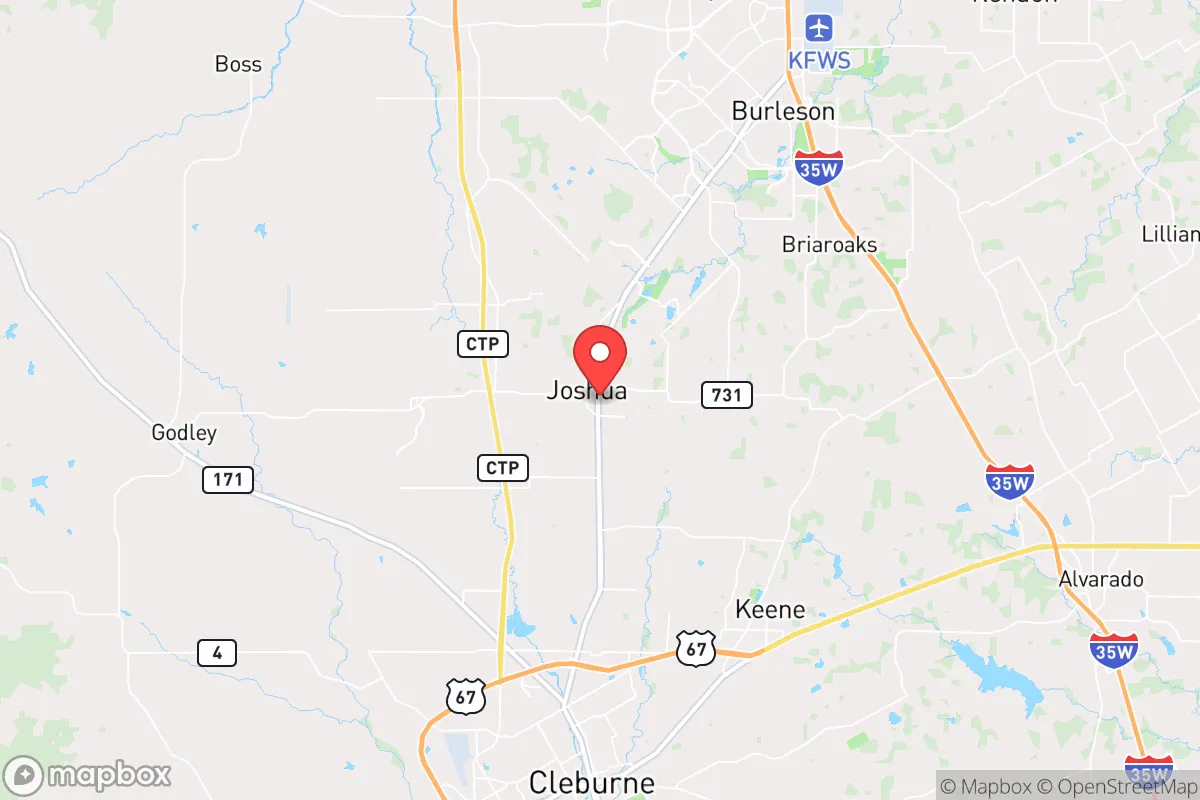
Joshua, Texas, offers a compelling mix of strategic advantages for those prioritizing long-term resilience and self-sufficiency, but it is not without significant trade-offs. Located in Johnson County, roughly 25 miles south of Fort Worth, this town of around 8,000 residents sits at a critical inflection point: close enough to the Dallas-Fort Worth metroplex for resource access, yet far enough to avoid the immediate blast zones and worst civil unrest of a major urban collapse. The area’s position on the edge of the Cross Timbers ecoregion provides a natural buffer of rolling hills and mixed woodland, offering better defensibility and water retention than the flat, open plains to the west. For a relocator operating from a survivalist or prepper mindset, Joshua represents a potential fallback position—but only if you understand its specific vulnerabilities and plan accordingly.
Geographic position and natural advantages for long-term survival
Joshua’s primary strategic asset is its location along the I-35W corridor, which provides a direct line to Fort Worth’s logistics hubs, medical facilities, and supply chains. In a stable environment, this proximity is a net positive: you can reach major hospitals in under 30 minutes, and the city’s own police and fire services are well-funded relative to its size. The natural terrain is a mix of post oak savanna and limestone-based soils, which means decent drainage and less flood risk than areas closer to the Trinity River. The local water table is accessible via private wells in most rural parcels, though city water comes from the Benbrook Lake system, which is vulnerable to upstream contamination or disruption. The area’s average annual rainfall of about 36 inches supports rain catchment systems, and the growing season is long enough for substantial food production. For a family looking to establish a semi-independent homestead, Joshua’s zoning allows for livestock on parcels as small as one acre in some unincorporated pockets, though city limits restrict this. The key natural advantage is the moderate topography and tree cover, which offers concealment and natural barriers against both weather events and human threats—something the open prairie to the west cannot provide.
Risks, exposures, and proximity to fallout-relevant landmarks
The most serious downside for a prepper is Joshua’s proximity to high-value targets in the DFW metroplex. Naval Air Station Joint Reserve Base Fort Worth is roughly 20 miles northeast, and the Lone Star Army Ammunition Plant is about 25 miles east in Texarkana’s broader logistics network—though the more immediate concern is the concentration of rail and highway infrastructure that could become chokepoints during a crisis. A major EMP event or conventional strike on DFW would likely disrupt power and communications for weeks, and Joshua sits within the primary fallout plume zone for a ground burst targeting Fort Worth’s defense installations. The prevailing winds from the south-southeast mean that fallout from a strike on the Dallas side would largely bypass Joshua, but a strike on Fort Worth’s industrial core would push contamination directly over the town. Additionally, the I-35W corridor is a known evacuation route, meaning Joshua could become a bottleneck for refugees fleeing the metroplex during a mass casualty event. The Johnson County Sheriff’s Office is competent but small—roughly 40 deputies for the entire county—so self-defense and community security are non-negotiable. The town’s location also places it within 50 miles of the Barnett Shale natural gas fields, which are both an energy asset and a potential target for sabotage or industrial accidents.
Practical resilience for a relocator: food, water, energy, and defensibility
For a single individual or family serious about preparedness, Joshua’s practical resilience depends on your specific property and setup. The city’s water supply is treated and reliable in normal times, but a prolonged grid-down scenario would require either a private well with a hand pump or a rainwater catchment system capable of storing at least 1,000 gallons per person for a 30-day period. The local soil is clay-heavy in many areas, which means raised beds or imported topsoil are necessary for serious gardening. The growing season runs from March to November, allowing for two crop cycles of staples like corn, beans, and squash. For protein, chickens and rabbits are practical on suburban lots, while goats or a small cattle operation require acreage outside city limits. Energy resilience is a mixed bag: natural gas is widely available, but a grid failure would cut off gas distribution without backup power. Solar panels with battery storage are viable given the region’s 220+ sunny days per year, but you’ll need to harden them against hail and high winds. Defensibility is moderate—the town’s layout is a mix of older neighborhoods with mature trees and newer subdivisions with open sightlines. A property with a fenced perimeter, a clear field of fire, and a basement or storm shelter is ideal, though basements are rare in Texas due to the clay soil. The local gun culture is strong, and Johnson County is a Second Amendment sanctuary, so arming yourself and training are straightforward. Community resilience is the wildcard: Joshua has active churches, a volunteer fire department, and a growing number of like-minded preppers, but the town is also seeing an influx of suburban commuters who may not share your priorities. Building relationships with neighbors who have complementary skills—medical, mechanical, security—is as important as stockpiling supplies.
The overall strategic picture for Joshua, Texas, is one of calculated risk. It offers a genuine fallback position with decent natural resources, a supportive political climate for self-reliance, and proximity to urban infrastructure that can be leveraged in stable times. But the same proximity that makes it convenient also makes it vulnerable to the cascading effects of a major disaster—whether that’s a terrorist attack on Fort Worth, a grid-down event from an EMP, or civil unrest spilling out of the metroplex. For a relocator who is willing to invest in off-grid water, energy, and food systems, and who is prepared to defend their property and build a local network, Joshua can work as a long-term base. For those expecting a bug-out location that requires minimal effort, the risks likely outweigh the rewards. Joshua is not a retreat—it’s a forward operating base, and it demands the same level of planning and commitment that any serious strategic position requires. If you’re ready to put in the work, it’s a solid choice. If not, look further west or north, where the buffers are wider and the targets are fewer.

* Values derived from national, state, county, city and local statistics and may differ in a specific area. Last updated: 2026-05-12T01:14:44.000Z
Narrative content on this page is AI-generated and may contain mistakes. Verify any details that matter before acting on them.
ReloMaps may earn a commission from affiliate links at no extra cost to you.

