Political ClimatePolitical Climate in Joshua, TX
District shown is the primary district for this city’s centroid. Cities may span multiple districts.
Local Political AnalysisPolitical Analysis of Joshua, TX
Joshua, Texas, is about as solidly conservative as it gets in the Lone Star State, and it’s been that way for as long as I can remember. The Cook Partisan Voting Index (PVI) here sits at R+18, which is a full 14 points more Republican than the state of Texas as a whole (R+4). That’s not just a lean—it’s a landslide. When you look at the voting patterns, you’ll see that Joshua hasn’t just voted red; it’s voted deep, deep red in every major election cycle for the past two decades. The trajectory is holding steady, too. While some parts of Texas—like nearby Dallas or even Fort Worth—have seen a slow drift leftward, Joshua has remained a stubborn, proud conservative stronghold. If anything, the recent influx of families fleeing the chaos of bigger cities has only reinforced that, as many of them are specifically looking for a place where their values aren’t under constant assault.
How it compares
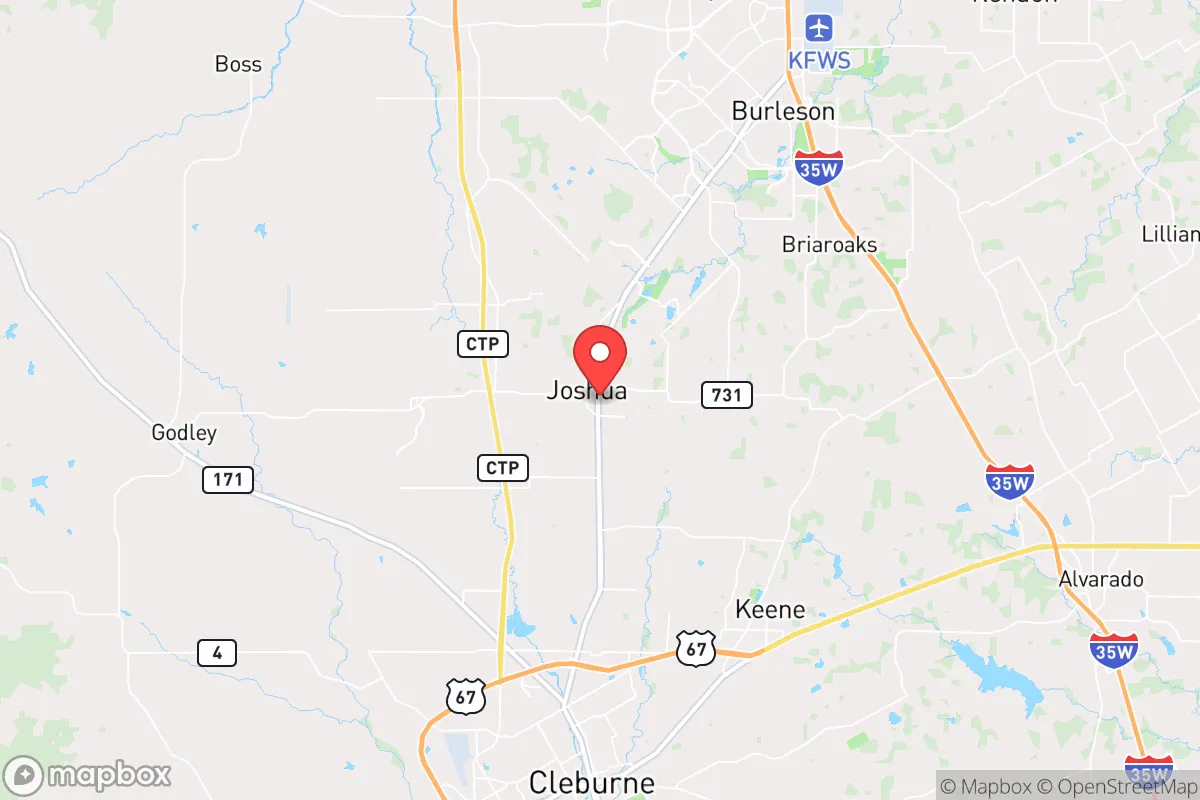
Compared to the rest of Texas, Joshua is a different world politically. The state’s R+4 PVI means it’s still reliably red, but it’s a battleground in places like Tarrant County (just north of us) or the suburbs of Houston, where you’ll see competitive races and a growing progressive influence. Joshua, on the other hand, is in Johnson County, and that county hasn’t gone blue in a presidential election since the 1960s. Drive 20 minutes east to Burleson, and you’ll find a similar vibe, but head 30 minutes north to Cleburne or even further to the outskirts of Fort Worth, and you start seeing more purple pockets. The contrast is stark: in Joshua, you don’t see yard signs for both parties during election season—you see one party, and it’s the one that believes in limited government, personal responsibility, and keeping the government out of your life. The state as a whole has to balance that with the growing urban centers of Austin and Houston, where progressive policies on taxes, regulations, and personal freedoms are creeping in. Joshua doesn’t have that problem. It’s a place where the local government still respects the Second Amendment, doesn’t overreach on property rights, and keeps taxes low because they trust you to spend your own money better than they can.
What this means for residents
For folks living here, this political climate means a lot of peace of mind. You don’t have to worry about the city council trying to impose mask mandates, restrict your business operations, or dictate what you can do with your land. The local school board isn’t pushing critical theory or woke curriculum—they’re focused on teaching kids how to think, not what to think. Property taxes are reasonable compared to the state average, and there’s no talk of adding new income taxes or overreaching zoning laws. The downside? If you’re hoping for a diverse political debate at the local coffee shop, you’ll be disappointed. It’s a bubble, but for most of us, that’s a feature, not a bug. The long-term outlook is good, but I do keep an eye on the state level. As Texas grows, there’s always a risk that progressive policies from the big cities could trickle down—like state-level mandates on energy or housing that ignore rural needs. But as long as Joshua keeps voting the way it does, and as long as we keep electing local officials who believe in freedom over control, I think we’ll stay the course.
One cultural distinction worth noting: Joshua has a strong sense of community that’s tied to its political identity. You’ll see church potlucks, volunteer fire departments, and neighbors helping neighbors without a government program in sight. That’s the kind of self-reliance that’s getting harder to find in Texas’s bigger cities, where bureaucracy and red tape are choking the life out of everyday freedoms. If you’re looking for a place where you can live your life without someone in an office telling you how to do it, Joshua is it. Just don’t expect it to change anytime soon—and that’s exactly how we like it.

State Political ClimatePolitical Climate in Texas
State Political AnalysisPolitical Environment in the State
Texas has been a reliably Republican state for decades, with a Cook PVI of R+4, but the coalition that keeps it red is shifting under your feet. The dominant political force remains a mix of fiscal conservatives, social conservatives, and libertarian-leaning independents, but the 10-20 year arc shows a slow, steady erosion of the GOP’s margin as blue metros like Austin, Dallas, and Houston swell with out-of-state transplants. In 2020, Trump still won Texas by 5.5 points, but that was down from 9 points in 2016 and 16 points in 2012 – a clear warning sign for anyone who values the state’s traditional small-government, low-tax ethos.
Urban vs. rural divide
The political map of Texas is a tale of two worlds. The vast rural and exurban counties – places like Lubbock, Midland, and the Panhandle – vote Republican by 70-80% margins, and they anchor the state’s conservative majority. But the big metros are where the battle lines are drawn. Austin (Travis County) is the state’s progressive stronghold, voting over 70% Democratic in every recent election, and it’s the epicenter of the “Texodus” of California-style politics. Dallas and Houston are more competitive but trending blue, especially in the inner suburbs. The real story is the suburban flip: counties like Collin (north of Dallas) and Williamson (north of Austin) were reliably red a decade ago, but in 2020, Biden nearly carried Collin and actually won Williamson – a seismic shift driven by educated, affluent transplants who bring their coastal voting habits with them. Meanwhile, the Rio Grande Valley, once a Democratic stronghold, has been inching rightward, with Trump improving his margins in Hidalgo and Cameron counties in 2020.
Policy environment
Texas’s policy environment is still a breath of fresh air for conservatives, but it’s under constant siege. The state has no personal income tax, a cap on property tax growth (Proposition 4, 2023), and a regulatory climate that’s among the most business-friendly in the nation. Education policy is a flashpoint: the 2023 school voucher battle (SB 8) failed in the House, but Governor Abbott is pushing hard for a 2025 version that would let parents use tax dollars for private or homeschool expenses – a major win for parental rights if it passes. Healthcare is a mixed bag: Texas refused Medicaid expansion, keeping the system lean, but rural hospitals are struggling. Election laws tightened after 2020 with SB 1 (2021), which banned 24-hour voting and drive-through voting, and added ID requirements for mail ballots – a move that drew fire from the left but was seen by conservatives as necessary to restore integrity. The state also passed a near-total abortion ban (SB 8, 2021, and the trigger law in 2022) and a permitless carry law (HB 1927, 2021) for firearms, cementing its pro-life and pro-Second Amendment stance.
Trajectory & freedom
On the freedom front, Texas is a tale of two trends. On one hand, the state has expanded personal liberty in key areas: permitless carry (HB 1927) means you can carry a handgun without a license, and the Texas Heartbeat Act (SB 8) effectively banned abortion after six weeks, protecting unborn life. Parental rights got a boost with the READER Act (HB 900, 2023), which restricted sexually explicit content in school libraries. But there are worrying signs of government overreach. The DEI ban (SB 17, 2023) eliminated diversity offices at public universities, which many conservatives applauded, but it also opened the door to more state micromanagement of campus speech. The border security push (Operation Lone Star) has been a massive state-level intervention, with billions spent and thousands of migrants bused to blue cities – popular with the base, but it’s a heavy-handed use of state power that some libertarians find troubling. The biggest threat to freedom, though, is the property tax burden: even with the 2023 cuts, Texas homeowners pay some of the highest effective property tax rates in the country, and the state’s reliance on them means your “low-tax” paradise can feel like a trap if home values keep soaring.
Civil unrest & political movements
Texas has seen its share of political flashpoints. The 2020 protests in Austin over George Floyd’s death turned violent, with the city council later defunding the police by $150 million – a move that backfired as crime spiked and the state legislature stepped in with the “back the blue” law (HB 1900, 2021), which penalizes cities that cut police budgets. Immigration politics are raw: the El Paso border crisis has made that city a national symbol of the chaos, while Governor Abbott’s busing of migrants to New York and Chicago has been a deliberate provocation. The “Texit” movement (Texas Nationalist Movement) is small but vocal, pushing for secession – mostly a fringe idea, but it reflects a deep distrust of federal overreach. Election integrity remains a hot-button issue: after the 2020 “Sharpstown” controversies in Harris County (Houston), the state took over election administration there in 2024, a move that was either necessary reform or partisan power grab, depending on who you ask. A new resident will notice the “Don’t Mess with Texas” bumper stickers and the occasional Confederate monument debate in smaller towns like Denton or Waco, but the real tension is between the old-school conservative culture and the influx of progressive newcomers.
Projection
Over the next 5-10 years, Texas is likely to become a true battleground state. The in-migration of 1,000+ people per day, mostly from California and New York, is tilting the suburbs blue. If current trends hold, Texas could be a toss-up state by 2032, with the GOP clinging to power through rural turnout and gerrymandered districts. The state legislature will probably pass a school voucher program and further restrict abortion, but the cultural war will intensify. The biggest wildcard is the Hispanic vote: if the Valley and urban Latinos continue shifting right, the GOP can hold the line; if they revert to blue, Democrats win. A new resident moving in now should expect a decade of political chaos – more fights over property taxes, more battles over school curriculum, and a state government that’s increasingly at odds with its biggest cities. The freedom you came for will be under constant pressure from both the federal government and the growing progressive bloc within the state.
For a conservative relocating to Texas, the bottom line is this: you’re still in a red state, but it’s a red state that’s fighting for its life. The low taxes, gun rights, and parental control over education are real and worth moving for, but you’ll need to pick your county carefully. Avoid Austin and the inner suburbs of Dallas and Houston if you want to live among like-minded neighbors; instead, look at the exurbs like Katy, Frisco, or New Braunfels, where the conservative culture is still dominant. Get involved in local politics – school boards, city councils, county commissions – because that’s where the battle for Texas’s soul will be won or lost in the next decade. The state is still a refuge from coastal overreach, but only if you help keep it that way.
* Values derived from national, state, county, city and local statistics and may differ in a specific area. Last updated: 2026-05-12T01:14:44.000Z
Narrative content on this page is AI-generated and may contain mistakes. Verify any details that matter before acting on them.
ReloMaps may earn a commission from affiliate links at no extra cost to you.

