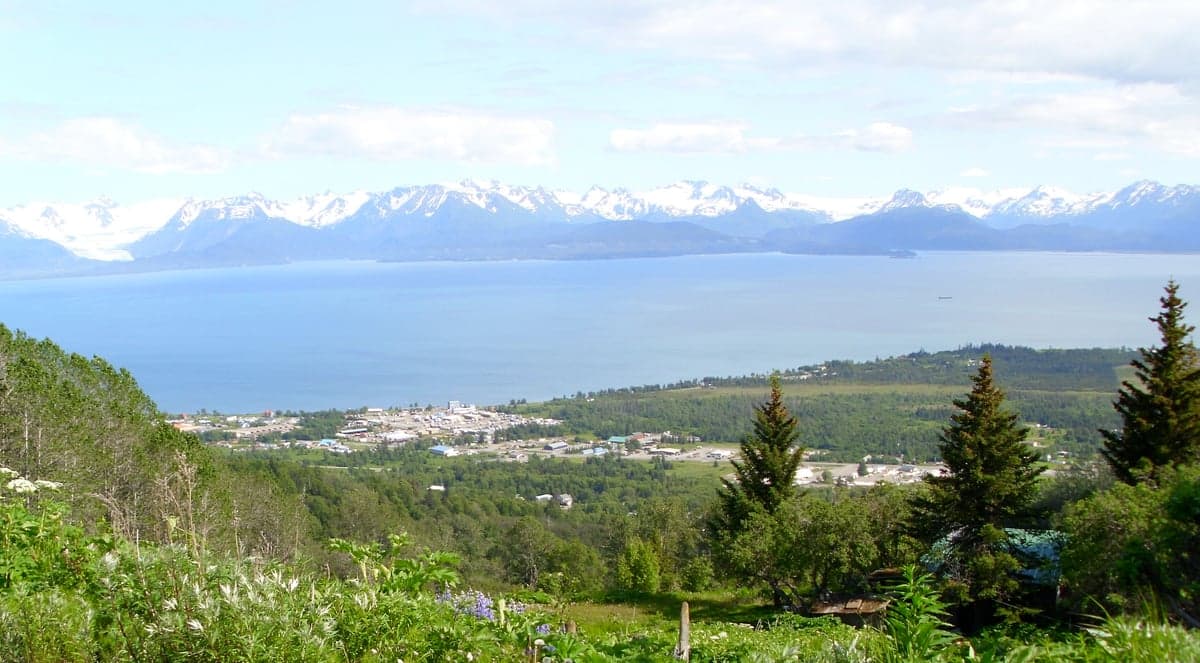
Photo: Wikipedia
Demographics of Kachemak, AK
Historical data isn't available for Kachemak, AK. Trends shown are for Kenai Peninsula County, AK.
Affluence Level in Kachemak, AK
A middle-class area roughly in line with national averages across income, home values, education, and employment.
People of Kachemak, AK
The people of Kachemak, Alaska, today number 835 residents, forming a tight-knit, predominantly white community with a notably high college attainment rate of 40.2%. The city’s character is shaped by its origins as a fishing and homesteading outpost on the southern shore of Kachemak Bay, where self-reliance and a connection to the surrounding wilderness remain core identity markers. With a foreign-born population of just 2.8% and a minimal Hispanic presence at 0.4%, Kachemak is one of the least ethnically diverse communities in the Kenai Peninsula Borough, attracting residents who prioritize quiet, resource-based living over urban amenities.
How the city was settled and grew
Kachemak’s settlement history is a post-1900 story, rooted in the Alaska homesteading era and the commercial fishing boom of the early 20th century. The area was originally inhabited by the Dena’ina Athabascan people, but the modern city traces its founding to the 1930s and 1940s, when the federal government opened land for homesteading under the Homestead Act of 1862, extended to Alaska. The first permanent non-Native settlers were largely Scandinavian and Anglo-American fishermen, trappers, and miners who built cabins along the shoreline in what is now the Old Town Kachemak district, a historic cluster of homes and docks hugging the bay. A second wave arrived during and after World War II, when military personnel stationed at nearby Fort Raymond and later the Kachemak Bay Naval Facility chose to stay, settling in the Hillside neighborhood, which offered elevated views and protection from coastal storms. By the 1950s, the population had grown to roughly 200, with the Spit Road area emerging as a commercial hub for fish processing and boat repair, drawing seasonal workers from the Pacific Northwest who often became year-round residents.
Modern era (post-1965)
After the 1965 Hart-Cellar Act, Kachemak saw minimal immigration-driven change, unlike many U.S. cities. The city’s remote location and limited economic base—primarily fishing, tourism, and small-scale services—did not attract the post-1965 immigrant waves that transformed Anchorage or Seward. Instead, domestic in-migration from the Lower 48 accelerated in the 1970s and 1980s, driven by the Alaska oil boom and a back-to-the-land movement. New arrivals—often young families and retirees from California, Oregon, and Washington—settled in the Bayview Estates subdivision, a planned development of single-family homes on larger lots, and in the East End district, where newer homes were built on former homestead parcels. The city’s racial composition remained overwhelmingly white, with the 2020 census showing 85.5% of residents identifying as white alone. The East/Southeast Asian community, at 2.8%, is the largest minority group, concentrated among a handful of families who operate or work in the seafood processing industry, primarily in the Harbor View area near the boat launch. There is no Black or Indian subcontinent population recorded, and the Hispanic share is negligible at 0.4%.
The future
Kachemak’s population is aging and slowly declining, mirroring trends across rural Alaska. The median age has crept upward as younger residents leave for job opportunities in Anchorage or the Lower 48, while retirees continue to move in for the quiet lifestyle and natural beauty. The foreign-born share is unlikely to grow significantly, given the lack of entry-level jobs in hospitality or construction that typically attract immigrant labor. The East/Southeast Asian community is stable but not expanding, tied to a niche industry. Over the next 10 to 20 years, Kachemak will likely homogenize further, becoming an even more uniformly white, older, and college-educated enclave. New development is concentrated in the Ridge Top subdivision, where a handful of custom homes are being built for remote workers and second-home buyers, but this will not reverse the demographic trend. The city is not tribalizing into distinct ethnic enclaves—it is too small and too homogeneous for that—but it is becoming a place where economic stratification is visible, with long-time fishing families in Old Town and newer, wealthier arrivals in Bayview Estates and Ridge Top.
For someone moving in now, Kachemak offers a stable, safe, and culturally insular community where neighbors know each other and the pace of life is dictated by tides and seasons. The trade-off is limited diversity, few job opportunities outside fishing and tourism, and a population that is not growing. It is a place for those who value solitude and self-sufficiency over demographic dynamism.

* Values derived from national, state, county, city and local statistics and may differ in a specific area. Last updated: 2026-04-19T19:25:26.000Z
Narrative content on this page is AI-generated and may contain mistakes. Verify any details that matter before acting on them.
ReloMaps may earn a commission from affiliate links at no extra cost to you.

