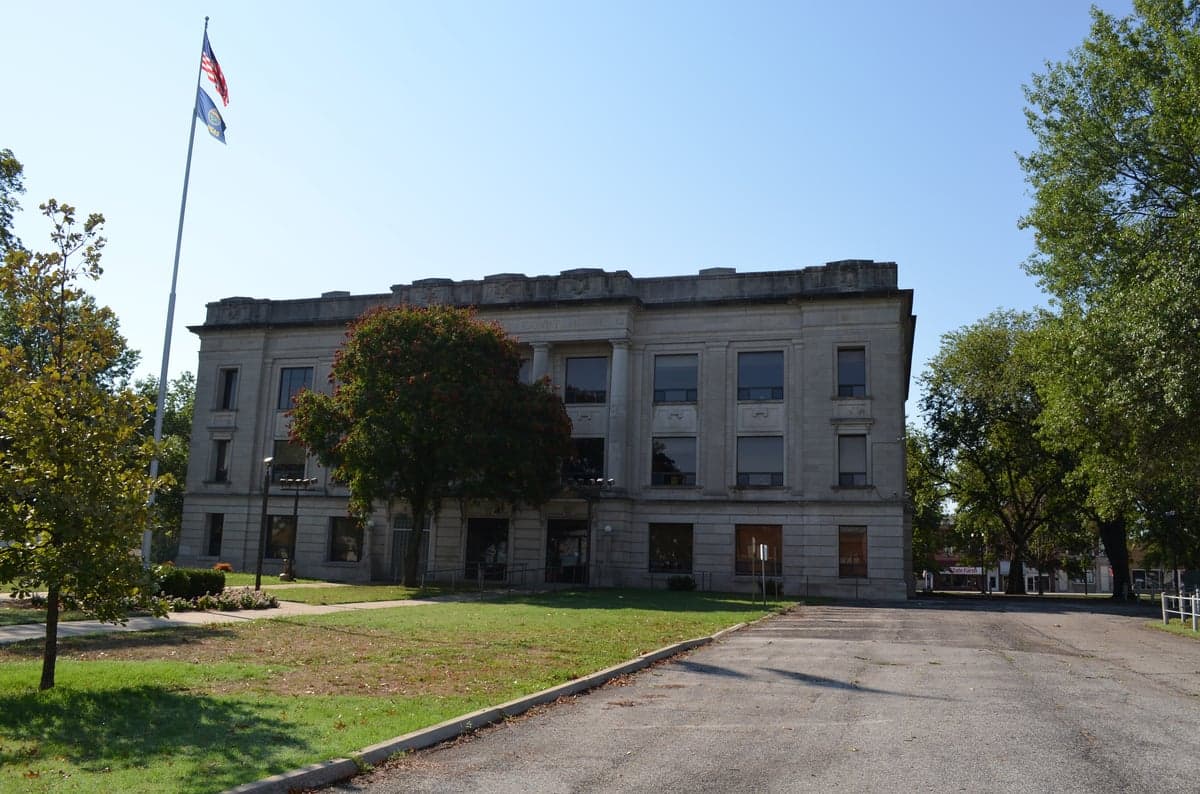
Photo: Wikipedia
Political ClimatePolitical Climate in Crawford County
Showing district-level results — no local-only data available.
Local Political AnalysisPolitical Analysis of Crawford County
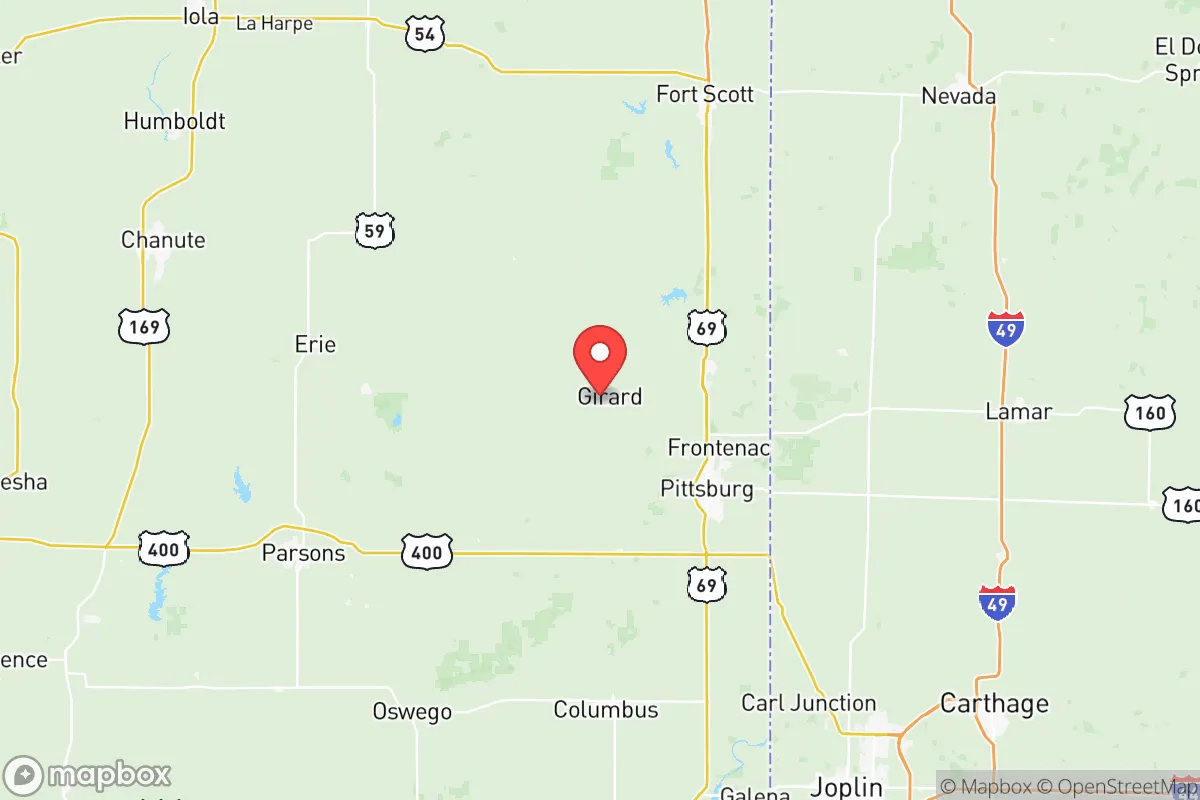
Crawford County, Kansas, is a reliably Republican area with a Cook PVI of R+10, making it slightly more conservative than the state of Kansas as a whole, which sits at R+9. However, the county’s political reality is far from monolithic. The city of Pittsburg, home to Pittsburg State University, consistently leans blue, with precincts around the campus and downtown often voting Democratic by 10-15 points in recent elections. In contrast, the smaller towns like Girard, Frontenac, and Arma are deeply red, often delivering 70% or more of their votes to Republican candidates. The rural precincts along the Missouri border, particularly around Cherokee and Weir, are the swingiest areas, where local issues like agriculture and mining can shift a precinct from red to purple in a given cycle.
How it compares
Compared to Kansas as a whole, Crawford County is a bit of a bellwether for the state’s rural-urban divide. While Kansas’s R+9 PVI is pulled rightward by places like Johnson County (suburban Kansas City) and the western plains, Crawford County’s R+10 is driven by its own internal split. The county’s Republican lean is about 1-2 points stronger than the state average, but the margin is deceptive. In 2020, Donald Trump won Crawford County by roughly 18 points, while he won Kansas by 15 points. The difference is that Pittsburg’s Democratic vote is more concentrated and vocal than in many other rural Kansas counties, giving the area a more competitive feel than its PVI suggests. The state’s recent trend toward the GOP, fueled by suburban shifts in Johnson County, hasn’t hit Crawford County as hard—Pittsburg’s university population keeps the Democratic base steady, while the rural areas have been reliably red for decades.
What this means for residents
For conservative residents, Crawford County is a comfortable place to live politically. Local offices, from the county commission to the sheriff, are almost always held by Republicans, and conservative values dominate public discourse in the smaller towns. You’ll find strong support for gun rights, lower taxes, and traditional family structures, especially in places like Girard and Frontenac. For liberal residents, the reality is more nuanced. In Pittsburg, you can find like-minded neighbors, a progressive city council, and a university environment that tolerates—if not always embraces—left-leaning ideas. But drive 10 minutes outside city limits, and the political atmosphere shifts sharply. Liberal residents often feel they need to be careful about displaying political signs or discussing certain topics in rural settings. The county’s political climate means that while you can live your life without much friction, the broader policy direction—on issues like abortion, education funding, and renewable energy—is set by the conservative majority. The local Democratic Party is active but small, and its influence is mostly felt in city-level races in Pittsburg.
Culturally, Crawford County stands apart from the rest of Kansas in a few key ways. The area has a strong mining and railroad history, which fosters a blue-collar, union-friendly streak in parts of Pittsburg and Cherokee County that you don’t see in the state’s more agricultural regions. This history also makes the county more receptive to labor rights and infrastructure spending than the typical Kansas conservative area. On social issues, the county is generally traditional, but the university presence in Pittsburg creates a small but visible counterculture—think local art scenes, a few LGBTQ-friendly spaces, and a more diverse food scene than you’d find in, say, Girard. The county’s political trajectory is stable: expect the rural areas to stay deep red, Pittsburg to remain a blue island, and the overall R+10 lean to persist as long as the university and mining heritage balance each other out. For anyone moving here, the key is knowing which town you’re in—and adjusting your expectations accordingly.

State Political ClimatePolitical Climate in Kansas
State Political AnalysisPolitical Environment in the State
Kansas is a solidly Republican state with a Cook PVI of R+9, meaning it typically votes about nine points more Republican than the national average. Over the last 10-20 years, the state has shifted rightward in statewide races, driven by a deepening rural-urban split and the consolidation of conservative power in the legislature, though it has also seen periodic Democratic wins in gubernatorial races (like Laura Kelly in 2018 and 2022) that signal a more moderate streak in the suburbs. The dominant coalition is a mix of rural conservatives, small-town traditionalists, and a growing number of exurban families fleeing the coasts, while the Kansas City metro and Lawrence provide the state’s Democratic base.
Urban vs. rural divide
The political map of Kansas is a textbook case of the urban-rural divide. The Democratic stronghold is the Kansas City metro area, particularly Johnson County (Overland Park, Olathe, Lenexa) and Wyandotte County (Kansas City, Kansas). Johnson County, once reliably red, has been trending purple-to-blue in recent cycles — in 2020, Joe Biden won it by about 8 points, a flip from Trump’s 4-point win there in 2016. Wyandotte County is heavily Democratic, often delivering 70%+ margins for Democrats. Lawrence, home to the University of Kansas, is another deep blue island, with a young, educated, and progressive electorate. In contrast, the rest of the state is deeply red. Sedgwick County (Wichita) is a bellwether — it leans Republican but can be competitive in close races, with the city of Wichita itself being more moderate and the surrounding suburbs and exurbs solidly conservative. Rural counties like Sherman (Goodland) in the west and Allen (Iola) in the southeast routinely vote 80%+ Republican. The divide is stark: the eastern third of the state, anchored by the Kansas City metro and Lawrence, provides nearly all Democratic votes, while the vast central and western plains are a Republican firewall.
Policy environment
Kansas’s policy environment is shaped by a conservative legislature and a more moderate governorship under Laura Kelly. The state has a flat income tax rate of 5.7% (after the 2024 tax cuts), a low corporate income tax rate, and no tax on Social Security benefits, making it attractive for retirees and businesses. The regulatory posture is generally business-friendly, with right-to-work laws and limited zoning in most rural areas. Education policy is a flashpoint: the state has seen repeated school funding lawsuits, and the legislature has pushed for school choice and charter school expansion, though Governor Kelly has vetoed some of the more aggressive voucher bills. Healthcare is a mixed bag — Kansas did not expand Medicaid under the Affordable Care Act, leaving a coverage gap for about 150,000 low-income adults, but the state has a robust network of rural hospitals and clinics. Election laws are moderately restrictive: Kansas requires a photo ID to vote and has a voter registration deadline 21 days before an election, but it does not have the strictest laws in the region. The state also has a “constitutional carry” law for firearms (permitless carry, enacted in 2015), and it is a “shall issue” state for concealed carry permits.
Recent policy direction
Recent legislation in Kansas points in a consistently conservative direction, with some notable exceptions. On gun and self-defense law, the state passed a “Second Amendment Preservation Act” in 2021 that prohibits state and local enforcement of certain federal gun laws, and in 2023 it expanded stand-your-ground protections. On parental and education rights, the legislature passed a “Parents’ Bill of Rights” in 2022, requiring schools to notify parents about curriculum changes and allowing them to opt their children out of certain materials. A 2023 law banned transgender girls from participating in girls’ sports from K-12 through college. On speech and privacy, Kansas has no broad anti-SLAPP law, but it does have a shield law for journalists. On medical and bodily autonomy, the state passed a near-total abortion ban in 2022 (the “Value Them Both” amendment failed at the ballot box in August 2022, but the legislature then enacted a ban on most abortions after 22 weeks, with no exceptions for rape or incest, though it is currently blocked by court order). On property rights, Kansas is a “Dillon’s Rule” state, meaning local governments have only powers explicitly granted by the state, which limits local control over zoning and land use. On taxation, the 2024 tax cut package reduced the top income tax rate from 5.7% to 5.7% (it was already at that level) and accelerated the elimination of the state’s food sales tax. On voting and ballot access, the state has not gone as far as some others — it has no voter ID for absentee ballots, and it allows same-day voter registration for presidential elections only.
Civil unrest & political movements
Kansas has seen relatively low levels of civil unrest compared to coastal states, but there have been notable flashpoints. The 2022 abortion amendment campaign saw intense grassroots organizing on both sides, with pro-choice groups turning out heavily in Johnson County and Lawrence, while pro-life groups dominated rural areas. The state has a small but active militia movement, particularly in the southeastern part of the state, and there have been periodic protests at the state capitol in Topeka over issues like vaccine mandates and mask requirements during the pandemic. Immigration politics are less heated than in border states, but there have been local controversies over sanctuary policies — in 2020, the city of Lawrence declared itself a “sanctuary city” for immigrants, which led to a legislative push to ban such policies statewide (the bill failed). Election integrity has been a recurring theme: in 2020, the state’s Republican attorney general joined a multi-state lawsuit challenging the election results, and there have been ongoing debates about the security of mail-in voting. A new resident would notice a generally calm political atmosphere in daily life, with the most visible activism being the occasional protest or rally at the statehouse or on university campuses.
Projection
Over the next 5-10 years, Kansas is likely to remain a solidly Republican state, but with a slowly growing Democratic presence in the Kansas City suburbs. The in-migration pattern is mixed: the state is attracting conservative-leaning families from California and Colorado who are drawn to lower taxes and a more traditional lifestyle, but it is also seeing an influx of younger, more diverse workers to the Kansas City metro for jobs in tech, healthcare, and logistics. The rural population will continue to decline, which will gradually shift the state’s political center of gravity eastward. The most likely scenario is that Kansas stays R+9 to R+12 in presidential races, but with more competitive gubernatorial and Senate races as the suburbs continue to moderate. A new resident moving in now should expect to find a state where conservative values dominate state policy, but where local politics in the major metros are increasingly contested and diverse.
For a new resident, the bottom line is that Kansas offers a stable, conservative-leaning environment with low taxes and a business-friendly climate, but with a notable urban-rural split that means your experience will vary dramatically depending on where you settle. If you’re looking for a place where your vote will matter in a Republican primary, rural Kansas is your spot. If you prefer a more moderate or liberal community, the Kansas City suburbs or Lawrence are your best bets. The state’s trajectory is one of slow, steady conservative consolidation at the state level, with a growing Democratic presence in the eastern metro areas that will keep things interesting but not flip the state anytime soon.
* Values derived from national, state, county, city and local statistics and may differ in a specific area. Last updated: 2026-06-12T06:56:14.000Z
Narrative content on this page is AI-generated and may contain mistakes. Verify any details that matter before acting on them.
ReloMaps may earn a commission from affiliate links at no extra cost to you.

