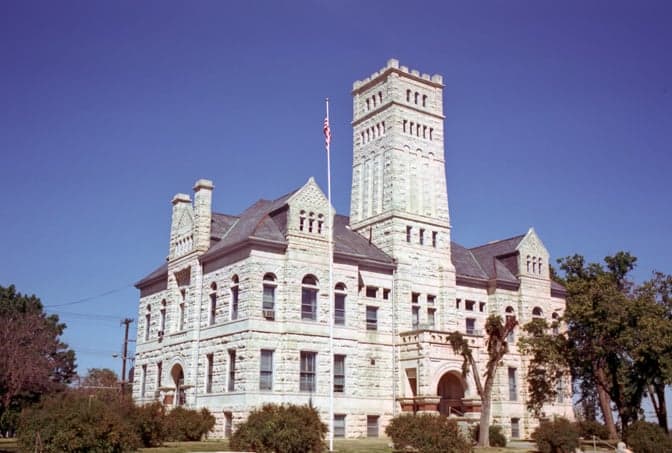
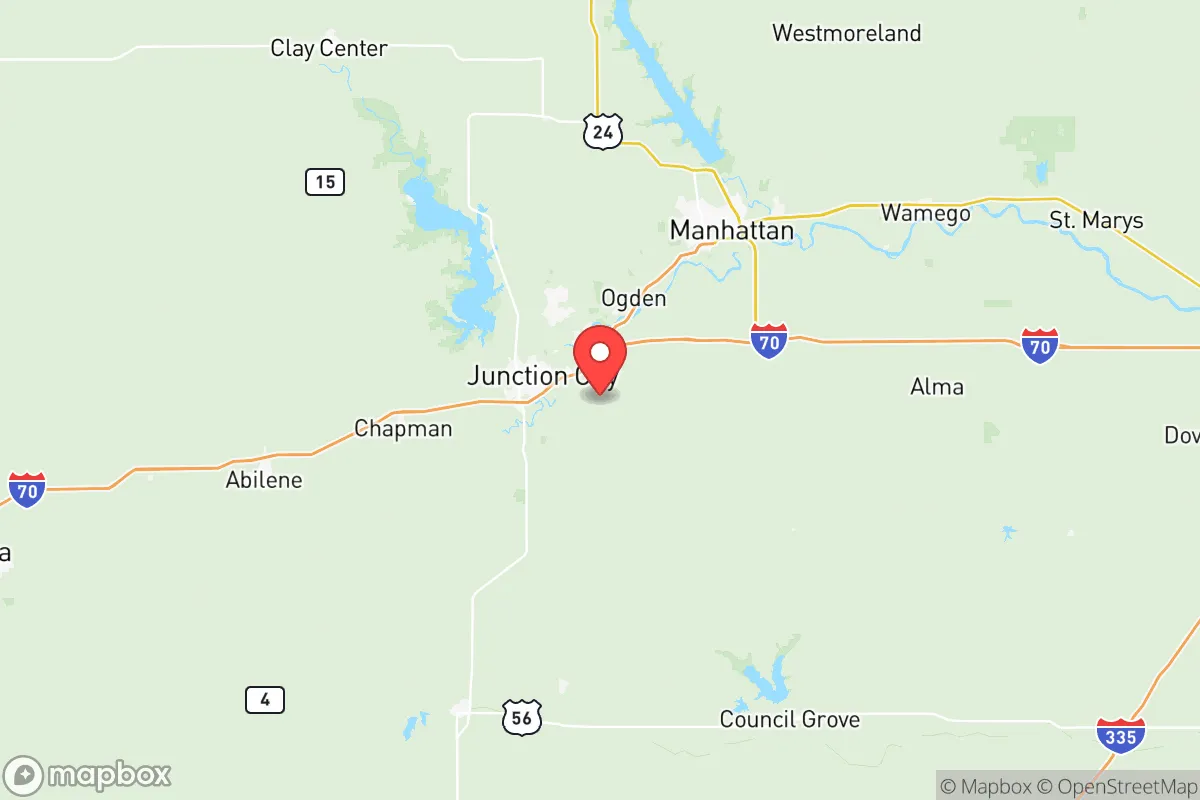
Photo: Wikipedia
Demographics of Geary County
Affluence Level in Geary County
A below-average socioeconomic profile. Incomes, home values, and educational attainment trail the U.S., with higher poverty and unemployment.
People of Geary County
Geary County, Kansas, is home to 35,895 residents, a population shaped overwhelmingly by the U.S. Army and the adjacent Fort Riley military installation. The county’s character is distinctly transient, young, and racially diverse, with a median age well below the national average and a demographic profile that mirrors the military’s own composition: 55.6% White, 16.2% Hispanic, 16.0% Black, and 3.1% East/Southeast Asian. This is not a county of deep-rooted generational families but of rotating waves of soldiers, civil servants, and support workers, giving Junction City and Grandview Plaza a pragmatic, service-oriented identity.
Settlement & growth (pre-1960)
Before American settlement, the land now comprising Geary County was part of the traditional territory of the Kaw (Kansa) and later the Pawnee and Osage nations. The Kansas River valley provided abundant game and fertile bottomlands, but the area saw no permanent European settlement until the 1850s. The U.S. government forcibly removed the Kaw to a reservation in Council Grove in 1846, and the first white settlers—mostly farmers from the Ohio River Valley and the Upper South—arrived after the Kansas–Nebraska Act of 1854 opened the territory to organized settlement.
The town of Junction City was founded in 1858 at the confluence of the Smoky Hill and Republican rivers, serving as a supply point for westward emigrants on the Oregon and Santa Fe trails. Its early population was a mix of free-state settlers from the Midwest and a smaller number of pro-slavery migrants from Missouri. The arrival of the Kansas Pacific Railroad in 1866 cemented Junction City as a regional trade hub. The single most transformative event for Geary County’s population was the establishment of Fort Riley in 1853, just south of Junction City. The fort drew a steady stream of soldiers, many of whom mustered out and settled locally, creating a pattern of military-to-civilian transition that persists today.
By 1900, the county’s population had reached roughly 10,000, overwhelmingly native-born white Americans of German, Irish, and English descent. A small Black community formed around Junction City, largely descendants of Buffalo Soldiers who had served at Fort Riley. The Dust Bowl and Great Depression of the 1930s brought a modest influx of displaced farmers from Oklahoma and the Texas Panhandle, but Geary County’s population remained stable through the mid-20th century, hovering around 15,000. World War II and the Korean War expanded Fort Riley’s footprint, drawing new waves of soldiers from across the country, but the county’s demographic character remained predominantly white and rural until the 1960s.
Modern era (post-1965)
The 1965 Hart-Cellar Act, which eliminated national-origin quotas, had an indirect but significant effect on Geary County. While the county itself did not become a primary destination for post-1965 immigrants, the U.S. military’s active recruitment of foreign-born personnel—particularly from the Philippines, Latin America, and the Caribbean—began to diversify the soldier population at Fort Riley. By the 1980s, Junction City and Grandview Plaza saw growing numbers of Filipino and Hispanic military families, many of whom settled permanently after service. The county’s foreign-born population today stands at just 3.0%, but that figure understates the cultural impact: many second-generation Hispanic and Asian residents, born in the U.S. to immigrant service members, remain in the area.
The most dramatic demographic shift in Geary County since 1965 has been the growth of the Black and Hispanic populations. The Black share rose from roughly 8% in 1970 to 16.0% today, driven by the post-Vietnam expansion of the all-volunteer Army and the stationing of mechanized infantry and armored units at Fort Riley. Hispanic growth accelerated after 2000, fueled by both military recruitment of Hispanic Americans and civilian migration from Texas and the Southwest for construction and service jobs tied to the fort’s expansion. The East/Southeast Asian population, at 3.1%, is concentrated among Filipino and Korean military families, with smaller numbers of Vietnamese and Chinese residents. The Indian subcontinent population is effectively zero, reflecting the absence of tech or medical sectors that draw South Asian immigrants elsewhere in Kansas.
Suburbanization in Geary County has been modest compared to the Kansas City metro. The main residential growth has occurred in the unincorporated areas around Fort Riley’s gates, particularly in Grandview Plaza and the western edge of Junction City. These areas feature newer housing developments, strip malls, and fast-food chains catering to military families. The county’s college-educated share is 24.4%, slightly below the Kansas average, reflecting the blue-collar and service-oriented nature of the local economy. The presence of Kansas State University in nearby Manhattan has drawn some educated residents, but Geary County itself remains a working-class, military-dependent community.
The future
Geary County’s population trajectory is tied almost entirely to the fortunes of Fort Riley. The base has avoided major BRAC closures, and its role as a heavy brigade combat team headquarters suggests relative stability through the 2030s. The county’s population is likely to remain in the 35,000–40,000 range, with slow growth driven by military-to-civilian transitions and the natural increase of young families. The racial and ethnic composition will continue to reflect the Army’s demographics: a slow increase in Hispanic share (projected to reach 20–22% by 2040), a stable or slightly declining Black share, and a small but persistent East/Southeast Asian presence.
The county is not tribalizing into distinct ethnic enclaves. Instead, the military base acts as a homogenizing force, mixing races and ethnicities in housing, schools, and workplaces. Junction City’s school district is already majority-minority, and this trend will continue. The cultural identity of Geary County is becoming less “rural Kansas” and more “military town America”—pragmatic, patriotic, and accustomed to diversity. In-migration from outside the military orbit is minimal; the county does not attract retirees, remote workers, or lifestyle migrants. The next 10–20 years will see a slow, steady demographic evolution rather than a rupture.
For someone moving to Geary County now, the bottom line is clear: this is a place where the Army sets the rhythm of life, where diversity is a daily reality rather than a political abstraction, and where the population is young, transient, and service-oriented. The county offers a stable, affordable, and safe environment for families, but it lacks the deep-rooted ethnic enclaves or cultural institutions found in larger Kansas cities. The future is more of the same: a military town that changes with the Army’s needs, absorbing new waves of soldiers and their families without fundamentally altering its character.

* Values derived from national, state, county, city and local statistics and may differ in a specific area. Last updated: 2026-05-28T09:52:51.000Z
Narrative content on this page is AI-generated and may contain mistakes. Verify any details that matter before acting on them.
ReloMaps may earn a commission from affiliate links at no extra cost to you.

