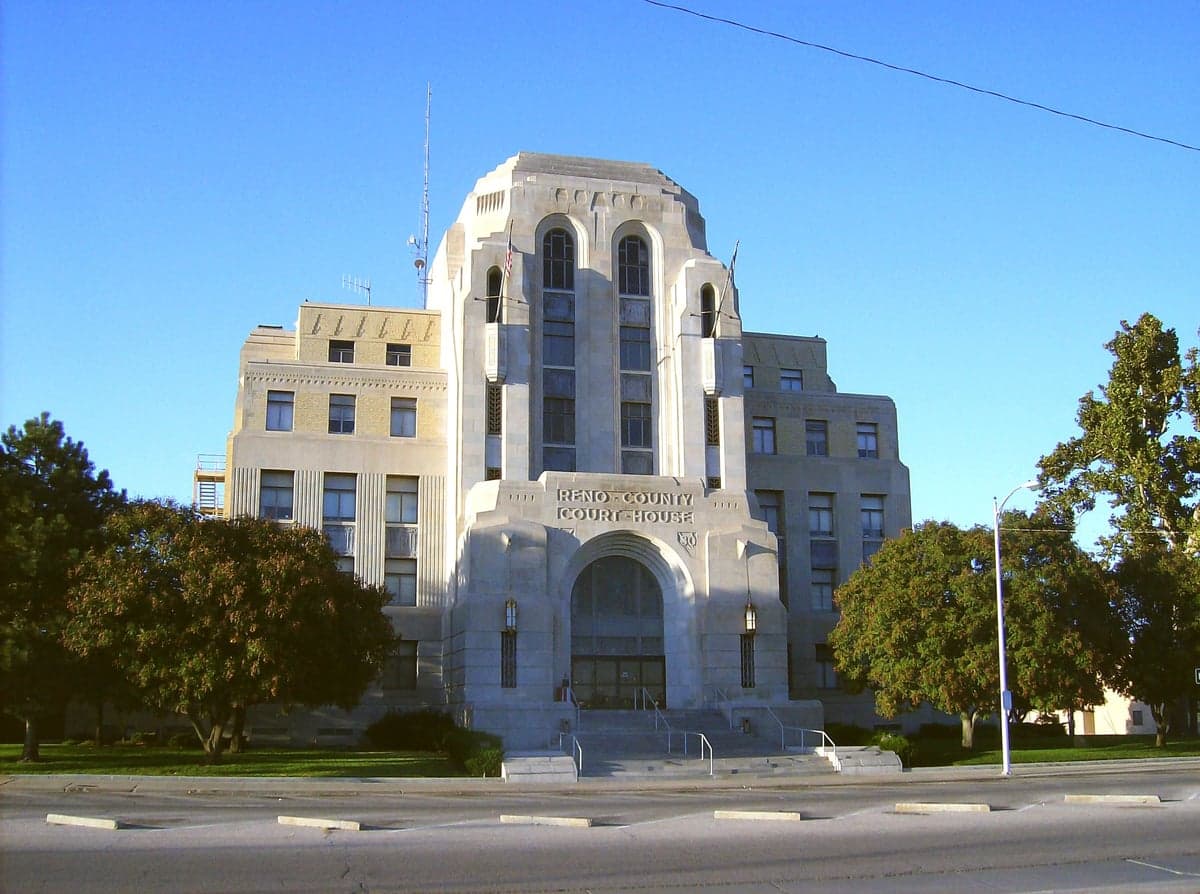
Photo: Wikipedia
Demographics of Reno County
Affluence Level in Reno County
A middle-class area roughly in line with national averages across income, home values, education, and employment.
People of Reno County
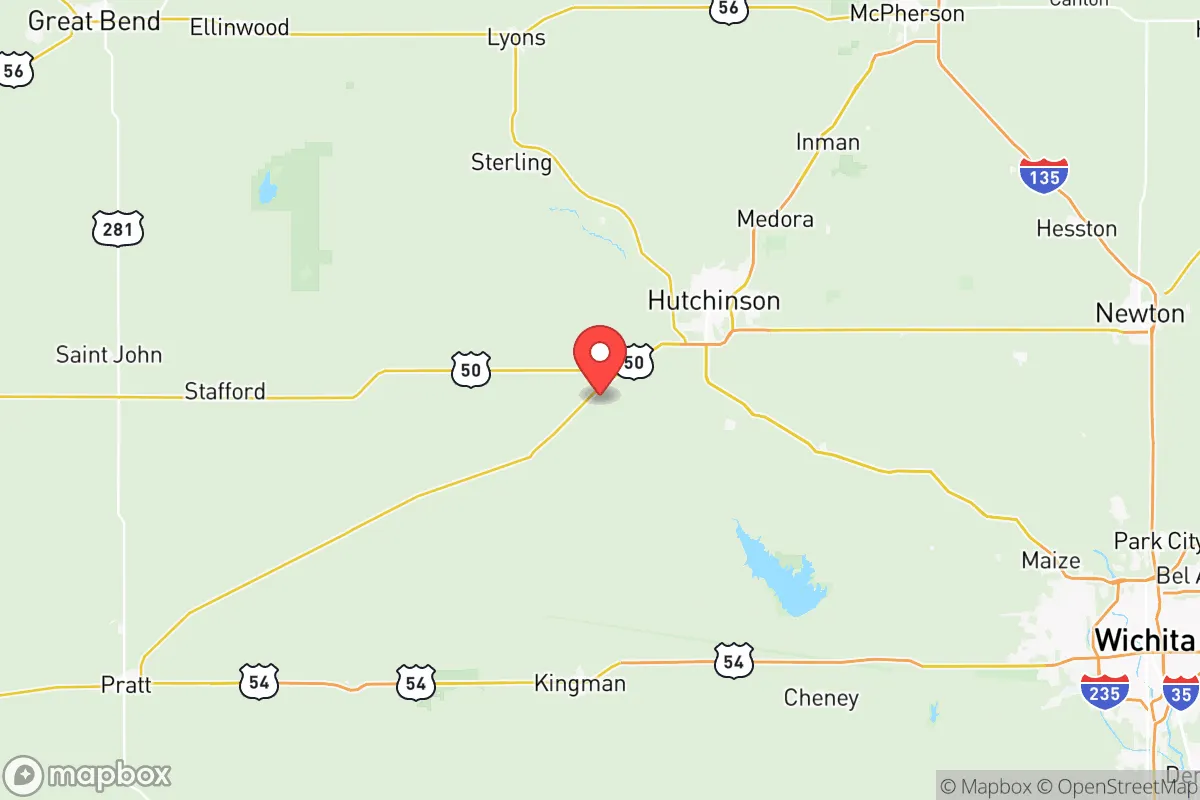
Reno County, Kansas, is home to 61,693 residents who form a predominantly white (82.7%) and native-born (98.7% U.S.-born) community, anchored by the regional hub of Hutchinson and a scattering of smaller towns like South Hutchinson, Buhler, Haven, and Nickerson. The population is characterized by its deep agricultural and Mennonite roots, a low college attainment rate of 20.5%, and a growing Hispanic minority (10.1%) that is reshaping the county’s cultural and economic landscape. This is a place where the legacy of 19th-century immigrant settlers still defines the social fabric, even as newer waves of domestic and international migration slowly diversify the population.
Settlement & growth (pre-1960)
Before American settlement, the land that is now Reno County was part of the traditional territory of the Osage and Wichita peoples, who used the Arkansas River valley for hunting and seasonal camps. The area was claimed by France as part of Louisiana, then passed to the United States in the 1803 Louisiana Purchase. The U.S. government forcibly removed the native nations to Indian Territory (present-day Oklahoma) in the 1830s and 1840s, opening the region to white settlement.
The first major wave of American settlers arrived in the 1870s, drawn by the Homestead Act of 1862 and the promise of cheap, fertile prairie land for wheat farming. The Santa Fe Railroad reached the area in 1872, founding the city of Hutchinson as a rail depot and trade center. These early settlers were predominantly Anglo-American farmers from the Midwest and Upper South—Indiana, Illinois, Ohio, and Missouri—seeking land and opportunity. The town of South Hutchinson grew as a working-class satellite, while Nickerson and Haven emerged as agricultural service centers along the railroad lines.
A distinct and influential group arrived in the 1870s and 1880s: German-speaking Mennonites from the Russian Empire (present-day Ukraine). Fleeing religious persecution and military conscription, these families brought with them a hardy strain of winter wheat—Turkey Red—that revolutionized Kansas agriculture. They settled primarily in the rural areas around Buhler and Haven, establishing tight-knit farming communities that maintained their German language and religious traditions well into the 20th century. The Mennonite influence remains visible today in the county’s strong agricultural cooperatives, conservative social values, and the presence of private Mennonite schools.
Through the early 1900s, the population grew steadily, reaching about 37,000 by 1920. The discovery of salt deposits beneath Hutchinson in 1887 sparked a second economic pillar: salt mining and processing. This industry attracted a smaller wave of European immigrant laborers, including Germans, Czechs, and Poles, who settled in Hutchinson’s working-class neighborhoods. The Dust Bowl of the 1930s hit Reno County hard, causing a temporary population decline as some farm families left for California, but the county rebounded after World War II with the expansion of agribusiness and light manufacturing. By 1960, the population had reached roughly 45,000, with Hutchinson dominating as the commercial and industrial center.
Modern era (post-1965)
The 1965 Hart-Cellar Act had a minimal direct impact on Reno County. The foreign-born population today is just 1.3%, far below the national average. The county did not experience the large-scale immigration from Asia, Latin America, or Africa that transformed many urban and coastal areas. Instead, the most significant demographic shift since 1965 has been the growth of the Hispanic population, driven primarily by domestic migration from Texas and the Southwest, as well as some direct immigration from Mexico.
Hispanic residents now make up 10.1% of the county’s population, up from less than 2% in 1980. They have concentrated in Hutchinson, particularly in the central and eastern parts of the city, where they work in meatpacking plants, construction, and agriculture. The Cargill salt mine and the National Beef Packing plant in nearby Dodge City have been major pull factors for Hispanic laborers, though Reno County’s own meat processing and agricultural sectors have also drawn families. A smaller Hispanic presence exists in South Hutchinson and Buhler, where seasonal farm labor transitions into permanent settlement.
The Black population remains small at 2.2%, largely concentrated in Hutchinson, with roots in the Great Migration of the early 20th century when African Americans moved from the South to work on railroads and in salt mines. The Asian population is negligible at 0.4%, and the Indian subcontinent population is even smaller at 0.2%, mostly professionals employed at Hutchinson’s hospitals or at Hutchinson Community College. Domestic out-migration of young adults seeking college and urban jobs has been a persistent trend, keeping the county’s college attainment rate low at 20.5%.
Suburbanization has been modest. South Hutchinson has grown as a bedroom community for Hutchinson, while Buhler and Haven have remained small, stable farming towns. The county has not experienced the explosive suburban growth seen in Johnson County near Kansas City. Instead, the population has slowly aged, with a median age of about 40, as younger residents leave and retirees stay.
The future
Reno County’s population is projected to remain relatively stable or decline slightly over the next 10-20 years, as natural decrease (more deaths than births) is only partially offset by in-migration. The Hispanic population is likely to continue growing, potentially reaching 15-18% by 2040, as families expand and new arrivals are drawn to agricultural and industrial jobs. This growth is gradually diversifying the county, but it is being absorbed into the existing cultural framework rather than creating distinct, isolated enclaves. Hispanic residents are increasingly integrated into local schools, churches, and civic life, particularly in Hutchinson.
The white, non-Hispanic population will continue to age and shrink, especially in rural towns like Nickerson and Haven, where school enrollments are declining. The Mennonite communities in Buhler and surrounding areas are stable but not growing, as younger generations often move to larger cities. The county is not tribalizing into ethnic enclaves; rather, it is slowly homogenizing into a more mixed, but still predominantly white and culturally conservative, community. In-migration from other parts of Kansas and the Midwest will likely be modest, drawn by affordable housing and slower-paced life.
For someone moving in now, Reno County offers a stable, low-cost, and safe environment with a strong agricultural identity and a growing Hispanic influence. The population is not undergoing rapid transformation, but it is gradually becoming more diverse, particularly in Hutchinson. The cultural identity remains rooted in its Mennonite and farming heritage, with a practical, self-reliant ethos that newcomers will find welcoming if they are willing to integrate into the existing community fabric.

* Values derived from national, state, county, city and local statistics and may differ in a specific area. Last updated: 2026-05-12T09:35:52.000Z
Narrative content on this page is AI-generated and may contain mistakes. Verify any details that matter before acting on them.
ReloMaps may earn a commission from affiliate links at no extra cost to you.

