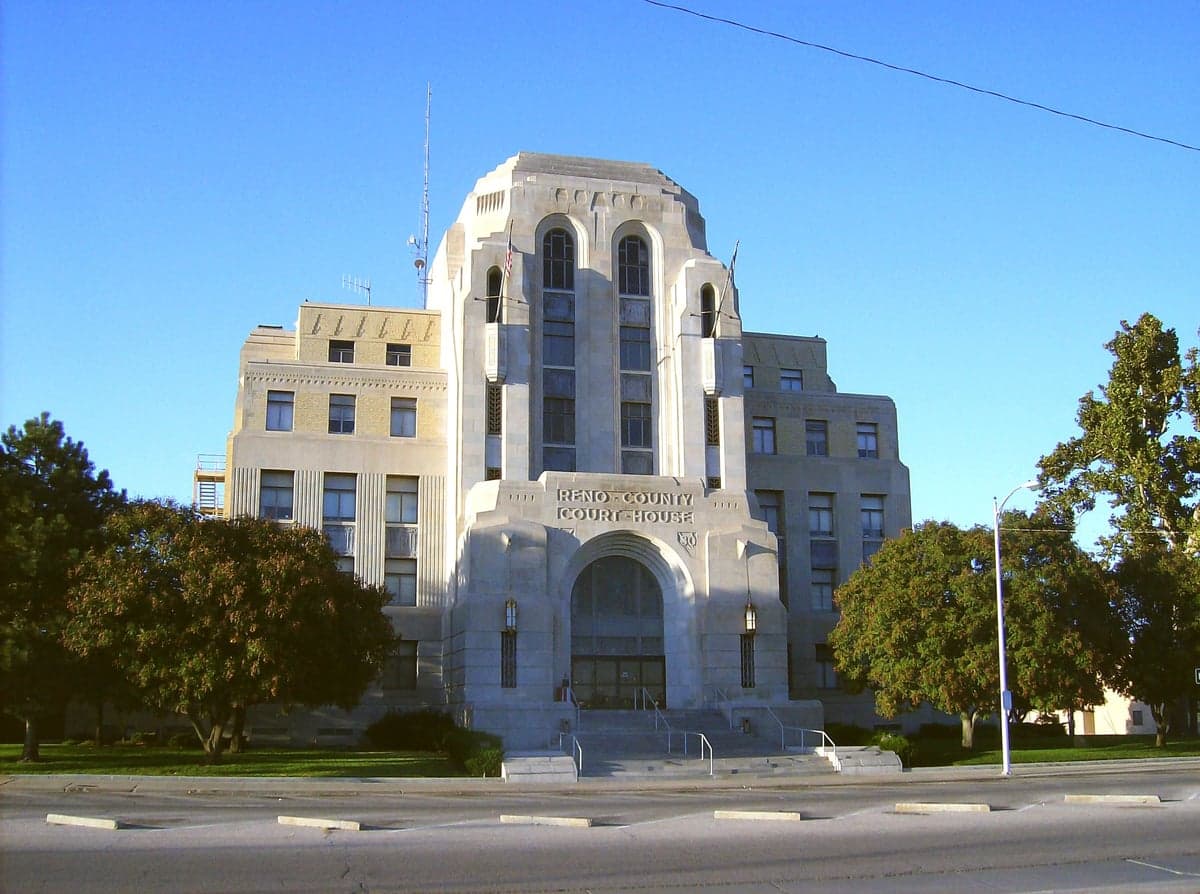
Photo: Wikipedia
Political ClimatePolitical Climate in Reno County
Showing district-level results — no local-only data available.
Local Political AnalysisPolitical Analysis of Reno County
Reno County has long been a solid conservative stronghold, and while the national winds have shifted, the local landscape remains deeply red. The Cook Political Index gives the county a solid R+16 rating, which is significantly more conservative than the state of Kansas as a whole, which sits at R+9. That gap isn't just a number; it reflects a real cultural and political divide between the rural, agricultural heart of the county and the more moderate-leaning pockets you find in places like Hutchinson or South Hutchinson. You can feel it in the local elections and the way folks talk about things at the coffee shop.
How it compares
To put it plainly, Reno County is a good 7 points more conservative than the state average. That means while Kansas as a whole might flirt with a more moderate Republican or even a centrist Democrat in a statewide race, Reno County is almost always a lock for the most conservative candidate on the ballot. The real action isn't between parties—it's within the Republican primary. You'll see a clear split between the more establishment, business-friendly conservatives in the city of Hutchinson and the deeply populist, libertarian-leaning conservatives in the smaller towns. For example, Hutchinson has a few precincts near the college and downtown that can lean a bit more moderate, but head out to Nickerson, Buhler, or Pretty Prairie, and you're in territory where the vote is overwhelmingly for the most constitutionally-minded candidate. The swing precincts aren't between red and blue; they're between a "pragmatic" conservative and a "no-compromise" conservative. That's where the real tension is.
What this means for residents
For a long-time resident like me, the biggest concern is the slow creep of state-level policies that feel like they're trying to undermine our local way of life. We've always been a place where you mind your own business and handle things at the county level. But lately, you see more and more mandates and unfunded requirements coming down from Topeka—things that feel like government overreach into how we run our schools, manage our land, or even how we choose to live our personal lives. The shift towards any kind of progressive ideology is a real red flag here. People are watching closely, especially after some of the more aggressive public health measures we saw a few years back. The local school board races and county commission seats are where the real fight is now, because that's where you can push back against that overreach. It's not about party labels anymore; it's about who actually believes in limited government and personal freedom.
Culturally, Reno County is still a place where the Second Amendment is a given, not a debate, and where property rights are sacred. You won't find many folks here who are eager to trade local control for a promise of state funding. The policy distinction is clear: we want to be left alone to live our lives, raise our families, and run our businesses without a bureaucrat in Topeka or Washington telling us how to do it. The trajectory is concerning if you look at the national trends, but locally, the conservative foundation is strong. The key is staying vigilant and making sure the next generation understands that the fight for freedom starts at the county commission meeting, not just on election day.

State Political ClimatePolitical Climate in Kansas
State Political AnalysisPolitical Environment in the State
Kansas is a solidly Republican state with a Cook PVI of R+9, but don’t let that number fool you into thinking it’s a monolith. Over the past 20 years, the state has swung from a reliably conservative stronghold to a battleground between traditional small-government Republicans and a growing progressive movement concentrated in the eastern metros. The dominant coalition remains center-right, but the trajectory has been a slow, steady leftward drift in the suburbs, while rural areas have hardened their conservative stance. If you’re looking for a place where your values on limited government, personal responsibility, and individual liberty are the norm, Kansas still delivers—but you need to know where to plant your flag.
Urban vs. rural divide
The political map of Kansas is a tale of two worlds. The eastern third of the state, anchored by Kansas City (Wyandotte County) and Lawrence (Douglas County), is the progressive engine. Johnson County, the affluent suburban ring around Kansas City, has been the big story: once reliably red, it’s now a purple swing area, with precincts in Overland Park and Shawnee flipping to Democrats in presidential and state races. Topeka (Shawnee County) leans blue, while Wichita (Sedgwick County) is a mixed bag—the city itself is moderate-to-liberal, but the surrounding suburbs like Andover and Derby remain conservative. The rest of the state—the vast rural and small-town expanse—is deep red. Counties like Thomas (Colby), Sherman (Goodland), and Grant (Ulysses) routinely vote 80%+ Republican. The divide isn’t just about party; it’s about worldview. Rural Kansans see government as a necessary evil at best, while urbanites increasingly view it as a tool for social engineering. That tension defines every legislative session.
Policy environment
Kansas’s policy environment is a mixed bag for conservatives. The good news: the state has a flat income tax (5.7% as of 2026) and no tax on Social Security benefits, thanks to the 2024 tax reform package championed by Governor Laura Kelly (a moderate Democrat) and the Republican legislature. Property taxes are locally set but relatively low compared to coastal states. The regulatory posture is business-friendly, with a right-to-work law and limited zoning in most rural counties. The bad news: education policy has been a flashpoint. The Kansas Supreme Court has repeatedly ordered the legislature to increase school funding, leading to a decades-long battle over local control. The result is that school districts in Johnson County and Lawrence have adopted progressive curricula (CRT-adjacent materials, gender ideology policies) that many conservative parents find intrusive. On healthcare, Kansas expanded Medicaid in 2023 under Kelly, a move that increased government dependency but also shored up rural hospitals. Election laws are solid: voter ID is required, and the state has clean voter rolls, though Democrats have pushed for no-excuse mail-in voting. The 2021 “Value Them Both” amendment (which affirmed no state constitutional right to abortion) was overturned by voters in 2022, a sign that the state is not as culturally conservative as its PVI suggests.
Trajectory & freedom
On the freedom front, Kansas is a tale of two trends. On the positive side for conservatives: the state passed a constitutional carry law in 2021 (HB 2058), allowing permitless concealed carry for adults 21 and older. The 2023 “Parental Bill of Rights” (HB 2236) gave parents explicit authority over their children’s medical decisions and school records, a direct response to the gender ideology push in schools. The 2024 “Medical Freedom Act” (SB 180) prohibits vaccine mandates by private employers and government entities, a strong stand for bodily autonomy. On the concerning side: the Kansas Supreme Court has been activist, striking down a 2015 law that banned a common second-trimester abortion procedure and ruling that the state constitution protects abortion access. This judicial overreach has made Kansas a regional destination for abortion tourism, with clinics in Wichita and Overland Park seeing out-of-state patients. The legislature has pushed back with a “Born-Alive” bill and a ban on taxpayer funding for abortion, but the court remains a threat. Property rights are generally strong, though the state’s use of eminent domain for the proposed “Kansas Turnpike expansion” in 2025 raised eyebrows among libertarians.
Civil unrest & political movements
Kansas has not seen the level of civil unrest seen in coastal states, but the temperature is rising. The 2022 abortion vote saw massive turnout and organized progressive activism, with groups like “Kansans for Constitutional Freedom” running a well-funded campaign. On the right, the “Kansas 2nd Amendment Coalition” and “Moms for Liberty” chapters in Johnson County have been active, pushing back on school board policies and library content. Immigration politics are relatively quiet—Kansas is not a border state, and the immigrant population is mostly concentrated in Garden City and Dodge City (meatpacking towns). There have been no sanctuary city declarations, and the state cooperates with ICE. Election integrity controversies flared in 2020 and 2022, with the Secretary of State (a Republican) conducting a forensic audit of the 2020 election in three counties—no widespread fraud was found, but the process exposed vulnerabilities in mail-in ballot handling. The most visible flashpoint for a new resident would be the culture war in public schools: school board meetings in Blue Valley and Olathe have been packed with parents demanding transparency on curriculum and library books. It’s not Portland-level chaos, but it’s a sign that the fight for freedom is happening at the local level.
Projection
Over the next 5-10 years, Kansas will continue its slow leftward drift in the suburbs, driven by in-migration from blue states (especially to Johnson County, where tech and finance jobs are growing). The rural exodus will accelerate, meaning the state’s political center of gravity will shift east. The Republican legislature will likely remain in control, but the governor’s race will be a toss-up—Kelly’s moderate brand has won twice, and a more progressive Democrat could win in 2026 if the GOP nominates a hardliner. The Kansas Supreme Court will remain a problem for conservatives, with appointments made by Democratic governors (Kelly has appointed three justices). Expect continued battles over school choice (vouchers are likely to pass in the next few years), tax cuts (the flat tax may drop to 5.2%), and parental rights. The biggest wild card is the state’s budget: Kansas has a surplus thanks to federal COVID money and strong ag prices, but a recession could force spending cuts that reignite the “Brownback experiment” debates. For a new resident, the takeaway is that Kansas is still a place where you can live free—but you’ll need to stay engaged locally to keep it that way.
Bottom line for a new resident: If you’re a conservative looking for a state with low taxes, strong gun rights, and a culture of personal responsibility, Kansas is a solid bet. But don’t assume the whole state is like the rural counties. Pick your location carefully: Andover or Derby near Wichita, or a small town like Colby in the west, will give you the freedom you’re looking for. Avoid Johnson County unless you’re ready for a political fight at every school board meeting. The state is trending purple, but with active citizenship, you can help keep it red.
* Values derived from national, state, county, city and local statistics and may differ in a specific area. Last updated: 2026-05-12T09:35:52.000Z
Narrative content on this page is AI-generated and may contain mistakes. Verify any details that matter before acting on them.
ReloMaps may earn a commission from affiliate links at no extra cost to you.

