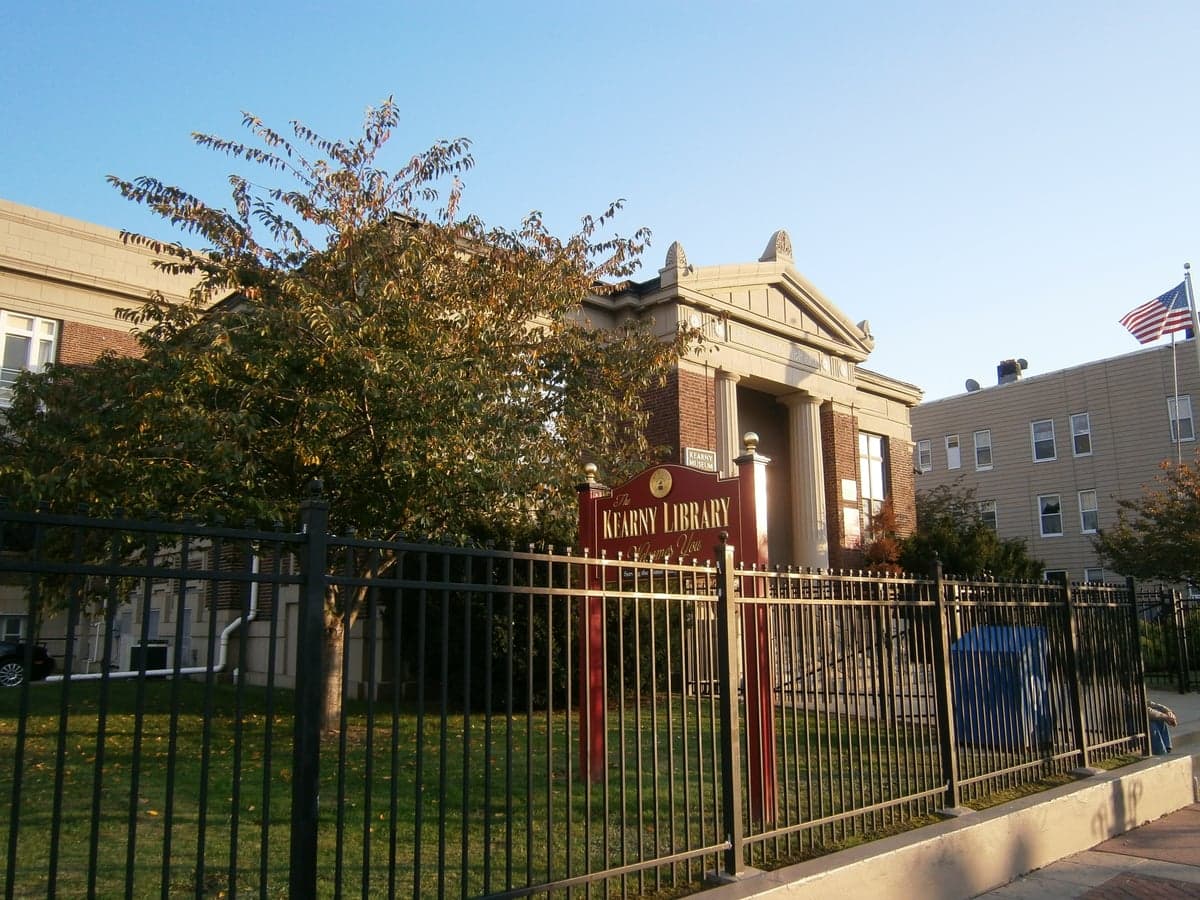
Photo: Wikipedia
Personal Sovereignty in Kearny, NJ
Viable for self-reliance. Generally workable, though some barriers may limit total independence.
What does Personal Sovereignty tell us?
Personal Sovereignty measures your capacity for self-reliance and independence with minimal government friction. Higher scores mean fewer barriers between you and the way you want to live... but it assumes you have the space you need and good neighbors.
What does this tell us?
Personal Sovereignty measures your capacity for self-reliance and independence with minimal government friction. Higher scores mean fewer barriers between you and the way you want to live... but it assumes you have the space you need and good neighbors.
State Policy
Energy independence: Importer (8% of energy produced in-state)
Personal Liberty
Homesteading

Personal Liberty Analysis
For a conservative-leaning individual or family prioritizing personal sovereignty, Kearny, New Jersey presents a challenging environment where state-level overreach significantly constrains local autonomy. While the town itself is a working-class Hudson County community with a dense, walkable layout, the overarching regulatory and tax climate imposed by Trenton severely limits the kind of self-reliant, low-government lifestyle many preppers and liberty-minded individuals seek. The core tension here is between Kearny’s convenient location near New York City and the aggressive erosion of personal freedoms that comes with living in one of the most heavily governed states in the union. For those who view government as a necessary evil at best, Kearny is a place where you trade sovereignty for proximity to economic opportunity, and that trade-off is steep.
Tax burden and regulatory posture: how the state squeezes your autonomy
New Jersey’s tax burden is the highest in the nation, and Kearny residents feel this acutely. The state’s progressive income tax tops out at 10.75% for high earners, and property taxes in Hudson County are notoriously high—often exceeding $8,000 to $12,000 annually on a modest home. This directly reduces your ability to save, invest in self-sufficiency measures like solar panels or water storage, or simply keep more of what you earn. The regulatory posture is equally aggressive: New Jersey has some of the strictest environmental and building codes in the country, making even minor home improvements a bureaucratic ordeal. Permits for sheds, fences, or alternative energy systems can take months and require costly inspections. For a prepper mindset, this is a hostile environment—every dollar sent to the state is a dollar not spent on food storage, ammunition, or land improvements. The state’s combined state and local tax burden consumes roughly 12-13% of income, leaving less room for the kind of financial independence that underpins personal sovereignty.
Self-defense and gun law specifics: what you can and cannot do
New Jersey’s gun laws are among the most restrictive in the United States, and Kearny offers no local relief. The state requires a Firearms Purchaser Identification Card (FPID) for handguns and long guns, a process that involves fingerprinting, background checks, and a 30- to 90-day wait. Concealed carry is effectively impossible for most residents due to the state’s “justifiable need” standard, which was only recently loosened by the Supreme Court’s Bruen decision—but New Jersey has responded with new restrictions on where guns can be carried, including “sensitive places” like parks, public transit, and private property without explicit permission. Magazine capacity is capped at 10 rounds, and certain semi-automatic rifles are banned by name. For a survivalist, this means your ability to defend your home and family is hamstrung by law. You cannot legally keep a standard-capacity magazine for a home-defense AR-15, and carrying a firearm for personal protection outside the home is a legal minefield. The state’s red flag law also allows for firearms to be seized without a criminal conviction, based on a court order. In Kearny, your right to self-defense is a privilege granted by the state, not an inherent right—a fundamental erosion of personal sovereignty that should give any liberty-minded individual serious pause.
Self-reliance and homesteading viability: lot sizes, zoning, and off-grid feasibility
Kearny is a densely built urban suburb with a population density of over 10,000 people per square mile. The typical residential lot is a narrow 25x100 feet, often with a small backyard that barely accommodates a grill and a shed. Zoning laws are strict and uniformly enforced—raising chickens, keeping goats, or installing a rainwater catchment system large enough for household use is almost certainly prohibited. The town’s municipal code explicitly bans “farm animals” in residential zones, and even vegetable gardens can be subject to nuisance complaints if they attract pests. Off-grid living is a non-starter: the town requires connection to municipal water and sewer, and solar panels must be grid-tied with utility approval. For a prepper focused on self-reliance, Kearny offers almost no room for meaningful homesteading. You cannot store enough water or food on a small lot to sustain a family for more than a few weeks, and any attempt to build a root cellar or underground bunker would violate building codes. The best you can do is a small raised-bed garden and a few rain barrels—but even that is at the mercy of neighbors who might complain. If self-reliance is a priority, Kearny is a place to pass through, not to put down roots.
Personal liberties: parental rights, medical autonomy, speech, and property
New Jersey’s progressive governance extends deeply into personal liberties. Parental rights are under constant pressure: the state mandates comprehensive sex education in public schools, and parents cannot opt their children out of lessons on sexual orientation or gender identity. Medical autonomy is similarly constrained—New Jersey has some of the strictest vaccine mandates in the country, including for school attendance, and during the COVID-19 pandemic, the state imposed sweeping mask and vaccine mandates that left little room for personal choice. Free speech is legally protected, but the cultural climate in Hudson County is heavily left-leaning, meaning that expressing conservative or libertarian views on hot-button issues like immigration, gun rights, or government overreach can lead to social ostracism or professional consequences. Property rights are also weak: the state’s eminent domain laws are broad, and towns like Kearny have used them for redevelopment projects that displace homeowners. The New Jersey Supreme Court has upheld the use of eminent domain for private economic development, meaning your home could be taken for a shopping center or apartment complex. For a survivalist, this is a nightmare scenario—your property, your children’s education, and your medical decisions are all subject to state control. The only area where Kearny offers some relief is in its proximity to New York City, which provides economic opportunities that might otherwise be unavailable—but that comes at the cost of living under a government that actively undermines personal sovereignty.
Overall, Kearny ranks very low for personal sovereignty compared to other areas in the United States. If you measure autonomy by tax burden, gun rights, homesteading potential, and freedom from government overreach, Kearny is near the bottom of the list. States like New Hampshire, Idaho, or even parts of Pennsylvania offer far more room for a self-reliant, liberty-focused lifestyle. For a prepper or conservative individual, Kearny is a place to work and earn, but not a place to build a sovereign life. The best strategy here is to treat it as a temporary base while you plan an exit to a jurisdiction that respects your rights to self-defense, property, and personal choice. The state’s grip is tight, and it’s not loosening anytime soon.

* Values derived from national, state, county, city and local statistics and may differ in a specific area. Last updated: 2026-04-25T03:07:34.000Z
Narrative content on this page is AI-generated and may contain mistakes. Verify any details that matter before acting on them.
ReloMaps may earn a commission from affiliate links at no extra cost to you.

