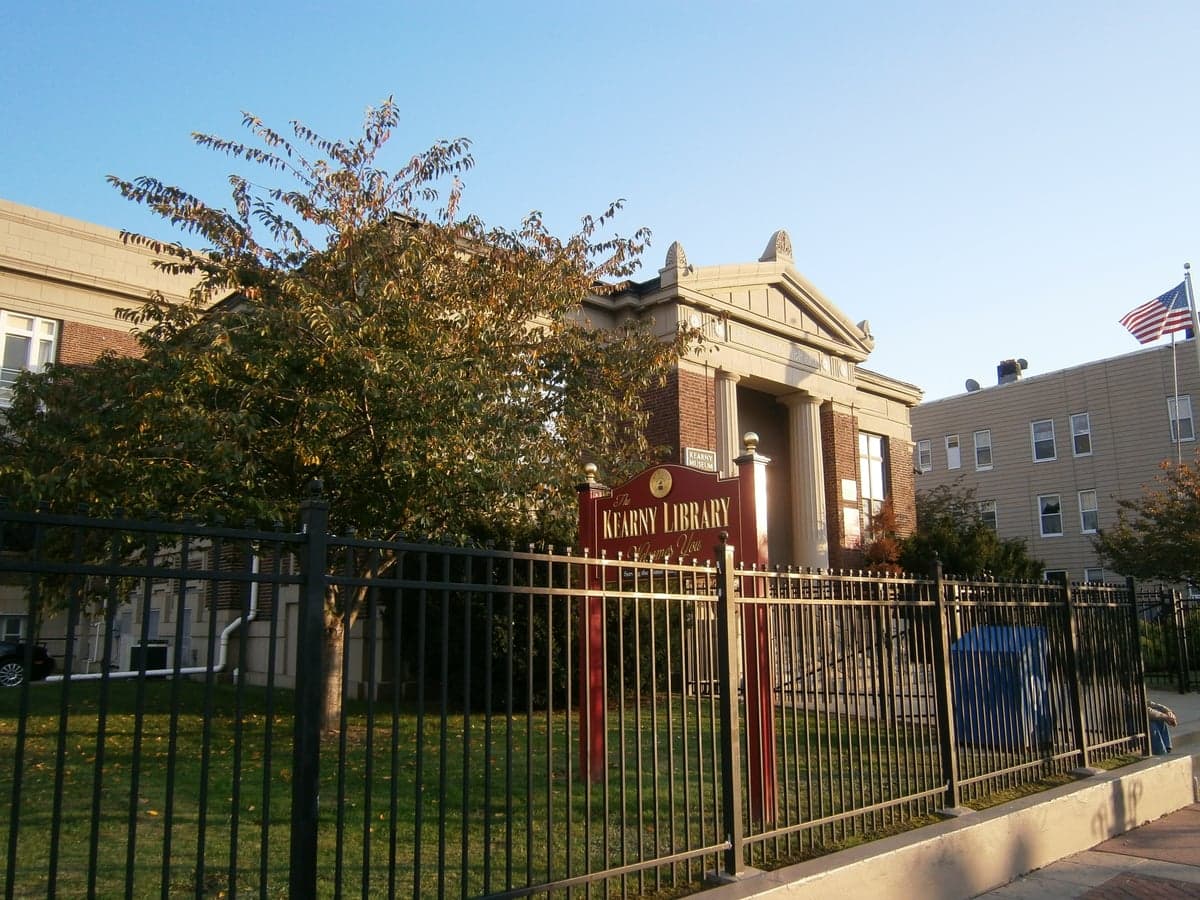
Photo: Wikipedia
Demographics of Kearny, NJ
Affluence Level in Kearny, NJ
A middle-class area roughly in line with national averages across income, home values, education, and employment.
People of Kearny, NJ
Kearny, New Jersey, is a dense, working-class city of 40,570 residents defined by its deep immigrant roots and a rapidly shifting ethnic landscape. Today, the city is majority-Hispanic at 50.9%, with a white population of 33.5%, alongside smaller but established Black (4.7%), East/Southeast Asian (2.1%), and Indian-subcontinent (1.4%) communities. Its identity is a blend of old industrial grit and new immigrant energy, with a foreign-born population of 18.3% and a college attainment rate of 29.4% that lags behind state averages.
How the city was settled and grew
Kearny’s human history begins with its founding in the 1860s as a planned industrial suburb, built on land grants from the Newark and New York railroad. The first major wave of settlers were Irish immigrants, who dug the Morris Canal and built the city’s early factories, settling in the Arlington and West Kearny neighborhoods. By the 1880s, German and Polish workers arrived to staff the sprawling Kearny Works of the Clark Thread Company (later Coats & Clark), establishing tight-knit enclaves in East Newark (a separate borough but historically tied) and the Downtown district around Kearny Avenue. The 1910s and 1920s brought a surge of Italian and Slovak immigrants, who built the brick rowhouses and three-family homes that still dominate South Kearny and the Belgrove area. These groups formed the backbone of Kearny’s white ethnic identity for decades, with the city reaching a peak population of roughly 40,000 by 1950.
Modern era (post-1965)
The 1965 Hart-Cellar Act reshaped Kearny’s demographics, but the shift was gradual. Through the 1970s and 1980s, the city remained overwhelmingly white (over 90%) as the original Irish, Italian, and Polish families aged in place. The first major post-1965 change came in the 1990s, when Hispanic immigrants—primarily from the Dominican Republic, Puerto Rico, and later Central America—began moving into the aging housing stock of West Kearny and the Arlington section. By 2000, the Hispanic share had risen to roughly 30%, and by 2020 it crossed the 50% threshold. Today, Hispanic residents are concentrated in West Kearny and the central corridor along Bergen Avenue, while the older white ethnic populations remain strongest in South Kearny and the Belgrove neighborhood, where many third- and fourth-generation families still live. The East/Southeast Asian community (2.1%) is small but visible in the Downtown area, with a handful of Filipino and Vietnamese families, while the Indian-subcontinent population (1.4%) is scattered, with no single dominant enclave. The Black population (4.7%) is concentrated in the Arlington section and public housing complexes near the Passaic River.
The future
Kearny’s population is heading toward further Hispanicization, with the white share projected to fall below 25% by 2035 if current trends hold. The Hispanic community is not homogenizing into a single bloc; Dominican and Puerto Rican families dominate West Kearny, while newer Central American arrivals are settling in the East Newark border area. The East/Southeast Asian and Indian-subcontinent populations are growing slowly, but remain too small to form distinct ethnic neighborhoods. The city is not tribalizing into hostile enclaves—most neighborhoods are mixed—but it is becoming more economically stratified, with newer Hispanic immigrants concentrated in lower-income rentals and older white ethnic families holding onto owner-occupied homes in South Kearny. The foreign-born share (18.3%) is stable, suggesting that immigration is plateauing rather than accelerating. The next 10-20 years will likely see Kearny become a solidly Hispanic-majority city with a shrinking white minority, a small but stable Black community, and modest Asian and Indian presence—a pattern similar to neighboring Harrison and parts of Newark.
For someone moving in now, Kearny is a city in demographic transition—still affordable relative to Hudson County, but with a school system and housing stock that reflect its working-class roots. The city is becoming more Hispanic, less white, and slightly more diverse in small pockets, but it remains a place where old ethnic loyalties still matter in local politics and neighborhood identity. New residents should expect a dense, transit-connected environment with a strong sense of place, but also a community where change is ongoing and not always smooth.

* Values derived from national, state, county, city and local statistics and may differ in a specific area. Last updated: 2026-04-25T03:07:34.000Z
Narrative content on this page is AI-generated and may contain mistakes. Verify any details that matter before acting on them.
ReloMaps may earn a commission from affiliate links at no extra cost to you.

