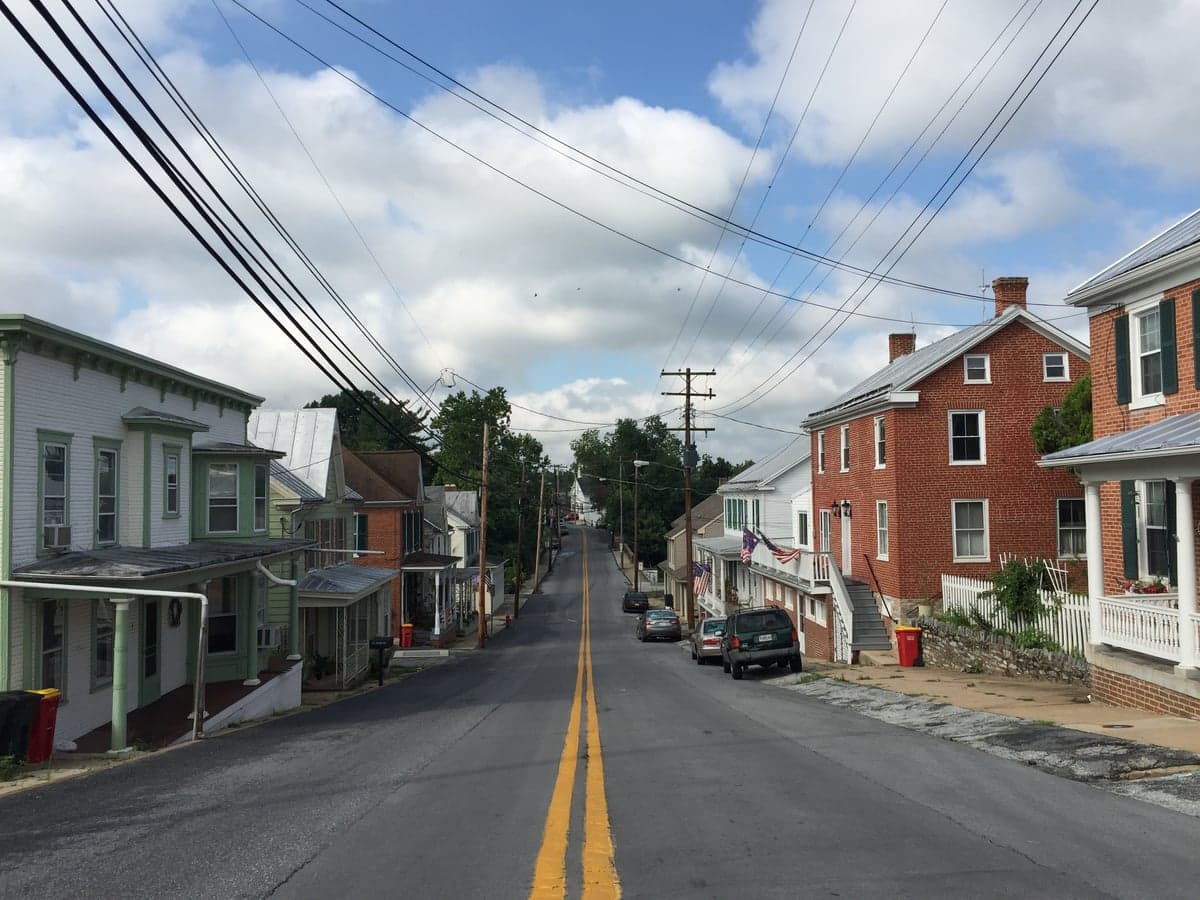
Photo: Wikipedia
Demographics of Keedysville, MD
Affluence Level in Keedysville, MD
An upper-middle-class area. Household wealth, education levels, and homeownership run ahead of national benchmarks.
People of Keedysville, MD
The roughly 1,240 residents of Keedysville, Maryland form one of Washington County’s most homogenous small towns — a predominantly white, family-oriented community where nearly 91% of the population shares a single racial background and foreign-born residents account for just 1.5%. The town’s identity is rooted in its agricultural past and its role as a quiet bedroom community for commuters working in Hagerstown and the Washington, D.C. metro area. With a college attainment rate of 40.8% — well above the national average for a town its size — Keedysville’s population is notably educated, yet its demographic profile has remained remarkably stable over the past half-century.
How the city was settled and grew
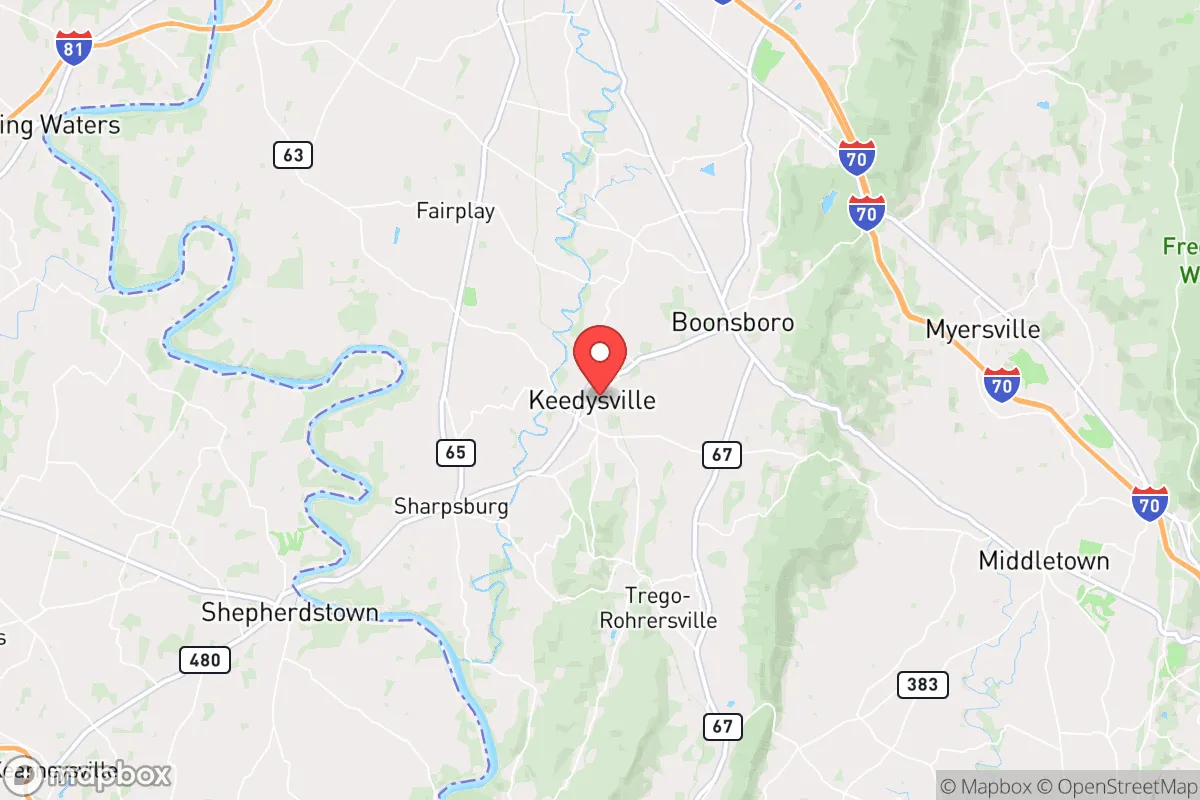
Keedysville was originally settled in the mid-18th century by German and Scots-Irish farmers drawn to the fertile limestone soils of the Great Appalachian Valley. The town was formally platted in 1830 around the intersection of what is now MD-67 and MD-845, named for the Keedy family who owned much of the surrounding land. The earliest residents clustered in what is now the Historic District along Main Street, a compact grid of stone and brick homes built by German stonemasons and their families. A second wave arrived after the Civil War, when the town’s proximity to the Baltimore & Ohio Railroad (just two miles south in nearby Weverton) made it a convenient stop for grain and livestock shipping. These post-war settlers — largely of English and Irish descent — established farms and small businesses along South Main Street and Shepherdstown Pike, creating a loose ring of homesteads that expanded the original village footprint. By 1900, Keedysville’s population had reached roughly 350, and it remained a predominantly agricultural community of German and British-descended families through the mid-20th century. No significant immigrant waves arrived during the industrial era; the town’s growth was almost entirely organic, driven by births and the occasional relocation of nearby farm families.
Modern era (post-1965)
The 1965 Hart-Cellar Act had virtually no effect on Keedysville’s demographics. The town’s foreign-born population today sits at just 1.5%, and the Black population is recorded at 0.0% — a figure that reflects both the area’s historical exclusionary patterns and its lack of post-1965 immigration infrastructure. Instead, the modern era has been defined by domestic in-migration from the Washington-Baltimore corridor. Beginning in the 1980s, professionals seeking larger lots and lower taxes began buying older homes in the Historic District and building new houses in the Keedysville Estates subdivision, a cluster of single-family homes on the town’s eastern edge. A second wave of suburban development in the 2000s added the Fox Run and Hickory Ridge neighborhoods, both of which attracted families from Montgomery and Frederick counties priced out of those closer-in suburbs. These newcomers are overwhelmingly white and college-educated, reinforcing the town’s existing demographic profile rather than diversifying it. The East/Southeast Asian population — the only non-white group of any statistical significance — stands at 1.5%, concentrated among a handful of families in the newer subdivisions, with no distinct ethnic neighborhood forming. The Hispanic share (1.4%) is similarly dispersed, with most households living in the South Main Street corridor near the town’s southern boundary.
The future
Keedysville’s population is projected to remain stable or grow only modestly over the next decade, constrained by limited housing stock and restrictive zoning that favors large-lot single-family development. The town’s demographic trajectory points toward continued homogeneity: the white share is likely to hold above 85%, while the East/Southeast Asian and Hispanic shares may each inch toward 2-3% as a few additional families move in from the D.C. suburbs. No new subdivisions are currently planned, and the town’s small size — roughly 0.5 square miles — leaves little room for the kind of dense, mixed-income development that might attract a more diverse population. The cultural identity of Keedysville is evolving slowly from a farming hamlet to a commuter exurb, but the social fabric remains deeply rooted in the German and Scots-Irish traditions of its founders, visible in the town’s annual community picnic and the active membership of St. Paul’s Lutheran Church on Main Street.
For someone moving in now, Keedysville offers a stable, low-diversity environment with strong schools and easy highway access — a place where the population is neither shrinking nor diversifying, but quietly aging in place. The next decade will likely see a gradual turnover of homes as older residents sell to younger families from the corridor, but the town’s essential character — white, educated, and politically moderate — is unlikely to shift meaningfully. It remains a deliberate choice for those seeking a predictable, small-town lifestyle within commuting distance of major employment centers.

* Values derived from national, state, county, city and local statistics and may differ in a specific area. Last updated: 2026-08-11T03:11:26.000Z
Narrative content on this page is AI-generated and may contain mistakes. Verify any details that matter before acting on them.
ReloMaps may earn a commission from affiliate links at no extra cost to you.

