
Photo: Wikipedia
Political ClimatePolitical Climate in Kennesaw, GA
District shown is the primary district for this city’s centroid. Cities may span multiple districts.
Local Political AnalysisPolitical Analysis of Kennesaw, GA
Kennesaw has long been a solidly conservative stronghold, and that hasn't changed much at the ballot box. The area carries a Cook PVI of R+19, meaning it votes about 19 points more Republican than the national average, and that number feels about right when you look at local races. But if you've lived here as long as I have, you've noticed the political winds shifting under the surface, and it's worth keeping an eye on where things are headed.
How it compares
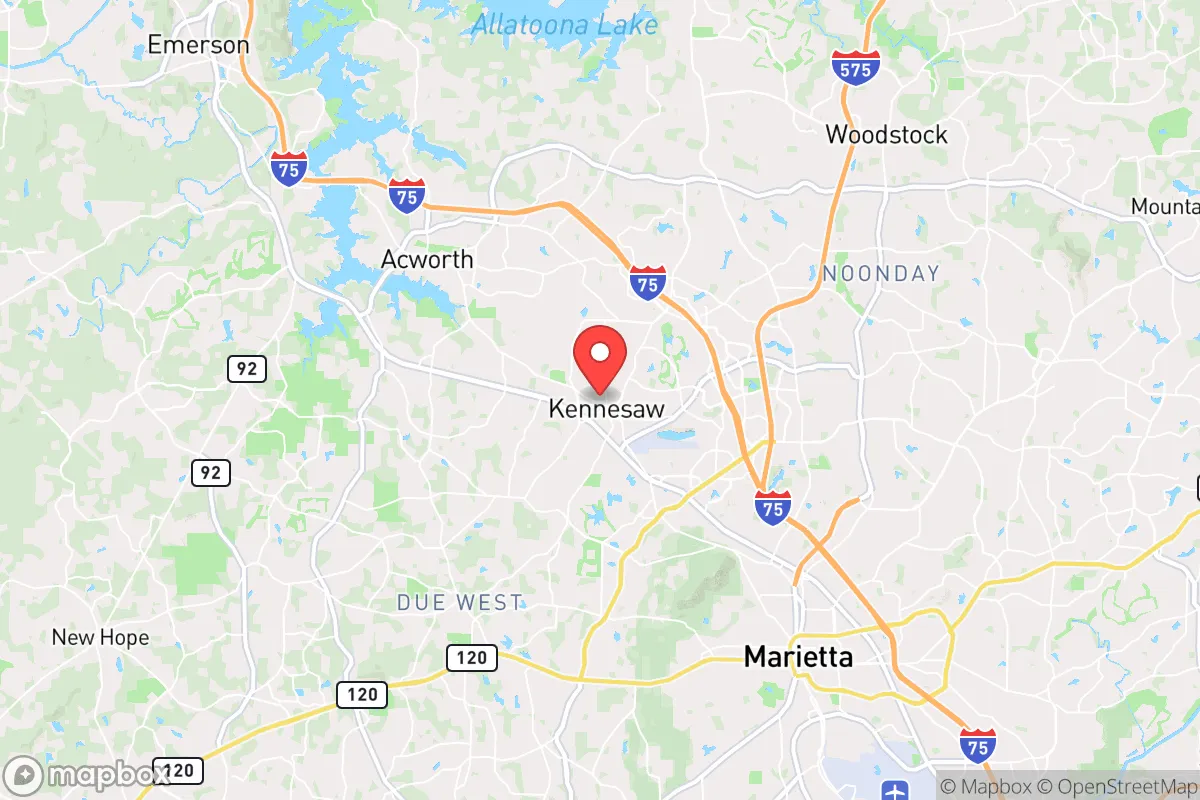
Drive ten miles south into Marietta, and you'll hit a different political planet. Marietta's core has been trending blue for years, with progressive city council members and a mayor who leans left on social issues. Kennesaw, by contrast, still feels like the old guard. We don't have the same influx of transplants from California or New York that's reshaping parts of Cobb County. Our neighbors in Acworth and Woodstock are more aligned with us, but even there you see younger families moving in who don't always share the same values about limited government and personal responsibility. The real contrast is with Atlanta proper, about 25 miles southeast, where the political machine runs on big-government solutions and progressive social engineering. Kennesaw remains a pocket of sanity in a region that's slowly drifting away from its roots.
What this means for residents
For now, the conservative majority keeps things like property taxes relatively low and zoning laws friendly to homeowners. You won't see the kind of overreach you get in more progressive cities—no heavy-handed mask mandates that lasted years, no sanctuary city policies that put locals at risk. The city council still respects the Second Amendment, which is a big deal here. Kennesaw actually has a city ordinance requiring heads of households to own a firearm, and while it's largely symbolic, it sends a clear message about where we stand on personal rights. But here's the concern: as Cobb County grows, the political balance is shifting. School board elections are getting tighter, and you see more candidates pushing DEI initiatives and critical race theory in the classroom. If you value local control and don't want bureaucrats dictating how you raise your kids or run your business, you need to stay engaged. The next few election cycles will determine whether Kennesaw stays a conservative haven or starts mirroring the progressive drift we see in Marietta and Smyrna.
One thing that sets Kennesaw apart culturally is that old-school Southern independence. People here don't like being told what to do, whether it's by the state government or the feds. You see it in the way folks push back on new development that would bring more traffic and higher density. There's a real skepticism of "smart growth" plans that sound like central planning in disguise. The city has managed to keep its small-town feel while growing, but that's getting harder every year. If you're thinking about moving here, understand that the political climate is still solidly conservative, but it's not immune to the pressures that are changing the rest of metro Atlanta. Keep your ear to the ground, vote in every local election, and don't assume the good old days are going to last forever without a fight.

State Political ClimatePolitical Climate in Georgia
State Political AnalysisPolitical Environment in the State
Georgia has transformed from a reliably conservative stronghold into a true battleground state over the past two decades, with its political lean shifting from solid red to a competitive purple that still leans right in statewide races. The state’s 2020 presidential result—where Joe Biden won by just 0.2%—marked a historic flip, but Republicans have since rebounded, with Governor Brian Kemp winning re-election by 7.5 points in 2022 and the GOP retaining control of both legislative chambers. The long-term trajectory shows a state where Atlanta’s explosive growth is pulling the needle leftward, while the rest of Georgia—from the rural Wiregrass to the North Georgia mountains—holds firm as conservative territory.
Urban vs. rural divide
The political map of Georgia is a story of two Georgias. Metro Atlanta, home to roughly 60% of the state’s population, drives the Democratic vote, with Fulton County (Atlanta) and DeKalb County delivering margins of +50 to +70 points for Democrats. The suburban ring—places like Cobb, Gwinnett, and Henry counties—has flipped from red to blue or purple over the last decade, driven by an influx of younger, more diverse, and college-educated voters. Meanwhile, rural and exurban Georgia remains deeply conservative. Murray County in the northwest voted 84% for Trump in 2020, and counties like Bacon, Jeff Davis, and Tattnall in the southeast routinely deliver 75-80% Republican margins. The divide is stark: the Atlanta metro produces about 70% of the state’s Democratic votes, while the rest of Georgia—including smaller cities like Augusta, Columbus, and Macon—leans Republican overall, though each has its own blue-leaning precincts around universities and downtowns.
Policy environment
Georgia’s policy environment is broadly conservative, with a flat income tax rate of 5.39% (down from 5.75% in 2024) and a Republican legislature that has consistently pushed for lower taxes and deregulation. The state is a right-to-work state with no state-level minimum wage above the federal $7.25, and it has a strong business-friendly reputation. On education, Georgia passed the Georgia Promise Scholarship Act in 2024, creating education savings accounts for students in low-performing schools—a major win for school choice advocates. Healthcare policy remains a flashpoint: Georgia did not expand Medicaid under the Affordable Care Act, instead pursuing a limited waiver program (Georgia Pathways) that requires work or community engagement, which has enrolled only a fraction of expected recipients. Election laws tightened after 2020 with SB 202, which added voter ID requirements for absentee ballots, limited drop boxes, and restricted third-party ballot collection—a move critics call suppression but supporters say ensures integrity. The state also has a permitless carry law (HB 218, 2022) and a heartbeat abortion ban (HB 481, 2019), making it one of the most restrictive states on abortion access.
Trajectory & freedom
Georgia’s trajectory on personal freedom is mixed but trending in a positive direction for conservatives. The state has expanded gun rights significantly: permitless carry (HB 218) passed in 2022, allowing law-abiding citizens to carry concealed firearms without a license. Parental rights were bolstered by the Parents’ Bill of Rights (SB 377, 2022), which requires schools to notify parents about curriculum changes and gives them access to instructional materials. On medical freedom, Georgia passed a law in 2023 prohibiting COVID-19 vaccine mandates by state and local governments, and it banned mask mandates in schools. Property rights saw a win with the Georgia Landowner Protection Act (2023), which limits eminent domain abuse. However, concerns remain: the state’s income tax, while lowered, is still a flat 5.39%, and property taxes in fast-growing counties like Forsyth and Cherokee have risen sharply with home values. The state also has a strict certificate of need (CON) law that limits healthcare competition, keeping costs higher than in free-market states like Texas or Florida. Overall, Georgia is moving toward more freedom on guns, education, and medical choice, but taxes and healthcare regulation remain areas where the state lags.
Civil unrest & political movements
Georgia has seen its share of political flashpoints. The 2020 election aftermath brought massive protests in Atlanta over racial justice, and the state became ground zero for election integrity debates after the 2021 Senate runoffs. The Stop Cop City movement—opposing the Atlanta Public Safety Training Center—turned violent in 2023, with activists labeling it an “eco-fascist” project and authorities calling it a necessary facility. Immigration politics are heated: Georgia passed HB 1105 in 2024, requiring local law enforcement to cooperate with federal immigration authorities and penalizing sanctuary policies. Gwinnett County, once a Republican stronghold, now has a large immigrant population and has become a Democratic bastion, fueling tensions over school resources and housing. Election integrity remains a live issue: the Georgia State Election Board, now controlled by Trump-aligned Republicans, has pushed for hand-counting ballots and stricter signature verification, drawing lawsuits from Democrats. A new resident would notice the political polarization in yard signs, bumper stickers, and local news coverage, but actual civil unrest is largely confined to Atlanta proper.
Projection
Over the next 5-10 years, Georgia will likely remain a competitive purple state with a slight Republican lean, but the demographic tide is moving left. Metro Atlanta is projected to add 1.5 million people by 2030, mostly in the blue-trending suburbs of Gwinnett, Cobb, and Henry counties. The rural vote, while still solidly red, is shrinking as young people leave for cities. However, in-migration from blue states like California and New York is not uniformly liberal—many newcomers are conservatives fleeing high taxes and crime, settling in exurbs like Forsyth County (north of Atlanta) and Oconee County (near Athens), which are among the fastest-growing and most Republican counties in the state. The wildcard is the 2026 governor’s race: if a Trump-aligned candidate defeats a moderate like Kemp, the state could shift further right on cultural issues but risk alienating suburban swing voters. For a new resident, expect a state where your vote will matter in every election, where conservative policies are likely to hold but face constant pressure from Atlanta’s growth, and where local politics—especially in the suburbs—will determine the quality of schools, taxes, and community character.
Bottom line: Georgia offers a strong conservative policy environment with low taxes, gun rights, and school choice, but the political ground is shifting under your feet. If you’re moving here, pick your county carefully—Forsyth, Cherokee, or Oconee will give you a reliably conservative community with good schools, while Gwinnett or Cobb are battlegrounds where your vote and voice can make a difference. The state is not yet lost to progressive ideology, but it requires active engagement to keep it that way.
* Values derived from national, state, county, city and local statistics and may differ in a specific area. Last updated: 2026-04-30T05:58:06.000Z
Narrative content on this page is AI-generated and may contain mistakes. Verify any details that matter before acting on them.
ReloMaps may earn a commission from affiliate links at no extra cost to you.

